Movie Review Library - L

Make sure you see the Latest Video Reviews page as well!
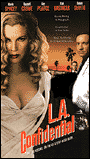

L.A. Confidential (1997)
Starring: Guy Pearce, Russell Crowe, Kevin Spacey
Director: Curtis Hanson
Plot: Three independent detectives find themselves fighting city-wide corruption as they investigate a brutal slaying at an all-night diner in 1950's Los Angeles.
Review: More than an homage that manages to capture the spirit, indeed the very essence of '40s and '50s film noir, L.A. Confidential is a gritty, modern-day film noir it its own right, one that constantly thrills and delights. Adapting the multi-layered James Ellroy novel, director / co-screenwriter Hanson has brilliantly recreated a time of brutal violence and wide-spread corruption by slowly peeling away the veneer of a society obsessed with glamour and outside facades. Indeed, the script successfully delivers a complex story that is both emotionally and intellectually involving, touching on many subjects and classic themes. The cinematography, sets, editing are also all impeccable and add greatly to the sense of drama. The impressive cast give convincing performances across the board (especially a then-relatively-unknown Crowe as the brawny, hardened, hot-tempered cop), an important consideration since the film really focuses on the characters, their interactions and their moral dilemmas. The real success, though, is that the film conveys events that may be situated in the past but with a very modern flavor. Gripping and fascinating, L.A. Confidential is easily one of the best, most entertaining films of the '90s.
Drama / Entertainment: 9/10

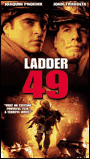
Ladder 49 (2004)
Starring: Joaquin Phoenix, John Travolta, Jacinda Barrett
Director: Jay Russell
Plot: Injured and trapped in a collapsed building waiting for rescue, a firefighter recalls his career, his friendships and his family life.
Review: Meant as a tribute to firefighters, Ladder 49 tries to show these everyday heroes as normal folk, blue collar, God-fearing family men who put their lives on the line by running into the flames. The intentions are noble, but the execution - much like the tedious, lazy script - is lacking. It doesn't help that we've seen this before as more powerful drama in The Guys and as better fire displays in Backdraft. Director Russell (My Dog Skip) may not have been the best choice to bring this fare to the screen, and the mostly pedestrian filmmaking makes each scene (except for the blazes) rather tepid. The fires themselves are never thrilling so much as dangerous incidents where a single moment's inattention can have dire consequences, and the blaze book ending the film is spectacular, no doubt, but there's little going on to really get us engaged during these moments. The plot unfolds in flashback as the naive (read rather dull) hero, stuck in fiery ruins, recalls his career and his family life. Too bad that the story itself is blatantly formulaic and uninspired: the scenes with the guys socializing is meant to provide some sentimental weight, but while amusing, they rarely convince. In fact, the characters are such cardboard cut-outs that we never really care for them. Phoenix plays his role as an average Joe so close to the vest as to be completely forgettable, while Travolta plays, well, Travolta. The rest of the cast equally sleep-walk through the film. As such, it's hard to feel any emotional response to the tragic ending because we haven't had the chance to believe in them. It's heart may be in the right place, but with little emotional punch and some tired working-class melodrama, Ladder 49 is just an unsatisfying movie experience.
Drama: 4/10

Lady Vanishes, The (1938)
Starring: Margaret Lockwood, Michael Redgrave, Dame May Whitty
Director: Alfred Hitchcock
Plot: During a trans-European train journey, a governess disappears and a young socialite seems to be the only one who remembers her ever coming on board. Convinced the old lady was kidnapped, the young woman enlists the aid of another passenger to find her.
Review: A clever, interesting mystery from Hitchcock deftly combining humor, suspense, and a touch of adventure. It doesn't quite compare with his better-known films of the same period such as The 39 Steps, or his later films, but his touches are still there. A light-hearted, entertaining thriller.
Suspense: 6/10
Entertainment
: 7/10


The Lake House (2006)
Starring: Keanu Reeves, Sandra Bullock, Christopher Plummer
Director: Alejandro Agresti
Plot: A lonely doctor who once lived in a remote lakeside lodge exchanges letters with its new owner, an architect, only to discover that they are living two years apart and that the house's mailbox is their only link.
Review: A remake of the delicate South Korean romance Il Mare, The Lake House suffers from the usual American stamping of original material. The time-difference premise had a lot of potential, even if it's been used before in movies like Frequency; as it plays out, however, it's only one of the many two-cent hooks used of late to make a Hollywood weepie more palatable. With its reluctance to take any chances, the potential of the material is wasted. Worse, the misuse of the un-explained fantasy twist makes the narrative flail through all the time paradoxes and logic loop-holes making anyone paying attention feel cheated. All this, perhaps, is to allow a statement on how two lost souls end up connecting through that old-fashioned system of letters, considering how the latest technologies seem to distance us. Too bad that idea, even when reinforcing it with parallels to Jane Austen's Persuasion, gets lost in the shuffle. It's one expected redeeming feature, a possibly heart-wrenching tragic conclusion, ends up a tacked-on cop-out for the "happily-ever-after" crowd. Veteran Argentinean director Agresti, in his first US-made film, has an interesting visual style which provides some nice cinematic touches here and there, and he adds a very melancholy feel, but even he can't raise the material above the average. Reeves and Bullock are charming actors and come off OK, but their characters are simply vaguely dissatisfied professionals and their eventual reunion doesn't quite provide enough of a driving force. There is a decent supporting cast in Aghdashloo and Plummer, but they're severely underused, and their relationships are merely place-holders for the leads' emotions and to add a bit of melodrama to the proceedings. Blame it all on the the obvious script which is more than a tad bland and never gets audiences engaged. The most interesting item may be the Lake House itself, a glass house resting on stilts on top of the lake, an architectural eye sore that comes off as a metaphor for the people who live in it. Yet for all its failings, The Lake House is still a warm and fuzzy romance with two bankable stars, and audiences desperate for a date movie in the heart of summer blockbusters will feel that it can't miss.
Entertainment: 5/10

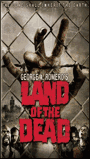
Land of the Dead (2005)
Starring: Simon Baker, John Leguizamo, Dennis Hopper, Asia Argento
Director: George A. Romero
Plot: Thinking themselves protected in a fortified city, the final survivors in a world overrun by the living dead soon discover that the zombies are evolving and are no longer mindless fodder.
Review: The fourth installment in the cult-classic "Dead" series, Land of the Dead is as viciously violent, repulsively gory, and as entertaining as its predecessors - only with much better production values. Despite its origins, any political comment that horror veteran writer / director Romero wanted to say in his zombie films has been captured in his genre-bending original 1968 tale Night of the Living Dead (the Red Scare and the fear of conformity) or his 70's version of Dawn of the Dead with its comment on crass consumerism. In fact, there's little more to add, except replicate the big-budget excesses that we've seen in recent zombie films. Yet, though never quite as inspired as one would have hoped, there are still gruesome shocks aplenty here and some obvious social satire at play and Romero does it with such gusto - tearing flesh, ripping body parts, spewing geysers of blood - that willing audiences will be more than satisfied with the carnage. Some nice touches, such as the scene of zombies crossing the river, or the bad-ass assault vehicle in action, do elevate the film above its schlock cousins. The story, about a small band of mercenaries trying to make a living and finally trying to save the remnants of humanity, or the decadence of the survivors, isn't very interesting, nor are the characters themselves even if played with great conviction by the likes of horror vets Argento as a reformed hooker (what a stretch!) and Hopper as a the villain. For fans of the living dead, Land of the Dead is a "classy" update / continuation to the series, but anyone else enters at their own risk.
Entertainment: 5/10

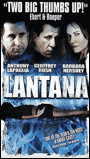
Lantana (2001)
Starring: Anthony LaPaglia, Geoffrey Rush
Director: Ray Lawrence
Plot: While investigating the disappearance of a noted therapist, a detective uncovers the unhappy relationships surrounding the suspects, revealing troubles with his own marriage.
Review: A somber, low-key drama, the emotionally-charged Lantana simmers with repressed feelings of guilt and an undercurrent of sadness. Peeling away at a series of unhappy relationships to the root of their despair, the mature script from Andrew Bovell (adapting his own play Speaking in Tongues), is keenly aware of its characters and the real repercussions of their actions, revealing the emotional turmoil beneath their facade. It also avoids obvious story directions, revealing a rare unpredictability. Unfortunately, due to the limits of the adaptation its theatrical roots are quite evident making the film feel a little artificial. It doesn't help that the players are linked by coincidences that strain believability, mostly surrounding the disappearance at the center of the story. But the multi-layered mystery really is only a rationale to a carefully constructed social drama that touches on themes of loss, bereavement and our attempts at redemption. However powerful the play, it wouldn't be half as effective without the solid, committed performances director Lawrence (Bliss) gets from his terrific cast, and none more surprising than usually stereotyped "heavy" LaPaglia as the violent, emotionally numb cop caught in a a mid-life crisis and a failing marriage. Rush and Hershey, as a bereaved couple trying to survive the emotional devastation following the death of their daughter, are also magnificent, capturing the emptiness of their everyday lives to perfection. Though it can't help but feel theatrical, Lantana is a deeply felt tale that packs an emotional punch.
Drama: 7/10

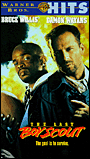
The Last Boy Scout (1991)
Starring: Bruce Willis, Damon Wayans, Chelsea Field
Director: Tony Scott
Plot: After his best friend and his client get killed, an ex- secret sevice agent now a boozing P.I. teams up with a forcibly-retired football player to uncover a plot in legalizing sports gambling.
Review: Like many of producer Joel Silver's '80s productions (of which this feels and looks like though it was made in 1991), The Last Boy Scout is formulaic to the extreme, aiming to give its star another action vehicle with little originality. Because of this, the film's main problem is the tired, predictable script that never manages to draw us in. Worse, the first half of the film drags, and the story about football betting and double-crosses has a hard time getting off the ground. Swearing and false bravado takes place of actual dialogue, and the family melodrama thrown in for good measure is terribly trite. Even the multitude of villains popping out of the woodworks are wooden and flat. Thankfully director Scott (Enemy of the State, Spy Game) does have a good eye for violent action, the production is slick and efficiently done, and the second half perks up with enough bullets flying and occasional one-line zingers to wake the audience up. As for the buddy comedy between the two leads, it's mostly flat, but there's a certain eventual charm in the tongue-in-cheek machismo on display. Willis, still in his post-Die Hard funk, plays another hard-drinking, badly shaven hero with his usual aplomb. Wayans, more a comedian than an action star, comes off a bit better, but still looks out of place. Look out for a young and unknown Halle Berry doing an embarrassing cameo as Wayans' stripper girl-friend early on, a role she would probably have us forget. The Last Boy Scout is only worth a minor investment, but for fans of Willis action flicks this one delivers the goods.
Entertainment: 5/10

The Last Breath (Le Dernier Souffle) (Quebec - 1999)
Starring: Luc Picard, Julien Poulin, Serge Houde
Director: Richard Ciupka
Plot: On the trail of his neo-Nazi brother's killer, a Montreal policeman travels to a small town in Arkansas where he gets framed for the murder of an undercover FBI agent.
Review: Le Dernier Souffle is a rare Quebec production that aims squarely at the cop-thriller genre, and though it has the right ingredients, it's one that eventually misses the mark. On the plus side the directing is efficient, the stark cinematography is good, and there's a reasonable amount of tension created throughout. It's too bad the script suffers from the same ridiculous stuff that American productions are so often blamed for: exaggerated coincidences, silly plot twists, stereotypical characters, predictable situations, and tired melodrama. Instead of being about a man's search for his brother's redemption, the story tries for more than than it can capably deliver, shoving an improbable amalgam of neo-Nazi thugs, red-neck militia, an FBI sting operation, a Russian plutonium shipment, and lots of other cliché plot elements to make this into a bigger movie than it really needed to be. If it had only explored the circumstances of its failed characters it could have made an interesting pot-boiler, but instead it chooses to compete with Hollywood productions and ends up only as a bland high-stakes thriller. Picard's performance is solid in the role of the cop losing his grip on his life, but the rest of the cast comes off as second-rate or downright amateurish, something that doesn't help the film either. Despite its inconsistencies, Le Dernier Souffle does have its moments, and for those looking for a decent thriller with some added French-Canadian spice it's entertaining enough.
Entertainment: 5/10

The Last Castle (2001)
Starring: Robert Redford, James Gandolfini, Mark Ruffalo
Director: Rod Lurie
Plot: Witness to the atrocities of the iron-fisted warden, a court-martialed general sent to a military prison rallies the prisoners to overthrow their captors and regain their honor.
Review: Taking select pages (and not the best) from modern-day prison films such as Shawshank Redemption and soldierly in-fighting such as A Few Good Men, the filmmakers have created a by-the-numbers prison movie that's high on pizzazz and low on logic with The Last Castle. For the most part, though, the film runs like a re-telling of the classic The Bridge on the River Kwai, with Redford in the Guiness role, rallying the morally stranded ex-soldiers and giving them purpose. The real battle however is between the experienced, stallwart general and the properly ego-maniacal warden, and the story mounts the conflict between the two with easy strokes and canned events. Director Lurie, who did such a fine, intelligent drama with The Contender, changes his palette to bigger things and seems satisfied here with efficient large spectacle and hack-worthy manipulative story-telling. One would have hoped for a more suspenseful, or at least smarter use of the material at hand. Adding to familiar situations and predictable plot however are some slick production values, joined by some good pacing and some rousing moments that make the film less a drama than an effective amusement. The final half-hour, as the prisoners stage a coup to take control of the prison is more something out of a Buckenheimer-style action flick (think Con-Air) than a drama but it works, with audiences sure to laugh at the ridiculousness on screen as much as they'll be entertained by the McGyver-isms on display. The final scene, meant to be a sentimental patriotic call, smacks of Hollywood excess - but then, so does most of the film. As for the cast, Gandolfini is adequately villainous as the nemesis but doesn't make a real impression, and Ruffalo (so good in small indie dramas) just doesn't make a mark. But forget them: the real attraction here is Redford who has always been a pretty charismatic actor, and here he doesn't disappoint as the wise general. Those looking for entertaining fare who are ready to put their sense of disbelief in high gear will enjoy what amounts to a popcorn outing. 
Entertainment: 6/10

Last Holiday (2006)
Starring: Queen Latifah, Ll Cool J, Timothy Hutton
Director: Wayne Wang
Plot: Told she has a terminal illness that allows her only weeks to live, a demure working-class woman decides to blow her savings on a once-in-a-lifetime trip to an exclusive European resort where she is mistaken for a high society gal.
Review: Loosely based on the 1950 comedy starring Alec Guinness, Last Holiday is another tepid by-the-numbers comedy, a custom-made vehicle for its bankable star. The beginning is actually quite promising, setting up its character and her social status with refreshingly little pretension. As soon as she arrives to luxury, and the more humorous events start piling up, it all stumbles into mistaken identity farce, a mode that allows for broad (and in this case very broad) comedy but few real laughs. The best scenes are of the cooking, actually, and the bonding scenes with her and Depardieu (as a French chef) are entertaining. Director Wang seems to go through the comic and dramatic elements haphazardly, and he isn't helped by a script that reheats clichés despite its best attempts, including a mildly amusing spoof to the Bond ski chase from For Your Eyes Only. And though there are some guffaws to be had, there are few romantic bits for those keeping score (or hoping for a date movie). The morale, of course, is live your life to the fullest, and we all know it's all going to end happily, so the plot point of her dying is never much of an issue. Yet if plot, direction and the comedy are second-rate, the very presence of Queen Latifah - charming and bon vivant - makes the whole difference, and is really the only reason to watch. The rest of the cast is decent enough, if unspectacular, but particularly depressing is Tim Hutton who has really slid from high over the last few years. Last Holiday is all harmless enough to make for a nice distraction, but there's little in this meal to recommended it.
Comedy: 5/10

Last Hurrah for Chivalry (1978)
Starring: Damian Lau, Lau Kong, Wei Pai
Director: John Woo
Plot: To avenge his father's death, a rich and powerful heir hires two swordsmen to help him.
Review: One of the first films by acclaimed HK director John Woo (The Killer, Face/Off), Last Hurrah for Chivalry already shows some of his trademark touches: intricately staged and inventive fight sequences, slow motion shots, and good pacing. Unfortunately, the action sequences are a bit dragged out, and no longer as impressive as they once were. A solid, entertaining HK film, even by today's standards, but not one that really stands out.
Action: 7/10
Entertainment: 7/10

Last Night (1998)
Starring: Don McKellar, Sandra Oh, Callum Rennie
Director: Don McKellar
Plot: Six hours before the end of the world, various individuals face their last moments on Earth in very different ways.
Review: Poignant and well-made, Last Night is a wonderful low-key film that approaches its subject and characters with an endearing and mature touch. As the different characters go about their necessary final rituals, their lives intermingle and finally separate. The film contrasts the typical big-budget end-of-the-world affairs by showing the small-scale drama of normal people facing up to their impending doom without the use of melodrama or mainstream conventions. There are no emotional upheavals, no bursts of violence, just quiet, intimate moments among very human beings. Last Night doesn't always succeed in its pacing or its goals, but it is still a thoughtful, often charming film.
Drama: 7/10

The Last Samurai (2003)
Starring: Tom Cruise, Ken Watanabe, Billy Connolly
Director: Edward Zwick
Plot: In the 1870's, hired to train the Japanese Emperor's troops in modern warfare, an American captain gets captured by the leader of the rebellion and learns the ways of their samurai code of honor.
Review: The main plot concept of The Last Samurai isn't new, that of lost man finding his place in another culture, but placing it in 19th century Japan makes for an interesting premise and opens up many possibilities. Unfortunately, only some of appear here, limiting the film to an interesting, engaging popcorn flick when it could have been much more. The film has many things that remind one of director Zwick's masterpiece Glory: the gorgeous scenery, the tight direction, the costumes, the attention to set details, the large battle sequences, and the story's basic themes. The filmmakers want to make us feel an appreciation for an exotic culture facing its extinction at the hands of American technology and Western influences, and this is an impeccably crafted production, no doubt. The script itself has its moments, including an occasionally humorous touch, but unfortunately relies too often on usual Hollywood clichés making it fall into typical mainstream melodrama. There's the obvious parallels made between these Japanese villagers and Native Americans, and the film falls back on the same mistakes by portraying this society's characters as "noble savages", never getting a real feel for who they are, what motivates them, and what they tend to lose. There's a definite sense of nostalgia for the end of an era, with its depiction of a people at peace and in tune with their surroundings and themselves, but by turning a complex society into such a simplistic, perfect view we lose any real sense of who they really were. The handful of sword-fighting sequences are terrific, and the large-scale battles (especially the climactic confrontation) are well done and exciting. We've seen all this before, of course, though the Japanese flavor may be new to those not familiar with director Akira Kurosawa's terrific films (Ran, Kagemusha). Cruise works out well in the role of the haunted captain; as the connection to a wider audience his may be a pretty one-dimensional character, but he captures the right tone. The main Japanese actors are strong presences, especially Watanabe as the Samurai leader, but it becomes obvious that they lack any actual depth apart from being honorable. The rest of the cast is solid, and though none really stand out (except, perhaps, for the short-lived Billy Connolly), they make do. To be fair, the film is made to be an epic in style and scope, and for the most part it succeeds in delivering the goods, but a little more effort in story depth would have made it a real find. Despite its flaws, The Last Samurai is a beautifully shot, grand adventure and as a mainstream effort it's both engaging enough and entertaining enough to recommend.
Drama / Entertainment: 7/10

The Last Tunnel (Le Dernier Tunnel) (Quebec - 2004)
Starring: Michel Côté, Jean Lapointe, Marie-France Marcotte
Director: Eric Canuel
Plot: Barely out of prison and facing a tough probation officer and dangerous teammates, a veteran bank robber sets about plans to dig a tunnel straight into a Montreal bank for a payoff worth millions
Review: Loosely based on the real-life of local criminal Marcel Talon, The Last Tunnel is a romanticized crime drama that aims high but never quite gets off the ground. Disappointing for audiences expecting a little more local color from a Quebec film, there's nothing here that we haven't seen in a slew of similar movies. It's beautifully shot and ably directed, for sure, but it's also predictable and slow-going, and probably would have worked out better as a TV movie than a commercial effort. Apart from the last half-hour, the film is pretty slow paced putting much more interest in the relationships than on the mechanics of the thriller, something that doesn't work to its advantage. The romance between its protagonist and his long-suffering lover is played out in broad, rather unconvincing strokes. The actors try hard, and Marcotte comes off well, but it feels too restrained as if they were only going trough the motions. There's also the focus on the camaraderie between the two aging criminals and the misery and loneliness of the dead-end lives they've led, moments that work out much better - it's just too bad it's done to such a lesser extent. The actual bank robbery, when it finally happens, smacks of Hollywood - it's well paced and well directed, and provides some real suspense, but it's also rather generic in its feel and progression. Only the final outcome, a sharp "crime doesn't pay" slap to usual mainstream fare, makes this rather special. Côté is properly intense in the lead role as the criminal mastermind, but it's veteran actor Lapointe, exuding pathos, who steals the show as the sick old-timer up to one last caper. Trying to compete with American productions and sensibilities, perhaps, the filmmakers of The Last Tunnel have created a decently made product but one that also comes up short in too many ways.
Drama: 4/10

Laura (1944)
Starring: Gene Tierney, Dana Andrews, Clifton Webb
Director: Otto Preminger
Plot: Pushed by an egotistic newspaper columnist, a hard-nosed detective falls in love with the portrait of a dead woman and becomes obsessed with finding her killer.
Review: Somber, uptight, and yet sly and almost campy in its genre excesses, director Preminger's Laura is a justly famous example of classic era film noir. With a definite lack of subtlety, the film quickly engages the audience in the mystery as the convoluted scenario twists and turns, desperately defying any sense. The stock characters are all elevated to almost parodies: a stoic, worldly detective who slowly loses his cool, a femme fatale who's already dead, a foppish, arrogant, jealous newspaper columnist (played with great caricatural haughtiness by Webb), and a penniless, charming playboy (a surprisingly young Vincent Price). With its prime genre elements in place, its solid, Award-Winning cinematography, memorable musical score pervading every scene and its coolly dangerous underpinnings, we quickly realize that it's the game that counts, the style of the endeavor, elements that surmount the plot's inconsistencies and makes even the killer's identity almost irrelevant. It is the interaction between these disparate personalities, the crackling dialogue and witty banter, that makes for much of the film's interest. In fact, Webb and Price practically mug the screen every chance they appear, each trying to steal the scene from the other as the rest of the cast looks on. In the end, though many of the moments can only be described as contrived and even absurd, Laura reaches a certain elegance, one that achieves a victory of style and wit over logic.
Entertainment: 8/10

*Classic* Lawrence of Arabia (1962)
Starring: Peter O'Toole, Omar Sharif, Alec Guinness
Director: David Lean
Plot: During World War I, an eccentric British officer manages to rally warring Arab tribes through dogged determination, courage and a good dose of cleverness to defeat the invading Turkish army.
Review: Lawrence of Arabia is by far director Lean's (The Bridge on the River Kwai) finest work, a spectacular sweeping epic in every sense - in scope, in production, in its massive human deployment, and in the larger-than-life exploits it displays on screen. Based on the real-life exploits of T.E. Lawrence, this is a rather romanticized view of his attempts to forge a united Arab nation during World War I. The compelling story, the violent battles, the breathtaking scenery, and the exciting adventure we seem to experience first-hand are only part of the film's success. The story isn't particularly difficult or heavy with meaning, though few events are depicted as black or white, but the perfectly paced, impeccable script manages to take us into the tale and even at almost four hours in length, never lets our attention waver. The stunning desert cinematography carries you away into a land where sand dunes, desolate landscapes and wind-carved cliffs are as beautiful as they are terrifying. And no one who has seen the film can ever forget the memorable Maurice Jarre score as a caravan of camels disappears into the sun-drenched expanse. Yet, despite the sense of adventure, the large battles, the haunting vistas on display, the story is a surprisingly personal one, taking the time throughout to focus on its conflicted hero and the ideals that drive him. A large part of the film's success therefore lies in O'Toole who, with a surprising passion and mastery of the role, brings out the complexities of the historical figure perfectly. The rest of the characters are also well-formed and convincingly portrayed by an all-star cast. Winner of seven Academy Awards including Best Picture and Best Director, Lawrence of Arabia is, without a doubt, one of the greatest adventure films ever made and a masterpiece of cinema.
Drama: 10/10

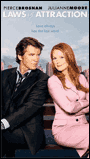
Laws of Attraction (2004)
Starring: Pierce Brosnan, Julianne Moore, Frances Fisher
Director: Peter Howitt
Plot: Two competing New York divorce attorneys accidentally get married during an Irish festival which has devastating results on their social life and their practice.
Review: Another formulaic Hollywood romantic comedy, Laws of Attraction aims for middling and hits it: it's light-hearted, mindless romantic fluff that doesn't differentiate itself from the myriad of similar fare. The script is predictable without giving the high-concept idea any life, and the plot unravels from the get-go. And don't look for any deep revelations or clever commentary on marriage or divorce, either, nor anything other than the usual lawyer clichés. Even through the broad humor and often tired gags, director Howitt keeps things moving along though he can't really keep the film really completely afloat. In fact, the whole exercise would be nothing if not for the inherent charm of its two stars who are so obviously above this material, it hurts. Yet while Brosnan comes off as with his usual ease as the roguish bachelor, Moore takes another stab at comedy with sometimes embarrassing results. It doesn't help that the characters' actions have to be downright ridiculous for this to work, or that there's little real chemistry between the two. Still, there's some laughs to be had by the supporting cast, like Parker Posey as a rock-star wife and Fisher as Moore's socialite mother. In the end, Laws of Attraction can't help but come off as lack-luster: it's cute enough but easily forgotten.
Entertainment: 4/10

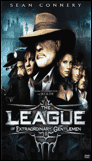
The League of Extraordinary Gentlemen (2003)
Starring: Sean Connery, Stuart Townsend, Peta Wilson
Director: Stephen Norrington
Plot: Famous fictional literary characters of the Victorian era, including Alan Quartermain, Mr. Hyde and Captain Nemo, band together to stop an evil genius from using his technological marvels to gain world domination.
Review: From a great premise and loosely based on Alan Moore's graphic novel, LXG is a film with lots of unused potential.  It all starts off extremely well as Europe succumbs to the machinations of an unknown assailant and his sophisticated engines of war, and Quartermain is introduced in a superbly paced and thrilling fight scene. The atmosphere is appropriately dark and brooding, the production values are impressive and the film looks great. The many diverse action sequences - including wire-work combat, computer-enhanced fights, gunplay, and anachronistic vehicular destruction - are edited and quick to a fault using sometimes unconvincing CGI effects, but are all entertaining. And to be fair, none of this is ever boring. However, all the good intentions and promise of rip-roaring adventure soon crumbles into a lackluster affair that's loud, silly, and surprisingly generic. The main culprit is the plot, which retreads all the mistakes of wannabe blockbusters and relies too much on eye-candy. Oh, there are literary references to be had and the movie is at its best when it plays to that strength, but by trying to dumb it all down for the lowest level of mainstream audiences it fails in its promises. The interaction between these famous characters should have been the real attraction, and there are some hints at what this could have been, but just too much focus is put on the action elements. The ensemble cast, led by thespian Connery (Quartermain) who adds a much needed touch of class to the proceedings, is for the most part surprisingly good. Yet despite the rich literary background available, none of the actors get much of a chance to flesh out these characters. Director Norrington (Blade) knows this type of movie well, and there's the feel of a decent movie behind the clichés and easy plot development - it's just too bad that it doesn't come through. In the end, LXG feels like a movie that was radically edited to cut-down on anything but the admittedly thrilling action set-pieces, and in doing so loses it's selling point and the one thing that really could have made it special: the characters.
Entertainment: 6/10

A League of Their Own (1992)
Starring: Tom Hanks, Geena Davis, Madonna
Director: Penny Marshall
Plot: During the height of World War II, two sisters join up the newly-created all-women's professional baseball team and turn the nation's derision, and their has-been coach, to cheer.
Review: Though baseball is the topic, A League of Their Own is much more than just a sport movie - it's an impeccable look at women finding their place in a man's world, and a terrific, likable comedy that has both smarts and charm. It aptly captures the passion these women had for a sport that was deemed only a man's game, and the difficulties of being taken seriously. It also shows the mores of the times, of course, to amusing effect: nobody expected them to play well as long as they looked good to the folks at home, a theme that's often ridiculed here as the ballplayers go through etiquette training. But most importantly, it shows the camaraderie between these very different players, as well as the rivalry inherent in a game played in the public eye. Director Marshall (Big, The Awakening) shows off her best work here and hits all cylinders with a thoroughly engaging and professional effort. She deftly moves through drama and comedy without ever losing track of her characters and makes a fine, tight script come to life. No small credit also goes to the terrific ensemble cast full of likable characters, and a showcase for Hanks and Davis, both of whom breathe real life to these two strong characters and have fun doing it. Their rivalry, and eventual understanding, is at the core of the film and makes it that much richer. Of special note is Madonna in a supporting role in what's easily her best acting gig. Not only is A League of Their Own an appealing, funny and sentimental Hollywood film with great mainstream appeal but there's a strong message here about the women who stayed behind whle the men went to war, generally, and those women who reached for their dreams and made American sport history.
Entertainment: 8/10

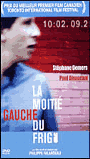
The Left-Hand Side of the Fridge (La Moitié gauche du frigo) (Quebec - 2000)
Starring: Paul Ahmarani, Stéphane Demers, Geneviève Néron 
Director: Philippe Falardeau
Plot: An out-of-work engineer accepts to be the focus of his roommate's documentary on unemployment, but as his search for a job drags the project puts a strain on their friendship.
Review: The use of the "fake" documentary has usually been used to satirize a sub-culture or a situation, but in The Left Hand of the Fridge the inherent intimacy that comes from the use of hand-held video cameras, and thanks to the sense of realism that is so well created throughout the film, provide a heart-felt exploration of our modern concepts of the workforce. This portrait of an engineer caught between attaining his dream job and forced to make ends meet is easily extended to most of the population, many of whom have been (or may still be) in the same dire situation. It's a springboard for many an instance of political / social commentary, and though it usually points to the large corporations and their sole focus on profits at the detriment of its workers, it also turns the tables on the filmmakers (sometimes literally) and shows that there are no objective observers. However, the film never falls into the languorous thanks to a good dose of easy humor found amongst the pathos and drama that make up such a topic, and a very personal and endearing look at the protagonists' lives. The film also achieves an intimacy with its subjects and its themes that is hard to ignore and impossible not to be taken in by. In fact, the actors and situations appear to be so natural one can't help wonder if this really isn't a slice of someone's real life. The social commentary is not as blue collar or as radical as Michael Moore (Roger and Me) has been (a jab that comes early on from an engineering executive), but in its portrayal of the ills of the modern workforce as well as its, finally, good-natured optimism The Left Hand of the Fridge is a production worth watching.
Drama: 7/10

Legacy of Rage (Hong Kong - 1986)
Starring: Brandon Lee, Michael Wong
Director: Ronny Yu
Plot: After being framed for the murder of a crooked cop and spending eight years in prison, a young man vows revenge on his best friend, now a big-time drug lord.
Review: Brandon Lee's film debut in this, his only HK production, already shows him as a good leading man, with an inkling of the skill and charisma he would later show in his American productions like Rapid Fire and The Crow. Those who expect intense martial arts action, though, will be disappointed - until the last reel, the film plays more like a melodrama than an action flick with lots of posturing and violence. The last fifteen minutes makes up for the ho-hum story with a no-holds barred blood-bath that reminds one of the ending of Scarface (or Raw Deal, take your pick). Legacy of Rage may not be that exciting, but it's an interesting and well-filmed look at the career start of Brandon Lee and director Ronny Yu (The Bride With White Hair).
Entertainment: 4/10

Legally Blonde (2001)
Starring: Reese Witherspoon, Selma Blair, Luke Wilson
Director: Robert Luketic
Plot: After being dumped by her boyfriend for not being "smart" enough, a ditzy blonde sorority queen follows him to Harvard Law School and manages to enroll in the program to win him back.
Review: The latest teen comedy Legally Blonde bucks the recent Hollywood trend of dumbed-down or gross-out humor with an ode to the "blonde", one that works thanks to its snappy pace and terrific lead actress. Mixing large parts of Clueless with fish-out-of-waster comedy and courtroom drama makes for a difficult combination and, alas, one that doesn't always succeed in part because of a warmed-over plot that's as predictable as yesterday's news. What saves the film, however, is the energetic and likable cast, a preponderance to both valorize and ridicule the cosmetics and fashion industry (and the Cosmo girls who follow it religiously) as well as the stuffy Harvard school, and a knowledge of its audience. There's no pushing the envelope or risk-taking here: the film is content to be a collection of endearing and / or amusing moments, with its fair share of dumb laughs and satirical jabs, some of which work quite well. Witherspoon easily lifts the film to a higher level than it ought to be, and manages to create a likeable persona in the bright, bubbly rich girl, someone who might easily have been irritating and just plain ditzy. Oh sure, the character is definitely naive and shallow, but when the cards are down, she proves that she can find a strength and an independence that proves refreshing, a rare message of female empowerment in comedies of this type. Legally Blonde may not be as original or memorable as the films it's inspired from, but as lighthearted comedy it stands up well.
Comedy: 6/10

The Legend of Bagger Vance (2000)
Starring: Will Smith, Matt Damon, Charlize Theron
Director: Robert Redford
Plot: A WW1 veteran and one-time master golfer now lost in self-pity and booze, returns to play for a grand exposition at his ex-girlfriend's golf resort thanks to the help of a mysterious, well-meaning caddy.
Review: Based on the novel by Stephen Pressfield, The Legend of Bagger Vance is a whimsical metaphor for the game of golf as a picture of human life, but one that devolves often into sappiness. The production is almost fairy-tale-like in its tone and warm colors, the film presenting a version of a pre-Depression US that should have been - no racism, no poverty per se, and everyone's just so darn nice. The script wants to explore the idea of the local folk hero, and of the man behind the legend. If it often feels desperately familiar, well, it is. For the more cynical, this is sure to be pure drivel. But it's obvious that Redford is impassioned by the game and wants to pass the feeling along. More in line with his heavy-handed The Horse Whisperer, it tries to capture feelings more than story here and, though it's nowhere near his efforts like Ordinary People, it's still pure Redford: easy-going, slow-moving, and always gorgeous to look at. The highlights, of course, are the training sessions with the cocky ex-expert and his new trainer, as are the enlivened tournament scenes. The acting from pretty actors Theron and Damon is nowhere near remarkable, only looking good for the camera as required. The two have nice chemistry, but it doesn't help that their romantic entanglement feels forced and unconvincing. The real surprise is Smith who hasn't really done drama since his outstanding performance in Six Degrees of Separation. It's a nice change for the actor, who manages to spout platitudes like a real Zen master and actually seem to mean it. Though the movie won't make you want to take up golf, the sumptuous visuals and the engaging narrative and cast still keeps our attention.
Entertainment / Drama: 6/10

The Legend of Rita (Germany - 1999)
Starring: Bibiana Beglau, Martin Wuttke, Nadja Uhl
Director: Volker Schlöndorff
Plot: After many years with a notorious West German terrorist group, a young woman is given a new identity and forced to disappear into the life of the working class with the help of the Communist East German secret police.
Review: Director Schlöndorff, best known on this side of the Atlantic for his controversial (and often censored) film The Tin Drum, once again braves the subject of German identity with The Legend of Rita. Based on events that occurred in the '70s with the left-wing terrorist Red Army Faction, the film examines both the themes of political terrorism, and socio-political climates in the divided Germany. The heartfelt drama is occasionally accentuated by some dark humor, and some very touching moments, especially when the newly arrived patriot becomes dear friends with a young woman who's only yearning is the opposite of hers - that of heading to the West and leaving the depression of the East behind. At first, our protagonist cannot believe that the people hate the very ideals she fought for, yet soon becomes not only disenchanted by the reality of life around her but afraid for her very life. One of the great successes of the film is that it manages to capture life in Communist Germany, the grimy feel of confined spaces, the oppressing routine, the emotional misery. Though Beglau really carries the movie, the rest of the cast is also excellent and thoroughly convincing. As for the script, it is well paced, from its energetic, care-free beginnings to its most depressing progression, full of hard, revealing details that sink in to the audience as they are realized by the protagonist. With The Legend of Rita, Schlöndorff has realized a nostalgic and poignant window into a different place and time not so far removed.
Drama: 8/10

The Legend of Suriyothai (Thailand - 2003)
Starring: M.L. Piyapas Bhirombhakdi, Johnny Enfone
Director: Chatrichalerm Yukol
Plot: A loyal princess and her husband must fight against internal betrayals in the royal court and war against Burma in 16th-century Siam.
Review: Financed by the queen and directed by a prince, some may presume the big-budgeted historical drama The Legend of Suriyothai to be a vanity project; perhaps it originally was, but with its beautiful art direction, intricate costumes, and large scale, the final product is one worthy of Hollywood historical epics. The story condenses 20 years worth of history, maintaining a very Shakespearean feel in its approach to the many conspiracies, court intrigue, vendettas and assassinations, yet the drama that plays out is never very convincing and occasionally even dull. Still, with the backup of producer Francis Ford Coppola, director Yukol has managed a solid sweeping epic even if the narrative itself is rarely as interesting as the visuals. The cinematography is always richly textured and grandiose, and the film is at its best when showing off some fabulous displays of pomp and pageantry and the awe-inspiring palaces intricately decorated with gold and carved wood. The struggle of the various kingdoms and the various clans is well explained, however - it might be confusing at first, but there's a definite sense that this is as much a history lesson as it is sprawling spectacle. The battle scenes, as armies of elephants and sword-wielding rabble clash with Portuguese mercenaries and armored officers, may be more akin to films of the 50's and 60's than to the standards of the likes of Gladiator, but it's a small quibble. Just about every popular Thai actor makes an appearance, and some of them make strong impressions. Unfortunately first-timer Bhirombhakdi (herself of royal blood) comes off as regal but distant and wooden as the title character. Surprisingly, she doesn't take a majority of screen time, the narrative trying to encompass all the various players equally. In the end, there's nothing particularly new with The Legend of Suriyothai for those who have had their fill of historical epics, but for those ready for an exotic twist to the usual fare, it's worth a look.
Drama / Entertainment: 6/10


The Legend of Zorro (2005)
Starring: Antonio Banderas, Catherine Zeta-Jones
Director: Martin Campbell
Plot: Depressed over his failure as a father and husband, a nobleman dons the mantle of Zorro to stop a conspiracy against California's impending union with the US while trying to recapture the respect of his family.
Review: With The Legend of Zorro, a sequel to the highly popular re-incarnation of the early-century creation The Mask of Zorro, the filmmakers have pushed all the right buttons to create what amounts to the ultimate homage to the cliffhanger / serials of old, and they've succeeded. All the daring-do and action / adventure we've come to expect from the classic character is present here, upped to the nines, and even what amounts to a laughably ridiculous amount of flips and acrobatics get carried away in all the fun. Of special note is the swordplay choreography which is some of the most impressive and inventive put to a Hollywood film in a long time. Director Campbell (Goldeneye) definitely knows his stuff, and has the knack to entertain a crowd, providing a fast-paced and engaging film not only during the action sequences but even in the exposition elements. The art direction in every scene, every shot looks darn spectacular, bathed in surreal, rich colors - this is an idyllic version of 19-th century California, and it looks great. All of this is helped by a fine sense of humor, especially during the interplay between its two stars as they bicker their way through their marital strife. Returning to one of his better roles, Banderas is both charming and sympathetic capturing both the heroic insouciance and his affable alter ego. Jones is simply smashing, and proves once again that her success in the original (her first screen appearance) was no coincidence. Both handle the sword and the dialogue with equal snap. And let's not forget our child hero, too: child characters usually mess things up, but not so here: this next-generation Zorro is feisty, mischievous, and has moves to match his father. If there's a hindrance to making it thoroughly enjoyable it's the unduly predictable and unnecessarily convoluted plot and one-note villains. Yet even this is forgivable thanks to a script that plays to its leads' strengths and to its heroic premise. The Legend of Zorro isn't as concerned with plot and character as the original, but for those longing for an earnest swashbuckling adventure, look no further.
Entertainment: 7/10

The Legend of Zu (Hong Kong - 2001)
Starring: Ekin Cheng, Cecilia Cheung, Sammo Hung
Director: Tsui Hark
Plot: The last member of a devastated tribe joins forces with other god-like immortals to fight an ancient, evil force that is assailing the sky cities above Zu Mountain.
Review: Taking a cue from recent special effects extravaganzas like Stormriders and A Man Called Hero, acclaimed director Hark (Once Upon a Time in China, Time and Tide) take the idea of comic-book fantasy to new heights with The Legend of Zu. This is a sequel of sorts to Hark's own Zu: Warriors of the Magic Mountain, but while the effects in this previous film were not quite up to par with his vision, here it's obvious that the leaps in technology, and an obviously bigger budget, have made it possible for his imagination to run wild - and wild it is! In fact, so much of what's on screen is computer generated (from the backgrounds, the foregrounds, the lighting, the imaginative weapons, etc.) that this could almost be deemed an animated feature. The acting and thread-bare plot are secondary to the dazzling, richly-colored visuals and the broad strokes of grand themes on hand such as those of rebirth, sacrifice, the battle of good vs. evil, etc that all play a larger-than-life part in the film. This is an epic tale that is, in scope, a step beyond anything attempted by HK cinema, a veritable anime given life more successfully than any other adaptation of the medium that comes to mind. As for the many action sequences, they are all quite impressive, if sometimes too quick for the eye to follow, with high-flying immortals with god-like powers and magical swords battling for supremacy in explosive confrontations. The much-publicized Zhang Ziyi only has a small, rather unglamorous role here, but the rest of the cast, including fantasy / martial arts stalwarts Cheng, Cheung and Hung, plays up their rather one-dimensional characters with ample mock seriousness and intensity. Often exhilarating, always sumptuous to watch, The Legend of Zu won't win any awards for its script, but as a splendid bubble-gum entertainment, it's the best of Hark's modern works and an eye-opening peek at what Hong Kong cinema is capable of.
Entertainment: 8/10

Lethal Weapon (1987)
Starring: Mel Gibson, Danny Glover
Director: Richard Donner
Plot: A career cop gets paired with an unstable partner to crack a murder case. Their investigation soon becomes personal and leads them face-to-face with drug-dealing mercenaries.
Review: Lethal Weapon is an entertaining, well-written action film. The characters are parodies of other cop movies, the buddy-movie concept is taken to extremes, and there are more clichés here than you can shake a stick at, but somehow it all gels into place. It has since spawned three sequels (and many imitators), but none as good as this one.
Action: 7/10
Entertainment: 8/10

Lethal Weapon 2 (1989)
Starring: Mel Gibson, Danny Glover, Joe Pesci
Director: Richard Donner
Plot: A mismatched pair of cops battle drug-dealing Afrikaners whose criminal activities are protected under diplomatic immunity.
Review: This second outing of the Lethal Weapon franchise has all the typical ingredients of a sequel, and that's its major problem. Gibson and Glover are much more comfortable reprising their roles, and the little drama found in the original quickly takes a back seat to their having fun at each other's expense. The story moves along nicely with few dull moments, mixing slapstick and potty humor (quite literally) with some good, larger-than-life action pieces and pyrotechnic displays. But the whole affair ends up seeming too mechanical, with nothing very original thrown into the original mix apart from loud-mouth Pesci who's included for even more comic relief. Still, the characters are endearing, and the film manages to push all the right buttons to keep us interested in this mindless, entertaining romp.
Action: 7/10
Entertainment: 7/10

Lethal Weapon 3 (1992)
Starring: Mel Gibson, Danny Glover, Rene Russo
Director: Richard Donner
Plot: Police officers Riggs and Murtaugh join a tough female internal affairs agent to stop a violent ex-cop from getting away with reselling confiscated weapons.
Review: Another installment in the popular series sees all the characters back for another outing, with even more forced, slapstick humor and bigger action set pieces. There's nothing really new here, and the pace is uneven, but the biggest disappointment is Gibson's character, who's title as a Lethal Weapon gets a real beating here as he acts more as a cop who can take a beating than one who can better dish it out. The addition of Russo is terrific, though, and she often gets the chance to one-up the guys with some fancy fight moves and smart quips. The action scenes are good, if a bit repetitive, and definitely raise the scope of film destruction in the series to another level (the film starts off with the demolition of a huge office building!). The plot is simple and straightforward, with a bit of a forced excursion into the melodramatic, and the villains are typical cookie-cutter heavies but then that's not why we watch this type of movie. There are obvious signs that the series is on its last legs, but it's still an enjoyable, typical summer blockbuster with all the trimmings.
Action: 7/10
Entertainment: 7/10

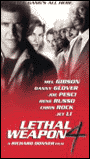
Lethal Weapon 4 (1998)
Starring: Mel Gibson, Danny Glover, Joe Pesci
Director: Richard Donner
Plot: Two middle-aged cops go up against Hong Kong criminals who are trying to buy the freedom of four imprisoned Chinese godfathers with counterfeit currency.
Review: Cranking up a notch on the excess department, Lethal Weapon 4 tries to outdo the previous three films in every way. Gibson and Glover seem tired of these roles, and are not up to the energy and agility shown by Hong Kong star Jet Li. Li really tears up the screen in his first role as a villain, but just doesn't get much of a chance to excel here. The main problems are too much talk, too many characters vying for attention, and too much unnecessary melodrama - and the constant theme of the two cops getting older is definitely getting tiresome. A good half-hour should have been cut out to help tighten the narrative. The typical series' antics are still very much alive, as are the impressive stunts, with the duo causing yet more destruction on the city streets and making fun at everyone's expense, but the exercise is getting sillier, and it's obvious that the series has run out of gas. In the end, Lethal Weapon 4 is a typical Hollywood popcorn movie that's entertaining enough but really just goes through the standard genre paces.
Action: 7/10
Entertainment: 6/10

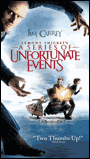
Lemony Snicket's A Series of Unfortunate Events (2004)
Starring: Jim Carrey, Meryl Streep, Emily Browning
Director: Brad Silberling
Plot: After losing their parents in a suspicious fire, three orphans try to escape the charge of a vile, distant relative, a failed actor who wants them dead to gain their rich inheritance.
Review: Based on the popular children's series, Lemony Snicket's A Series of Unfortunate Events is a dark children's fable that oozes the macabre and loves the nightmarish side of things, yet never comes off as scary or unpleasant even for the youngest in the audience. The individual Events, recounting the splendid misadventures of the orphans, is imaginative fun and quite clever in both its narrative choices and its cinematography. Unfortunately, though all these are great as stand alone sequences, they're too episodic and fail to generate any real suspense, something that fails the film as a whole. On the other hand, director Silberling (Moonlight Mile) imbues just the right Grimm fairy-tale like ambiance and has a good sense of comic timing. If he doesn't quite capture the very best of the dark fantasy elements he does provide some great eye-candy, full of sepia tones. Indeed, the production design and artistic choices are inspired and look fabulous (a mix of the modern, the 60's and the bizarre), and the film is full of gorgeous, inventive visuals right down to the end credit animation. If you've ever liked Carrey's trademark antics and demented facial expressions, you'll love him in this film which bests his craziness of Ace Ventura - if you don't, you're going to have to put up with a lot of it. As the villainous Count (and for some, the main attraction), he's completely over the top and quite hilarious, proving that there's few actors better at clowning around. The real surprise, however, are the three kids who are just plain adorable: Browning, as the inventive elder, is sharp and spirited; Liam Aiken, the bookworm, is simply charming; and the Hoffman twins, as the precocious 2-year old, is simply cute as a button and gets all the best lines (her goo-goos are subtitled). Supporting players Streep and Connolly, as eccentric friends of the family, play it to the hilt and are a fine addition. In the end Unfortunate Events is a curious family film that succeeds more than it fails, and though it might not be a bona-fide classic it's an entertaining and visually stylish attempt.
Entertainment: 6/10

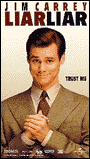
Liar Liar (1997)
Starring: Jim Carrey, Jennifer Tilly, Maura Tierney
Director: Tom Shadyac
Plot: A fast-talking lawyer and obsessive liar has his life turned upside down, both personally and professionally, when his estranged son wishes that his father could not tell a lie for 24 hours.
Review: Love him or hate him, there is no denying that Jim Carrey is the king of modern American slapstick and physical humor, and nothing proves it as well as Liar, Liar. In fact, the whole film is but a vehicle for Carrey's crazed antics and facial contortions. The story is of the typical Hollywood father's-redemption tale, and in this the film is truly banal. But the premise is a good one, and the film knows enough to run with it and to take advantage of its star and its limited comic situations. The melodramatic moments when Carrey tries to redeem himself to his wife and son are not as successful, but then the film is really just an excuse for gags, not drama. As a showcase for Carrey, Liar, Liar is a decent, funny comedy.
Comedy: 6/10

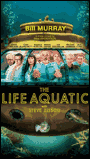
The Life Aquatic with Steve Zissou (2004)
Starring: Bill Murray, Owen Wilson, Cate Blanchett
Director: Wes Anderson
Plot: Accompanied by his estranged son, a once-popular oceanographer and his team embark on their final voyage to track down a mysterious Jaguar Shark that ate one of their team-mates.
Review: A smorgasbord of imaginative ideas, clever details, and dramatic pathos, The Life Aquatic with Steve Zissou presents an off-kilter world that plays like a Jacque Cousteau adventure on the edge of the surreal. The dreamlike narrative is full of inspired elements that will either grab or distance audiences, such as the camera following the crew through a large set of a cut-off boat, the consciously poor CGI effects of the fantastical, impossible marine life and the faux documentaries that harkens back to the '50s and '60s filmmaking styles. Yet despite a few hilarious sequences, like the armed-rescue against modern-day pirates, the film relies mostly on low-key, deadpan humor. This might lead to few laugh-out-loud moments, but there's an underlying current of wit and invention that charms from start to finish. Add to that a feeling of childhood wonder, an affecting father-son relationship despite its obvious comic elements, and a heartfelt ode to lost youth and you've got a one-of-a-kind, affecting experience. Though not quite as wholly accomplished as his excellent The Royal Tenenbaums, writer / director Anderson has once again hit the mark in creating a world full of nostalgia, with denizens that we really care for. Murray has re-created himself as a low-key, mature comedian lately and he is just terrific here as the larger-than-life over-the-hill adventurer longing for his long-gone popularity. Apart from the dysfunctional family made up of estranged son Wilson and vampish Anjelica Houston, there's Blanchett as the enigmatic journalist and the rest of Team Zissou made up of sympathetic and very eccentric losers played by the likes of an over-the-top Willem Dafoe. Despite its light-hearted blend of whimsical adventure, human comedy and affecting character moments The Life Aquatic will definitely not click with all audiences, but for those who can let themselves be entangled in its charms this is a wonderful gem of a film.
Entertainment / Drama: 9/10

Lilo & Stitch (2002)
Starring: Daveigh Chase, Jason Scott Lee, Tia Carrere
Directors: Chris Sanders, Dean DeBlois
Plot: A genetically created koala-like monster with a taste for destruction escapes the clutches of the galactic police and hides away on Earth where he is mistaken for a pet and adopted by a lonely Hawaiian girl.
Review: Lilo & Stitch has got "chutzpah" written all over it, and for audiences in dire need of something fresh and exciting, it's most welcome. The film is consistently inventive and hilarious, easily the most interesting and engaging Disney flick since Mulan. Despite the predictable plot, the proceedings feel fresh and original, with a more subversive sense of humor than most past animated productions from the Mouse House. From Elvis impersonations, to a Men in Black rib, and so much in-between, this is a fabulous, densely-packed script where terrific dialogue and great one-liners abound, and with more laughs than any other six-pack of Disney flicks combined. Adults will probably get more out of the visual gags and clever humor than kids, but there's lots of excitement, laughs and easy-to-digest pathos to please everyone. Though it sometimes skitters on the cloying with Disney's bag of manipulative (but amazingly effective) sentimental tricks, it also manages to create a surprisingly strong bond to these characters. Case in point, the destructive little pest is stymied at every turn, but like the ugly duckling ends up wanting to find a family unit to belong to; his transformation to a sympathetic, likable lost soul is well done and actually quite moving. The appealing cast of characters are all well-voiced, too. Even more surprising, the family problems are well drawn without stretching the melodrama too much. The mostly 2-D cel animation is excellent, smooth, stylish and very colorful with the watercolor backgrounds giving the Hawaii setting a lush, exotic look. The smooth soundtrack is mostly made up of old favorites, mostly of the King's classics like "Hound Dog" and the appropriate "Devil in Disguise". The trademark happy ending is inevitable, but the ride is well worth the time. Kudos to all involved for making such a clever, good-natured flick! Utterly charming and light-heartedly zany, Lilo & Stitch is the animated highlight of the year.
Entertainment: 9/10

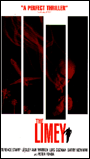
The Limey (1999)
Starring: Terence Stamp, Peter Fonda
Director: Steven Soderbergh
Plot: A tough Englishman fresh out of prison arrives in L.A. to seek revenge on the people he deems responsible for his daughter's death.
Review: After last year's somewhat lighter Out of Sight, director Soderbergh has turned his hand to a more brutal crime drama with The Limey. Some great character acting by Stamp, recreating a role he played 30 years ago in Poor Cow, along with a good, intelligent script easily make up for the otherwise tame and simple story. Indeed, Stamp's performance, with his dark wit, quick violence and occasional moments of almost comic buffoonery, is what really makes the movie a success. The Limey is a film where the style and cinematography plays with our sense of time and place, like an acute sense of déjà vu, jumping from the present to the past, both immediate and distant, using different camera techniques to heighten the sense of tension and keep the audience on their toes. Style definitely does make up for substance here, but its still great to watch it all unfold.
Drama: 8/10

The Lion King 1 1/2 (2003)
Starring: Nathan Lane, Ernie Sabella, Matthew Broderick
Director: Bradley Raymond
Plot: Two supporting characters from The Lion King recall how they first met and how their search for a new home brought them to raise a young cub and eventually help him regain the throne.
Review: In the strangely named prequel The Lion King 1 1/2, the events of The Lion King and the back-story preceding it is retold from the perspective of Timon and Pumbaa, the two characters from the original film that provided most of the comic relief. It's a very different approach to its predecessor: this one is a straight-up musical-comedy that surprisingly enough works more often than not. For starters, this is by far one of the better straight-to-video animated sequels, and if the cel-animation isn't quite up to the level of Disney theatrical releases it's definitely better than TV fare. Even better, the feature was clearly made for fun, with the narrative taking some inventive chances that one wouldn't normally see in this kind of movie such as MST3K-type intermissions, where the characters rewind and comment on their "home movies". The new songs, which supposedly had the involvement of Elton John, aren't anything special but at least they're not grating. Most all the of original voice actors are back, but really this is all an excuse for funny-man Lane, as the fast-talking meerkat, to take control and be the star. And with some clever dialogue and finely-tuned comic-timing the movie helps him accomplish just that. While adults might find it quite forgettable, The Lion King 1 1/2 adds up to a light-hearted and amusing affair that will definitely keep kids entertained for repeated viewings.
Entertainment: 6/10

The Little Mermaid (1989)
Starring: Rene Auberjonois, Samuel E. Wright, Jodi Benson
Directors: John Musker, Ron Clements
Plot: A mermaid, the youngest daughter of the King of the Seas, falls for a human prince and makes an unfortunate bargain with a sea witch to give her legs so she walk on land and win the man she loves.
Review: The 28th animated feature from Walt Disney, The Little Mermaid heralded Disney's modern Golden Age of hand-drawn films in the 1990's, and many of them follow closely the same formula (Beauty and the Beast, Hercules, etc). Loosely based on the Hans Christian Andersen fairy tale, the story is slovenly romanticized of course, adding the familiar tropes to make it more palatable for younger kids (though some of the darker scenes of witchcraft, including the exciting climactic confrontation, may be a little rough for them). The "princess" bit is given lots of emphasis, some of which might bore the males in the audience, one of the reasons perhaps the film has a reputation for being made with young girls in mind. But if these moments are very much in the fore, and even if the humor is relegated to the slapstick with nary an adult in-joke to be found, thankfully the narrative is efficient and engaging, and the lyrics and music by Howard Ashman and Alan Menken are terrific, with the definite highlight being the showy, toe-tapping Oscar-winning tune Under the Sea. Disney's trademark elements are very much in attendance, too, including the scenery-chewing villain, the wide-eyed heroine, and the amusing supporting animal cast. The voice acting is solid, but even the leads take a back seat to Auberjonois' cranky singing crab, the real hit of the film. As for the animation itself, it's pretty and smooth, and works well on the small screen but can't help but appear less impressive than it was back in its original release. Still, despite feeling a bit dated, The Little Mermaid remains a fun little romp that's sure to please the entire family.
Entertainment: 7/10

A Little Princess (1995)
Starring: Liesel Matthews, Eleanor Bron, Liam Cunningham
Director: Alfonso Cuaron
Plot: A rich, spirited and imaginative young girl is forced into servitude at an all-girls boarding school in New York when her father disappears in a European battlefield during World War I.
Review: Bucking the trend of recent stale fare aimed at kids, A Little Princess is a real "family" picture that is both vivid and enthralling, one that will have everyone delighted, and one that doesn't cop out on intelligence for its fanciful tale. Based on the 1888 book by Frances Hodgson Burnett, this twist on the Cinderella story moves the timeline up to the dawn of World War I. This is a thoroughly enchanting adaptation that, thanks to some marvelous production design and an engaging script that has all the requirements for a modern-day fairy-tale, recreates a sense of wonder and enchantment while depicting a poor, Oliver Twist type tale on the other. It's melodramatic, for sure, but heart-warming and whimsical all the same. Director Cuaron (best known for two very different pictures, The Secret Garden and the gritty, steamy Y Tu Mama Tambien) has a great sense of the marvelous and the magical, as seen through the eyes of children. Young, sprightly lead actress Matthews is a revelation and does a well-tuned, sympathetic performance. Moving from India has left her with some deep impressions of that exotic land which she shares with the sheltered students, and resorts to the creation of a fantasy world to ward off and adapt to the desperation of her new situation. These instances, including the make-believe Indian tales of mythical heroism, are filmed with glorious colors and splendid sets. The wicked headmistress (played to perfection by Bron) comes out as a bitter and cruel woman who is also broken and unloved (and, surprisingly, not entirely heartless). A tale on the importance of imagination in our lives, A Little Princess stands head and shoulders above similar commercial Hollywood offerings and is definitely worth looking up.
Entertainment / Family: 8/10

Little Voice (1999)
Starring: Jane Horrocks, Ewan McGregor, Michael Caine
Director: Mark Herman
Plot: Little Voice is the nickname of a shy young woman who lives a very introverted life singing along, indeed convincingly emulating, her dead father's favorite recording stars. Her domineering mother and her mother's small-time showbiz agent boyfriend try to propel her into the spotlight, with terrible results.
Review: Passing off as a comedy, this film is more a light-hearted drama, with a clever script, good acting (especially by Jane Horrocks as Little Voice who definitely steals the show), and a fabulous singing number where Little Voice shows the world her stuff.
Comedy: 6/10
Drama: 7/10

Live and Let Die (1973)
Starring: Roger Moore, Yaphet Kotto, Jane Seymour
Director: Guy Hamilton
Plot: British secret agent 007 is sent to Louisiana to stop a drug-running criminal organization lead by a two-bit island dictator who is helped by a psychic tarot reader.
Review: '70s Blaxploitation flicks meets the new Bond in Live and Let Die, one of the least successful installments of the series. To modern audiences this is a rather ludicrous effort, referencing Voodoo antics and superstitions, with silly dialogue, horrible performances, and an inescapable racist and (as ever) misogynistic overtone. As Roger Moore's first foray in the Bond role, this is a far cry from the Sean Connery hey-day of big-budget sets and charming machismo. Instead, we get a different Bond, one where camp, quips, and a debonair attitude have taken over, stressing the low points that marked Moore's stamp on the series. The villains are appropriately villainous, if rather mundane after SPECTRE, and our hero put in enough dire straits to make up for a lot, but things don't live up to the expectations of the series. Heck, even the trademark gadgets are missing! The action also seems a tad tired and insipid, though some moments, like the extended boat chase sequence through the bayou, are fun to watch. As for the script, it's a muddle of black jive, street-smart attitude, and Bond theatrics, appearing a little too conscious of its own tongue-in-cheekness. Great, catchy theme song from Paul McCartney, though. To be fair, there are enough lively instances here, Moore is a definite charmer, and things move along well (if unconvincingly) to make Live and Let Die a passable time-waster.
Entertainment: 5/10

The Living Daylights (1987)
Starring: Timothy Dalton, Maryam D'Abo, Jeroen Krabbe
Director: John Glen
Plot: Super secret agent James Bond must foil the assassination plans of a fake, mastermind KGB defector and a renegade arms dealer who are setting up a huge deal in raw opium.
Review: The Living Daylights features the introduction of a new Bond and a new direction for the franchise. The filmmakers have decided to bring back the Cold War-type thriller to the fore and the script tries to give a more serious tone during the plot development, but some of the shenanigans still border on the camp of the Roger Moore type period. The action sequences are as good as we expect from the series, especially the car chase with the new gadget-laden Aston Martin Volante and the impressive stunt at the open back of a cargo plane between Bond and a would-be-assassin, but the rest of the film offers nothing very special. Indeed, the moments between action sequences are quite bland, in part because the villains are probably the most uninteresting of any Bond film, the plot is inane, the acting is weak, and D'Abo as the latest Bond girl is never endearing. Dalton, as the new incarnation of Bond, does a very different turn of the role giving a performance that is much grittier and intense than previous actor's take, but also misses on the required charm and suave demeanor associated to the role. Still, all the usual elements of what makes up a Bond film are in place including exotic locales, a touch of humor, action galore, and a decent pace. The Living Daylights may rate as one of the least successful entries in the series, but it's still diverting.
Entertainment: 6/10

Living in Oblivion (1995)
Starring: Steve Buscemi, Catherine Keener
Director: Tom DiCillo
Living in Oblivion focuses on the shooting of a low-budget film in which everything goes wrong: the main actress is too self-conscious, the main actor is a Prima Donna, the crew is inexperienced and befuddled by the merest detail, and through it all the director (played by indie king Steve Buscemi) tries to keep his movie together. Starts slowly, but picks up half-way through with some hilarious scenes. Good insight, with a satirical edge, into the mishaps that go into making a movie.
Comedy: 6/10
Entertainment: 6/10

Lone Wolf McQuade (1983)
Starring: Chuck Norris, David Carradine, Barbara Carrera
Director: Steve Carver
Plot: A highly skilled Texas Ranger and his novice partner take on a vicious, murdering gun-runner who is stealing U.S. military weapons and selling them to rebels in South America.
Review: What might have come off as another in the line of swaggering action vehicles for its lead is instead a culmination of the '80s action genre with a surprising amount of style. Indeed, from the terrific, atmospheric Morricone-like score, to the grunginess of the sweaty scenes, to the trademark posturing and stand-offs, the film has a great, carefully defined Spaghetti-Western feel to it. Heck, this one has "guilty pleasure" written all over it, from the opening scene when Norris mows down a large gang of horse thieves single-handedly, to the explosive climax and final mano-a-mano confrontation with Carradine. Favorite scene: Norris, beaten and bleeding, is buried alive in his Jeep, but wakes up, pours a can of beer on himself, starts the turbo on his engine and drives the 4x4 straight out of the ground! And this type of macho bravura is maintained throughout with a no-nonsense approach to its action sequences and an efficiently paced script. This is easily the best of the Chuck Norris vehicles, using it's lead's limited acting ability, and decent martial arts skills, to good effect. Of course, it also helps that he has such a great opponent in the scene-chewing Carradine. Sure the proceedings are sometimes crass and exploitative, the acting terrible, the production values rather low, and the story utterly predictable, but there's an energy, an efficiency in its storytelling, its thrills and its constant action scenes that is uncommon for this sort of film. In fact, there's rarely a dull moment, with a gun battle, an explosion, or an exchange of blows always around the corner from the short moments of melodrama or simplistic character development. Fans looking for a quick fix can't go wrong with Lone Wolf McQuade - it has all you can ever hope for in an '80s action flick.
Entertainment: 8/10

The Longest Nite (Hong Kong - 1997)
Starring: Tony Leung, Lau Ching Wan, Maggie Shaw 
Director: Patrick Yau
Plot: As a Triad group puts out a contract on the leader of a rival gang, a vicious crooked cop tries to scare off potential assassins and frames a cool criminal, but as the night drags on he realizes that other wheels have been set in motion.
Review: Director Yau (Expect the Unexpected) is in his element here with The Longest Nite, a stylishly shot ultra-gritty crime thriller. Though there is actually little action here of the type we would expect, apart from a dragged-out final gun battle in a mirror factory that confuses the two protagonists in similar fashion as it did in Face/Off, it's not really the point. The main thrust of the film is that constant feeling of mean-spirited psychological evil emanating from each one of the characters, the pervasive feeling of claustrophobia that only increases as the night unfolds. The plot twists in surprising ways, uncovering many layers of lies and deception, avoiding any type of character development and solely focusing on the actions and the ever-present brutality inherent in this cinematic criminal world. As the script evokes the classic neo-noir, with its anti-hero protagonist doomed from the very start, so does the excellent cinematography which bathes every scene in shadows and garish neon light. Tony Leung, in a fascinatingly cold, unsympathetic role, grabs our attention from the first moment with his explosive bouts of violence and his haunted face. More an exercise in style than substance, The Longest Nite is still an eerie, well constructed crime thriller that's sure to please genre fans.
Entertainment: 6/10

The Longest Summer (Hong Kong - 1998)
Starring: Robby Cheung, Tony Ho, Jo Kuk
Director: Fruit Chan
Plot: Five abandoned Chinese soldiers in the former British army of Hong Kong must come to terms with the changing face of a society that no longer needs them as the 1997 handover to China approaches.
Review: The Longest Summer is a film on the "changing of the guard" as the British leave and the Chinese take possession once again of Hong Kong, a subject very dear to many HK filmmakers. The film is a more mature production, and one grander in scope, than director/screenwriter Chan's previous intimate picture Made in Hong Kong. Here he uses the characters of these Chinese soldiers to express the political situation of the Hong Kong people during the transition, with the relationship between two brothers embodying the two sides of the issue. It's an ambitious and dramatic film with many story elements and a lot to say, but by trying to bring up too many different "important" themes such as the now-orphaned society, new social pressures, rampant crime and opportunism, etc. it ends up seeming jumbled and unfocused. The sequence with the hand-over festivities, particularly, is overly long with more time spent on the countless fireworks than on the characters. Still, though it may not be completely successful, it is still an interesting, well directed, and seemingly heartfelt social commentary on an important event in the history of Hong Kong.
Drama: 6/10

The Longest Yard (2005)
Starring: Adam Sandler, Chris Rock, Burt Reynolds
Director: Peter Segal
Plot: Ending up in a Texas prison, a former quarterback tries to create football players out of the nastiest inmates to take on the professional guards' team led by a corrupt warden.
Review: A watered-down remake of the 1974 version, The Longest Yard presents a slicker but more low-brow affair that's sure to please the teen crowd. It being an MTV production of an Adam Sandler vehicle, we get exactly what one would expect: muscle-brained guys trying to look cool, lots of crude (but occasionally effective) humor, too many demeaning stereotypes, and lots of crunching football action. Unsurprisingly, gone is the political subtext and the grittiness of the original - and forget any statement on prison life or any character development. What we get is a formulaic, predictable "guy flick" that's more engaging and funny than it has any right to be thanks to the commercial aptitude of director Segal (Anger Management, 50 First Dates) and the comic timing of the cast. Of course, the whole affair is quite ridiculous - from the recruiting drive to the live-TV final game - but the biggest leap of faith required is in believing the (usually) bumbling Sandler could ever be an ex-quarterback. Sleeping through the performance as the rebellious has-been, Sandler still manages with equal parts humor, easy sympathy, and misplaced machismo. As the team's mentor Reynolds, somewhat reprising his memorable role in the original, doesn't make much of an impression. Rock, however, has the best lines even if he's never used to his full potential. In the end, The Longest Yard has enough going for it to make for an entertaining, if instantly forgettable, sports flick.
Entertainment: 6/10

Looney Tunes: Back in Action (2003)
Starring: Brendan Fraser, Jenna Elfman, Steve Martin
Director: Joe Dante
Plot: A wannabe stuntman teams up with a studio executive and some animated characters on a world-hopping advneutre to save his secret agent father and retrieve a mythical diamond before an evil corporation can get its hands on it.
Review: A lunatic flight of fancy that often as not captures the spirit of the original cartoons, Looney Tunes: Back in Action follows in the footsteps of Who Framed Roger Rabbit? and Space Jam, mixing live actors with the bevy of animated characters from the Warner Cartoons vault. And they're all here it seems, from head-liners Bugs Bunny and Daffy Duck to the Tasmanian Devil and even the singing frog! Director Joe Dante (Gremlins, Innerspace) has had many ups and downs in his career, and this effort is somewhere in the middle. There's no denying that he's captured the right stuff: the visual gags come fast and furious and there's a definite crazed energy. The pacing and antics will ensure that it keeps kids awake, while the myriad comic pop references (from the Daleks, to Psycho, to 1950's Invasion of the Body Snatchers) will keep everyone else at attention. Indeed, there's tons of stuff here both in the story and backgrounds that really screams for repeat viewing, and the fast pace is in tune with the madcap adventures of the original cartoons. An imaginative chase literally in and through the Louvre's painting collection is a highlight. The always-affable Fraser and perky Elfman do an OK job but are really only a sounding board for the 'toons. However, there's a great cameo cast including a prancing Martin as the ACME head, a curvaceous Heather Locklear, a suave Timothy Dalton (as a 007 clone, surprise), and a terrific Joan Cusack as the head researcher of Area 52. Unfortunately, despite all the great intentions and impressive attention paid to stuffing the script with all the possible comedy that can be crammed into 90 minutes (including parodies of James Bond, Star Wars, Indiana Jones, and more) there's something missing. Oh, the filmmakers are obviously taking this all to heart and believe in their product but that's what it comes out as: a product, professionally studied and executed but without that missing ingredient that would make it special. Still, inventive, entertaining and technically impeccable, Back in Action might not be the perfect Bugs Bunny film, but it sure gives it the old college try.
Entertainment: 6/10

The Lord of the Rings: The Fellowship of the Ring (2001)
Starring: Elijah Wood, Ian McKellen, Viggo Mortensen
Director: Peter Jackson
Plot: Aided by a fellowship of various races and a wise wizard, a courageous young Hobbit accepts the dangerous quest to destroy a magic ring that once gave an evil presence power over all the lands.
Review: Epic in both scale and production, The Fellowship of the Ring, the first installment of the Lord of the Rings trilogy, captures the essence of Tolkien's work, condensing it and yet retaining the story's complexity, multi-faceted characters and mature drama while making it still comprehensible to those new to the tale. Even at three hours, the narrative is fast-moving and rich in detail, and though some things got cut from the novels, it is one of the best cinematic adaptations to a literary work every filmed, full of adventure, magic, and intricate, spell-binding battles, yet one that never forsakes the charm, wonder and mythical properties of the original material. The often spectacular special effects are here only to help further the story, from full-scale conflicts to an impressively-rendered monstrous menagerie, to clever works of wizardry, with even the minor ones working to create an overall sense of a land where everything is possible. The fabulous production design, creating Elven, Dwarf and Hobbit towns that seem right out of a travel brochure, along with the beautiful New Zealand vistas, make the fantasy world of Middle Earth come to life. The impeccable direction by Jackson (The Frighteners, Dead Alive) of both the real and un-real components, is greatly aided by the magnificent all-star ensemble cast (with kudos to McKellen and Wood for some spot-on performances, as well as Ian Holm and Christopher Lee in supporting roles). All these elements help the film stand out from past Hollywood-style fantasy adventures by creating a universe that breathes with its own fascinating history. Heck, the first 15 minutes themselves, the mere prologue to the story, will have audiences giddy with excitement, a feeling that stays throughout. The Fellowship of the Ring is a terrific, mesmerizing first installment that never ceases to enchant and one that should be placed next to the greatest adventure / fantasy tales ever put to the screen.
Entertainment: 9/10

The Lord of the Rings: The Two Towers (2002)
Starring: Elijah Wood, Ian McKellen, Viggo Mortensen
Director: Peter Jackson
Plot: Separated by events, the hobbits try to find their way to Mordor helped by the the devious Gollum while the rest of the group rally to defend Isigord's fortress against the armies of the wizard Sarumon.
Review: On the steps of the grand The Fellowship of the Ring, The Two Towers suffers a bit, but only in comparison, and that mostly from being the middle segment of a greater story. Thankfully, the filmmakers tackle this episode as courageously as before, and much like the first chapter, the fantasy world is convincing, the cast is superb, the effects impressive, the narrative thoroughly engaging, the drama larger-than-life, and the action (when it comes) superb. And everything is bigger: the stakes are higher, the action more intense, and the confrontations more massive; this is War. Even clocking in at three hours, it all seems to pass by too quickly. Director Jackson once again proves as incredibly able at choreographing huge battle scenes as he is of bringing forth the story's more intimate moments (especially Frodo's internal struggle). Now that the Fellowship has been broken into three groups, there are three different stories to tell and this sometimes causes some pacing hiccups, something that comes out in the weaker first half. But this is still exciting, epic storytelling, and the term "weak" is relative only to what comes afterwards: the rousing, battle-rich second half is stunning and absolutely spectacular, showing in grand detail the Human fight for Helm's Deep and the tree creatures' attack on the Orc tower of Sarumon while managing to find a good balance with personal interactions. Both of these are a step above what audiences have seen before, and the computer effects (though not perfect) are still dazzling. New characters are also introduced, most importantly Gollum, a digitally created creature that is believably drawn out and is quickly accepted as part of the cast. Though no longer as surprising, nor as well-rounded as the first installment, The Two Towers still succeeds brilliantly in adapting the classic fantasy world of Tolkien into an epic adventure that is definitely worth watching over and over again.
Theatrical version - Entertainment: 8/10
Revised note on the Extended DVD version:
The release of the extended version corrects many of the minor faults in the film, and offers up more character interaction and more attention to the many sub-plots, making for a more rounded overall view of events - and a film that surpasses the original.
DVD version - Entertainment: 9/10

The Lord of the Rings: The Return of the King (2003)
Starring: Elijah Wood, Ian McKellen, Viggo Mortensen
Director: Peter Jackson
Plot: While a fial confrontation between Orcs and Men rages in the plains of Gondor, two small hobbits find their way through the dark lands of Mordor to destroy the enemy's most dangerous weapon, a ring of power.
Review: With The Return of the King, cast and crew have created a finale for one of the greatest epics in recent memory, one that provides total immersion, and one that fans of the novels as well as newcomers can truly appreciate. This time around, he stakes are higher, the tensions and emotions greater, and the battles (both the large scale ones with armies at war and the more personal ones faced by Frodo and Sam) more visceral - this is indeed the ultimate battle between good and evil. In lieu of re-iterating what has been said for the past films, let's just say that the production values are again top-notch, the story riveting, the New Zealand cinematography stunning, the acting by the whole stellar cast impeccable, and the direction once again assured. Though the script takes the occasional liberty with the novel, sometimes throwing out whole passages, kudos must still go to the screenwriters for bringing Tolkien's vision to the screen so successfully. Ably balancing the grand spectacle with the dense narrative, it never loses sight of its characters. The computer effects are for the most part excellent, though the battle for Minas Tirith - as grandiose and thrilling at it is, with its colossal mammoths and thousands of participants - relies too much on CGI and thus doesn't quite capture the intensity of the second film's center-piece, the Battle for Helm's Deep. Much like the first series' beginning, the ending takes a while to cover all its bases but for audiences who have invested the more than nine hours on the trilogy, this feels just right. If there's one flaw, it's that at over three hours, the film actually feels too short: more so than the previous installments, there are just too many things, too many sub-plots and characters to tie up satisfactorily. However these minor quibbles aside (ones that will no doubt be corrected with the Extended Version due next year), The Return of the King closes off a masterful adaptation of a literary classic - it's a terrific conclusion to a truly epic fantasy adventure.
Entertainment: 9/10

Lord of War (2005)
Starring: Nicolas Cage, Ethan Hawke, Jared Leto
Director: Andrew Niccol
Plot: Having risen to the status of rich and notorious arms dealer to African countries, a Russian immigrant is chased by an obsessive Interpol agent.
Review: A fast-paced satire spanning 20 years and many conflicts, Lord of War is something of a rarity, presenting the relatively little known world of arms dealing in a very slick, commercial style that manages to both entertain as an adventure film and get its point across. Thank the smart, witty script, superb cinematography and able direction by Niccol (Gattaca, Simone) who has created an amalgam of five real-life accounts of people in the trade and brought them to life in a narrative tract that plays out very similarly to some of the dramas on the drug industry - think Blow with weaponry instead of cocaine. As the title character, Cage plays the role of the gunrunner with the offhand charm of a car salesman and sensibility of a dreamer. His anti-hero isn't so much immoral as amoral - he's just pursuing the profession because he's "good at it". As a personal drama it's rather shallow stuff despite some good efforts at showing his family life with trophy wife being based on lies and deceit. His character and social life, however, are secondary to the peek into the black-market dealings and the political commentary of the weapons industry and the governments that secretly condone them. The film is at its best when it throws itself in the tropes of the dark comic thriller, with all the harrowing events (like his meetings with the blood-thirsty Liberian dictator) and hairy situations (shipments getting boarded by Interpol agents) that the profession entails. Loads of clever narration also helps to get into the cunning details and help further explain the hero's descent into a Hell of his own making. It's pretty scary stuff, especially since much of it is based on fact. In supporting roles, Leto (as his drug-addled brother) and Hawke (as the enforcement agent) do well enough with the limited screen time, and there's a nice cameo by Ian Holm. All told, Lord of War is a satisfying, engaging film, a clever, black-hearted satire that hits all the right buttons.
Entertainment / Drama: 7/10

Lost and Delirious (2001)
Starring: Piper Perabo, Jessica Pare, Mischa Barton
Director: Lea Pool
Plot: Forced into an all-girl boarding school, a shy teen discovers her two young female room-mates are having a torrid affair, one that can't help but turn badly when they get caught.
Review: With her adaptation of Lost and Delirious, Quebec director Lea Pool has produced a deftly crafted teen drama from a subject that's rarely seen. This story of the world of boarding school mixed in with lesbianism and a coming-of-age story is slickly made and not always subtle but eager to convince and to trap us in the world of its teenage girls' romantic longings. Pool has a great eye for directing her actors, and the film often reaches a definite intimacy, none more so than in the young teens' sexual relationship: though not flaunted, it is shown as being innocently erotic, showing the intensity of their bond without being lascivious or (too) voyeuristic. The three young actresses are impeccable and convincing, and the strength of their characterizations is what makes the film ultimately so engaging. Perabo's character is made to do some embarrassing, melodramatic stuff that verges on the theatrical but thanks to the actress' energy and conviction, these come off well. Her painful, heart-wrenched performance shows that Pool is sometimes trying a little too hard (especially as our heroin spins into lovelorn despair), but mostly she depicts the passion between the two girls with honesty. Graham Greene as the gardener, is severely underused and doesn't quite fit, expounding easy platitudes instead of personality. However, the main disappointment is that things don't seem to develop enough - the emotions come through, but it's not always convincing. Various sub-plots also never get a chance to percolate, such as the narrator's relationship with her dad, or the teachers' pasts. The story may end up feeling be a little hollow, but with a good cast and some able story-telling Lost and Delirious is an occasionally moving dep