Movie Review Library - B

Make sure you see the Latest Video Reviews page as well!
(Reviews, Ba - Bk)


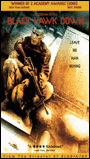
Black Hawk Down (2001)
Starring: Josh Hartnett, Ewan McGregor, Tom Sizemore
Director: Ridley Scott
Plot: In 1993, a 30-minute military operation to capture two lieutenants of a vicious Somalian warlord goes terribly wrong when the soldiers encounter unexpectedly heavy militia forces and turns into a deadly 17-hour firefight. 
Review: After Gladiator and Hannibal, Black Hawk Down is another step in director Scott's (Blade Runner, Alien) continuing search for an Oscar. He is a consummate, stylish filmmaker, and the movie is always engaging and interesting to look at with imagery that is gritty, gut-wrenching, and appropriately violent - this is urban combat on a grand scale, and when things go bad, they're disastrous. Saving Private Ryan raised the bar for the bloody depiction, and audience immersion, of the battlefield and here it's extended to a two-hour trip. The tactical details involving helicopters, Humvees, foot soldiers and even mobs are well set-up and believable. Yet though the obvious skill in all aspects of the production are impressive, there's a certain shallowness to the overdrawn proceedings, as if the real story was kept hidden beneath the explosive pyrotechnics. Obviously, recreating exactly the events that occurred is both impossible and lacks a certain Tinseltown flair, so the story does take liberties with fact to provide a better fictional account of modern men at war. Unfortunately, the complexities of the US's Somalia mission haven't so much been simplified as side-stepped. By limiting the exposition and historical / political set-up of the conflict, we're left with an exercise that is harrowing, yes, but that ends up feeling much more like a dragged-out action flick than a war drama. There's a lot of shooting, many tense moments, and an urgency to the proceedings that's quite tangible, but there are also instances of easy melodrama and jingoistic fervor that Hollywood is so good at that just leaves a bad taste. The all-star ensemble cast, including some surprising faces, does a decent if somehow unconvincing job of soldiering and end up as pretty one-dimensional characters. Black Hawk Down doesn't offer any penetrating new observations on war or its soldiers, but as a well-done depiction of the frenzied chaos of urban combat with a Coles Notes description of the Somalia debacle, it's an effective, often riveting, piece of filmmaking.
War / Drama: 7/10

The Black Hole (1979)
Starring: Maximilian Schell, Robert Forster, Anthony Perkins
Director: Gary Nelson
Plot: A small band of astronauts stumbles across a long-lost starship poised on the edge of a massive black hole and must confront the mad scientist at its helm and his dangerous army of robots.
Review: The big-budget sci-fi flick The Black Hole, Disney's first attempt at a more mature crowd, is also it's one and only attempt at exploiting some of the Star Wars blockbuster glory. The sales pitch might have been to mix in some obvious Star Wars influences with the spirit of 2001: A Space Odyssey, but what comes out is a B-movie through and through making it more akin to an episode of TV's Lost in Space. No matter the original "adult" intentions, the film still holds on to Disney's need for family fare with the need for cute robots and easy theatrics. Yet the first half of the film is much too slow and ponderous for kids (and the dark, horror-like aspects perhaps too scary for young ones) while the second half, with its silly but amusing (and ridiculously long) laser fights, will lose most adult viewers. And even the filmmakers are probably scratching their heads in regards to the ridiculous (but admittedly impressive-looking) religious imagery that ends the film, with its depictions of Heaven and Hell. As for the acting, its sub-par, even from veterans Schell and Ernest Borgnine, and the dialogue comes out as pompous and completely forgettable. Director Nelson (best known for the 1977 version of Disney's comedy Freaky Friday) is obviously not in his element with all the effects shots that are meant to awe the audience. For fans of the genre, however, there are some positive highlights: there's the menacing crimson-red henchman-robot Maximillian, the 2001-inspired psychedelic trip into the black hole, and probably the most impressive shot of the film, that of a huge, (and perfectly-round!) glowing-red meteorite crashing into the ship and rolling down the main alleyway while the crew races across a bridge to escape it. On top of this, the whole production design is simply fabulous for a 1970's sci-fi effort and is worth a look. Though the model and physical effects are rather primitive compared to modern digital ones, they're still impressive to look at and still hold up quite well, most especially the fabulous city-sized starship which, lit up on its introduction, looks like a convergence of steel and glass with a definite Victorian design. Too bad the story couldn't compete with the fine efforts put in on the special effects - The Black Hole could have been a movie to remember, instead of just another SF curiosity.
Entertainment: 4/10

The Black List (La Liste Noire) (Quebec - 1995)
Starring: Michel Côté, Geneviève Brouillette, Sylvie Bourque 
Director: Jean-Marc Vallée
Plot: A judge's life and family are threatened when, during a sex offense trial, a prostitute publicly offers up a list of her influential clients which include friends and colleagues.
Review: The Black List offers up a concoction of greed, sex, and suspense in the backdrop of society's highest levels of justice. But what makes it really interesting is the that the story tries to include a vivid moral dilemma, and a realistic sense of desperation, confusion and suffering in its cast of characters as the prostitute's blackmail scheme backfires and the violence escalates. The plot twists and dialogue are, for the most part, quite good and keep the viewers interested. The cast is solid and believable but it's unfortunate that not enough time is given to flesh them out individually. The real disappointment is that the dramatic tension is lost towards the end and the expected emotional resolution that could have made the film a terrific social drama is replaced instead by a trick ending (one that lays bare many inconsistencies of the plot) that relegates the film to only a decent thriller. The Black List is still an involving and clever film, just one that could have been much more.
Entertainment: 7/10

Black Mask (Hong Kong - 1996)
Starring: Jet Li, Lau Ching-wan, Francoise Yip
Director: Daniel Lee
Plot: After escaping a secret super-soldier project, a survivor dons a mask of anonymity to go up against his former teammates who are using their new-found skills to viciously exterminate their drug-dealing competitors.
Review: Combining producer Tsui Hark's trademark fantasy elements with modern comic-book super-heroics, Black Mask is an interesting effort to create an original vehicle for star Jet Li. The many violent, frenetic action sequences combining martial arts, wire-fu, and a bevy of deadly gadgets are well executed, if not particularly original, and have the mark of famed action choreographer Yuen Woo-ping (The Matrix, Iron Monkey) all over them. The film is also typical of the new breed of Hong Kong films - slick, well shot, with above-average production values. Unfortunately, though the film looks good, the plot doesn't allow you to care much for the characters. Jet Li is fine and adequately charming when necessary in the comic relief bits, and always impressive in the fight scenes, though the rapid editing doesn't allow his skills to shine through. Lau Ching-Wan, as the tough cop, plays his role straight and adds a certain energy and class to the proceedings. Though the story and pacing may be a little weak, as a stylish cartoon adventure, Black Mask offers up a healthy dose of high-flying action to satisfy any fan of the genre.
Entertainment / Action: 6/10

Black Mask 2: City Of Masks (Hong Kong - 2001)
Starring: Andy On, Traci Lords, Tyler Mane
Director: Tsui Hark
Plot: A genetically enhanced warrior who has escaped the clutches of his makers engages in a battle against DNA-altered wrestlers to stop a biological bomb that could mutate the city's inhabitants.
Review: Obviously meant as an over-the-top homage to the strangest of comic-book adaptations, Black Mask 2, the sequel to Jet Li's mildly popular Black Mask, is a strange, unsuccessful affair indeed. With legendary Hong Kong director Tsui Hark at the helm and martial arts choreographer Yuen Woo-Ping (The Matrix) at his side, there was great expectations for the film. Unfortunately, Hark's new-found love of cheesy special effects and overly convoluted storytelling makes this more in tune with low-budget direct-to-video camp classics than to his classic works like Once Upon a Time in China or even his later hits such as Time and Tide. The film tries for high-flying antics, from a fight on top of stampeding elephants to absurd attempts at super-heroics, and it feels like its trying too hard. In fact, it comes out as a meant-for-children effort, full of strange, rubber-suit monsters and (sigh) wrestling action. And the romantic interest, meant for slapstick relief, just slows things to a crawl. Newcomer Andy On does his best with the material and he's not bad as the dark-clad hero, but there's little he or the rest of the cast can really do with such a logic-deprived script. Also obviously meant for an international (read American) audience, the film was shot in English with a bevy of recognizable third-rate actors, never a good sign. Not to say it's a complete waste: for those willing to sit through the silliness, Hark does know his stuff and there's enough inventive shlock, candy-colored cinematography, and amusing foolishness to entertain less discerning viewers. Too bad, though, that Black Mask 2 doesn't live up to expectations and ends up painful to sit through.
Entertainment: 3/10

Black Rain (1989)
Starring: Michael Douglas, Andy Garcia, Ken Takakura
Director: Ridley Scott
Plot: A New York cop grudgingly joins forces with a reserved Japanese detective to catch a vicious young Yakuza boss who has killed his partner and escaped in downtown Tokyo.
Review: Black Rain has quite a bit going for it: it's slick, efficiently paced, and its high production values are immediately evident. From the start, this is an amazingly visually stylish effort reminiscent of director Scott's masterful Blade Runner. The cinematography is given the added touch and is downright excellent, every scene enhanced with rich texture, from the dark corners of Osaka to its densely packed offices and dens. This has given the film a more modern look and has kept it from being as dated as other genre films. Despite the lavishness of the production, however, this is a purely mainstream effort, the fish-out-of-water story but another entry in the odd-couple cop buddy movie so popular in the '80s. Still, despite its formulaic, by-the-book story the action is kept on high gear and the explosive confrontations (either verbal or bullet-ridden) keep things moving. Scott, never one to eschew on violence, delivers the requisite blood and guts with efficiency and the appropriate amount of thrilling set pieces with gusto. There's also an appropriately exotic (if a bit Hollywood-ian in its focus) depiction of Japanese culture that makes things feel fresh. As for the cast, Douglas, surprisingly, is convincing enough as the swaggering, street-tough action hero. Garcia, however, steals the show as his charming, prim-and-proper young partner, while Takakura, who played a similar role opposite Robert Mitchum in Yakuza, is quietly appealing. Though not one of Scott's better efforts, Black Rain is still an engaging, entertaining action flick that's above the average fare thanks to the director's trademark touches.
Entertainment: 7/10

The Blacksheep Affair (1998)
Starring: Chiu Man-Cheuk, Shu Kei, Ken Wong
Director: Allen Lam
Plot: A Chinese commando is reposted to an East European country and soon finds himself at odds with both a corrupt military general and a murderous but charismatic leader of a Japanese doomsday cult. 
Review: The Blacksheep Affair is full of decent, sometimes even great, action scenes, starting off with an airplane hijacking and advancing to multiple gun-battles and an explosive car chase. But where the film really shines is when the talented Cheuk gets to show off his martial arts skills, and thankfully there are quite a few opportunities, often quite impressive and inventive, all choreographed by the legendary Ching Sui Tung (Swordsman II). The climactic fight scene between Cheuk and the Japanese villain combining wire work, acrobatics, martial arts and even sword-fighting, is worth the whole film. The story is a mixed bag, throwing into the story Japanese religious terrorists, a lover lost during Tiennamen Square found again, arms smuggling, European prejudices, and even a dash of political unrest and Chinese propaganda. Though none of it is really delved into and sometimes bogs the film down a bit, it doesn't really detract from the action. One inadvertently hilarious, and sometimes jarring, element is that everyone in this former Soviet republic speaks badly scripted English! A fun, entertaining film for action buffs.
Action: 8/10
Entertainment: 7/10

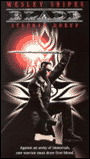
Blade (1998)
Starring: Wesley Snipes, N'bushe Wright, Stephen Dorff
Director: Stephen Norrington
Plot: Still trying to avenge his mother's death, a half-human half-vampire "day walker" hunts the city's underground to stop a vampire and his high-tech crew from unleashing an Apocalypse.
Review: Blending elements of action and horror, Blade, based on the Marvel Comics superhero, is an engagingly dark, energetic super-hero movie. In fact, this is an extremely violent film, where gruesome, savage bloodletting abounds. Slick, stylish production values and some impressive sets, combined with some great camera shots, long shadows and some fast edits pull us into this strange, eerie world. The film is in constant motion, peppered with many action sequences and fight scenes, full of martial arts, wire acrobatics and gunplay, all well staged and, thanks to some good choreography and quick edits, all lightning-quick. The details of the vampire politics on display, as well as the rich vampire history, help make the story intriguing and help create a fictional universe that could easily hold a new movie franchise. Sure, the whole proceedings are not bound by simple things such as real-world logic but by the gravity-defying laws of Hong Kong films and comic-books, but there's a gripping, exciting story here, and though there are indeed some gaping holes in many of the plot, it all moves along at a brisk pace. Snipes plays the role of the vampire hunter with as much intensity and gusto as he can muster with just an edge of vulnerability to his dark side, and it's a delight to see him on screen. The rest of the cast is OK, with Dorff a rather subdued villain, and Kris Krisofferson, as Blade's mentor, doing a good over-the-top performance. Few comic-book heroes make the jump from the page to the screen successfully, but Blade is one that exceeds its humble beginnings to give audiences some rousing entertainment.
Entertainment: 8/10

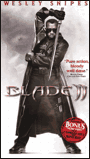
Blade II (2002)
Starring: Wesley Snipes, Ron Perlman, Kris Kristofferson
Director: Guillermo Del Toro
Plot: A vampire hunter is forced to team up with a crack unit of his bloodsucking adversaries to help defeat a greater threat - a terrifying new mutant race that feeds on vampires.
Review: Whereas the first Blade had a good combination of action, story and character development, the sequel seems to eschew everything but attitude (which it has in spades) and continuous action, doled out in large chunks with a bevy of pounding tunes, as if afraid audiences would be bored by any kind of exposition. The fight scenes are definitely impressive, and there are more of them than any six-pack of typical action films combined, but the moves are so quick, the editing so rapid, that it all becomes just a blur - so much so that one can't appreciate the evident finesse and choreography on display. Another atrocity is the extensive use of unconvincing computer graphics to allow its heroes and villains superhuman feats, ones that appear too fake to readily accept. The problem here is similar to The Mummy Returns - the action has been cranked up ten-fold, but the elements that made the previous so watchable has disappeared. The film has a great sense of visual style, mostly due to Euro director Del Toro (Cronos, The Devil's Backbone) and, thanks to some strong horror elements, with some effective gross-out moments and a decidedly dark, brooding atmosphere, it does deliver the necessary thrills. Yet the vampire lore and well-defined world so well crafted in the first installment is barely used here, alluding to it only as a stepping stone for a loosely plotted story to help fill in the gaps between action scenes. The character interaction is also limited to witty macho quips hissed back and forth, some of which are actually quite amusing. Apart from Snipes, who carries off the cooler-than-cool persona, the rest of the supporting cast (including the criminally underused HK martial artist Donnie Yen) is pure cannon fodder. One exception is Perlman, who excels in another over-the-top bad guy role as the volatile sub-leader of the vampire task force. As a loud, mindless, fast-paced action flick, Blade II definitely delivers, but for fans of the first film it's a step backwards for the franchise.
Entertainment: 6/10

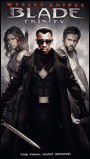
Blade: Trinity (2004)
Starring: Wesley Snipes, Jessica Biel, Ryan Reynolds
Director: David Goyer
Plot: Hunted by the FBI, a sword-wielding human-vampire joins up with a team of vampire slayers to face the ultimate vampire, Dracula.
Review: The final installment to the franchise vampire franchise, Blade: Trinity has lots of movement and blather, but little to make it memorable. Gone is the originality and energy of the first film or the over-the-top stylishness (some would say silliness) of the second, replaced with a rather bland impetus to take the series beyond the original chapter into painfully predictable territory. Even the main villain, Dracula himself, comes off as a banal stereotype, with little detail as to what makes this 6000-year old warrior (as per the film's legend) so unique. Sure, there are enough martial arts fighting, car chases and miscellaneous action sequences to keep jaded viewers awake - highlights include an escape from police custody, the final mano-a-mano showdown - but none of them are original or effective enough to make an impression. Between these action bits, the direction by series writer Goyer falls flat, never creating the right amount of tension and instead focusing too much on slow-going exposition in an attempt at fleshing out the background story. Some of the dialogue has its moments (especially during a brutal torture scene) and there are some great ideas (Vampire dogs, anyone?) but it's soon obvious that the film has all the failings of a first-time director in love with his own script. Too much attention on a new cast of characters means there's little time to develop Blade himself and, returning as the titular vampire hunter in a dour, wooden performance, Snipes plays second-fiddle for much of the film's running time. At least kick-ass newcomers Biel and Reynolds, sultry and smart-mouth respectively, make up for much of the loss as the young slayers in need of a mentor. Though it's entertaining enough for undiscerning viewers and does have its share of moments, Blade: Trinity makes it clear that the series has run out of steam.
Entertainment: 5/10

The Blade (Hong Kong - 1995)
Starring: Zhou Wen-zhou, Xiong Xin-xin
Director: Tsui Hark
Plot: After losing an arm fighting a band of vicious local bandits, a sword-maker decides to learn one-armed kung-fu to extract revenge on the tattooed master that killed his father.
Review: Taking its inspiration from the Shaw Brother's The One-Armed Swordsman, The Blade is director Tsui Hark's answer to Wong Kar-Wai's surreal Ashes of Time, but without that film's amazing tapestry of images or style. Indeed, this is a disappointing exercise from Tsui Hark (Once Upon a Time in China, Peking Opera Blues) with a surprisingly slow, often ponderous pace. The story could have been better presented, and the events more stirring, but the film seems content to throw an erratic plot-line with unexplained characters and motivations for the sake of some stylishly edited action. As for the fight sequences, they are decent, but there's nothing very inventive or original here, and the quick, often blurry editing just ends up making them confusing. Thankfully the trademark Tsui Hark cinematography is clearly evident with some interesting play of shadows and color, and the acrobatic final one-on-one battle of swords makes up for a lot, it's just unfortunate that Zho Wen-zhou (The Blacksheep Affair) is so underused. The Blade has all the elements for a great film, but ends up as only a mildly entertaining effort.
Entertainment: 5/10

Blade Runner (1982)
Starring: Harrison Ford, Rutger Hauer, Sean Young
Director: Ridley Scott
Plot: After four near-human "replicants" illegally land in 2019 Los Angeles, a cop specializing in hunting them down is dispatched to terminate them, but his assignment takes on a different tone when he falls in love with a replicant himself.
Review: Blade Runner, director Ridley Scott's follow-up to the hugely successful dark sci-fi horror Alien, could well be said to be his crowning achievement. The film manages to be more than a typical big-budget adaptation of the novella by Philip K. Dick, retaining the existential ponderings of the original story, mainly the theme of what it is to be human. The film is best described as a science-fiction film noir with all the trimmings - a morally ambiguous anti-hero, a femme fatale, the typical shadowy interiors and dark streets all surrounding an interesting sci-fi premise. In fact, the film is a very personal, almost intimate, character-driven narrative set on a vast template of a sprawling city landscape and an intricate background. Its most stunning achievement, though, is the way the film set the standard for bleak futures: dark, dirty, stylish, full of bustling streets, neon lights, darkened corners, a persistent brooding atmosphere created by the amazing special effects, great sets, detailed decor and original use of light and shadows. With its impressive visuals, intricate storyline, intelligent script, and a moody Vangelis musical score, Blade Runner is a classic of 1980's science-fiction, and one that well-deserves its reputation.
Drama: 9/10

Blair Witch Project, The (1999)
Starring: Heather Donahue, Joshua Leonard
Director: Daniel Myrick
Plot: Three film students decide to go into the woods and document their search for the legend of the Blair Witch. They disappear without a trace. A year later, their footage is found...
Review: The film has received wide acclaim from both audiences and media, and deservedly so, showing that a small-budget and good script can compete with Hollywood. It's an interesting and, in the last moments, a terrifying horror picture. The suspense is constant throughout, and the style of filming and true-sounding dialogue make it seem very real. Unfortunately, the story seems a little stretched at 82 minutes. As a warning, the major part of the story is filmed using a hand camera and its constant jittering can make some people a little queasy. In the end, it may not be as good as some critics are making it out to be, but it is definitely worth watching.
Entertainment: 7/10

Blind Fury (1990)
Starring: Rutger Hauer, Terry O'Quinn, Brandon Call
Director: Phillip Noyce
Plot: A blind Vietnam veteran who shows some amazing swordmanship abilities decides to protect an old army buddy's son from a crooked casino owner and his murderous henchmen.
Review: Blind Fury takes a high-concept idea, mixes it with a typical Hollywood action movie plot, and tries to have fun with it, with mixed results. The story is really a loosely based, Americanized version of the popular 1960's Japanese series The Blind Swordsman, but alas without the style, flair or engaging writing evident in the original works. In fact, the script is as banal as it gets and often quite tiresome when it wants to be melodramatic, something that isn't helped by the second-rate acting from everyone involved (the kid is particularly annoying). This looks and feels like direct-to-video effort, with TV production values and style. Not that's it's badly done, but luckily for director Noyce, he went on to do better things such as Patriot Games and Clear and Present Danger. Thankfully, the movie doesn't take itself too seriously, and there are quite a few opportunities for silly fun such as the blind man driving a van through city streets or besting some mean-spirited hoodlums while appearing helpless. Another bright spot is the many swordfights showing off some decent choreography. The highlight, however, is a climactic duel with martial artist Sho Kosugi (who made many a trashy ninja flick in the '80s). There are some occasional winks to the original series, too, such as Hauer turning the stakes on a cheating casino at the Roulette table (shades of Zatoichi's Revenge). Hauer does a fine, convincing and often amusing effort here, especially when getting rid of the bufoon-like henchmen who are mostly there for laughs or as mere sword fodder. In the end, Blind Fury isn't a terrible flick and might just be up some undemanding action fan's ally.
Entertainment: 4/10

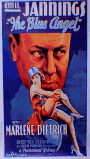
*Classic* The Blue Angel (Der Blaue Engel) (Germany - 1930)
Starring: Marlene Dietrich, Emil Jannings
Director: Josef von Sternberg
Plot: A repressed school-teacher decides to confront a cabaret singer who is bewitching his students, but ends up infatuated with her and so begins his descent into moral and professional ruin.
Review: Hailed as a masterpiece of German cinema, this is Marlene Dietrich's last film before moving to Hollywood. Dietrich is formidable here, portraying provocative intensity with a single look. Director von Sternberg creates another stark, dark look at the middle-class using the hypocrite professor to point a blaming finger at German society. The character's degradation is emphasized by some painful scenes, culminating in a pathetic clown act in front of his former students. The Blue Angel reflects the political situation of the times, as Germany was in economic ruin after WWI, and it remains even today a powerful and emotional piece of film-making.
Drama: 8/10

The Blue Butterfly (2004)
Starring: William Hurt, Pascale Bussières, Marc Donato
Director: Léa Pool
Plot: Afflicted with a debilitating, terminal disease, a young boy and his mother convince a reknown bontanist specializing in insects to take a trip with them to Cost Rica in search of a fabled Blue Butterfly.
Review: With a premise right out of an uplifting TV-movie-of-the-week subject, Blue Butterfly would seem to have an easy battle to win the hearts of audiences, but it's so lackluster and drab that it can't even hold our attention. Supposedly inspired by a true story, the film is meant as a journey of discovery for the sick young boy and one of redemption for the gruff, socially-inept older scientist as tepid father-son relationship forms between them, but the narrative brings on the pathos with the subtlety of a hammer making this overly sentimental and unconvincing. It even gets downright syrupy in the end, culminating in a downright "miraculous" recovery. There's such a lack of actual conflict during most of the film - death is seen as inevitable, and the tourist-level search for the elusive butterfly is never very exciting - that the inclusion of a terribly unlikely and rather unnecessary twist in the final act seems more a sign of desperation than a storytelling requirement. Forcing the young boy to wander the rain forest alone in the dark, it's a sequence that allows the filmmakers to provide some psychedelic first-person-view imagery of his surroundings and the teeming life around him. It's an interesting scene that reinforces how ineffective the rest of the film really is. This is a step back for local director Pool whose Lost and Delirious was a nuanced, tight and believable teen drama; it's never quite boring, but neither is it ever really engaging. William Hurt appears to be slumming it here, but he's a consummate professional and he brings a certain sensibility to the role. Quebec actress Bussières does an atypical role as the protective mom, but its one with little redeeming quality. The young Donato does all right, but his character isn't easy to like despite our need to sympathize with him, something that makes the rest of the film harder to swallow. Thankfully there's the odd look at the insect wildlife, which provides some Discovery-channel interest, but as drama goes it's a well-intentioned but dull effort. 
Drama: 4/10

Blue Car (2003)
Starring: David Strathairn, Agnes Bruckner, Margaret Colin
Director: Karen Moncrieff
Plot: Finding encouragement from her English teacher, a teenage student tries to cope with her difficult home life by expressing herself through poetry, but it's a support that turns to an awkward attraction.
Review: Harsh, heart-breaking, yet never going over the line to being sentimental, Blue Car is a brutally honest look at a teenager's coming-of-age. Her family life, coping with a disturbed younger sister and a perpetually distant, angry mother, is familiar and comes off as rank melodrama. Yet this is, in a way, vital to understand the much more subtle, growing emotional intimacy between teacher and student. The story also keeps things uncertain in regards to this relationship - is he just a mentor, a father figure, or is there more? All the way through the story pulls you in, going from a low-key inspirational story to one that's equally disturbing and unflinching, and one can't help but feel her pain and hopes every step of the way. The tension and troubles continue to mount until the climactic moment when the young poet makes her way to the national finals in Florida. It's a troubling yet cathartic moment that rings with a sense of bitter-sweet optimism. Though the story may be familiar, first-time writer / director Moncrieff makes it her own by keeping the focus on the young woman's perspective, giving us a glimpse of her heroine's psyche. The three leads really make the picture work. As the teen, Bruckner is convincing in an unforced performance, showing both teen angst and a strong will. Strathairn does well with a difficult role, keeping the dedicated teacher sympathetic through the worst of it. Colin, as the depressed mother, only has a one-note performance but it's effective. An ultimately heart-breaking drama, Blue Car is a low-key film that keeps you hooked until the last moment.
Drama: 7/10

Blue Streak (1999)
Starring: Martin Lawrence, Luke Wilson
Director: Les Mayfield
Plot: A jewel thief trying to con his way into a police station to retrieve a large diamond is mistaken for a real detective.
Review: Blue Streak, another in a series of comedy / crime capers for its star, is a surprisingly stylish, funny and well-paced concoction with enough action, zany antics and twists to provide a good time. Though unfair comparisons with 48 Hrs and Beverly Hills Cop have been thrown about due to its main plot (a black thief among a white police force), the film manages to work with its own rules. The comedy consists mostly of fish-out-of-water routines as the street-wise hero tries to blend in with his inadvertent surroundings and the usual Lawrence shtick of hamming it up for the camera. Fans of Lawrence's physical humor will lap this up, of course, but in this instance it works well for the rest of us, too. Even the action scenes, with the usual healthy offering of shoot outs and car chases, are well produced and actually quite exciting and fit in well with the rest of the story. The plot and events are ridiculous yet there are so many amusing skits and situations that we can't help but go along for the ride. As for the rest of the cast, their main reason for being is to act as the straight guys and sounding boards for Lawrence's antics, and as dumb-as-doornails cops they do just fine. Blue Streak isn't a genre-defining film, perhaps, but its aim to simply entertain goes a long way to making this a surprisingly enjoyable action / comedy.
Entertainment: 6/10

Blue Thunder (1983)
Starring: Roy Scheider, Candy Clark, Malcolm McDowell
Director: John Badham
Plot: A good cop, an ex-Vietnam helicopter pilot, is called on to test a new, heavily-armed copter destined for crowd control but uncovers a murderous conspiracy to use its power for a much darker scheme.
Review: The paranoid techno-thriller Blue Thunder is very much a product of the early '80s, and one of the better examples of the early years of the blockbuster action flicks. While the first half of the film has its share of action, violence, humor and melodrama, there's also a strong undercurrent of political themes, principally on the Orwellian technology available to governments and the potential to eradicate our privacy. The script also includes many dramatic sub-plots, such as Murphy being a Vietnam vet who is still having flashbacks and has problems with his relationship, sub-plots which give color to the film but never really go anywhere. As the plot builds up to its climax, the story's plausibility, teetering up until then, falls by the way of the silly. In the end, all of it was mere preliminary for the action finale, an impressive series of well-executed aerial dogfights between the buildings of L.A. Some of these scenes may not be as effective as the latest CGI offerings but they're still readily exciting. Bandham (Saturday Night Fever, Wargames) directs with a good flair for pacing and the cinematic, showing off the copter and its prowess in surveillance and firepower to best effect. The cast is OK, with Scheider doing another fine turn as a likeable, down-to-earth hero while McDowell starts off here his second career as a cocky, despicable villain. Though somewhat dated, with its solid storyline and classic combat sequences Blue Thunder is one of the decade's highlights in Hollywood action films.
Entertainment: 7/10

Bollywood Hollywood (Canada - 2002)
Starring: Rahul Khanna, Lisa Ray, Rishma Malik 
Director: Deepa Mehta
Plot: A wealthy Indian-Canadian hires an Indian-looking escort to pose as his fiancée for the duration of his sister's wedding in order to satisfy his family only to fall for her in the end.
Review: A Canadian take on the Bollywood thing - the Indian version of Hollywood that produces three-hour dramas filled with song-and-dance extravaganzas - Bollywood Hollywood is a delightful little culture-clash comedy drama with a very local flavor. Those familiar with the hit Pretty Woman will see much resemblance in the plot, but it rises above its inherent silliness thanks to a large dash of community self-ribbing and even a dash of very Canuck angst. There's also a certain sense of vitality and a view of Indian culture (even displaced in Toronto) that makes the effort feel fairly exotic. Writer / director Mehta might have gone out on a limb to direct such fluffy fare after such heady, deep, and controversial dramas as Earth and Fire, but it's obvious she knows what it takes to make a mainstream, crowd-pleasing endeavor. The usual melodrama and family conflicts are present, of course, and there's even time for a few decent song-and-dance routines to be had, though these are nowhere near as effervescent or colorful as true Bollywood fare. What makes the proceedings really effective, however, is the terrific play between leads Khanna and stunning model-turned-actress Ray as well as Mehta's intimate attention to her characters and their situations. Sure, Bollywood Hollywood is a lightweight affair, but it's one that mixes well its Indian and Canadian roots to make for a tasty dish.
Entertainment: 7/10

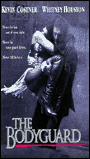
The Bodyguard (1992)
Starring: Kevin Costner, Whitney Houston
Director: Mick Jackson
Plot: An ex-Secret Serviceman turned bodyguard for hire falls for the glamorous, popular singer he has been hired to protect from a killer who has been sending her strange death threats.
Review: The Bodyguard seems to have been aimed at both movie-going sexes, with a plot mixing equal parts romance and thriller, but in the end neither one works very well with the romantic aspects coming out the worse for wear. There's just no denying that the whole thing is rather silly, yet those who are willing to put their minds on neutral and go along for the ride will find that the action / thriller bits are adequately presented for the most part, and director Jackson (Volcano, L.A. Story) keeps things moving along at an easy pace. Houston is at her best playing the haughty diva, and the sequences where she sings are, of course, impeccable; harder to convince are her scenes where she is required to emote and make us believe she's a "real" person. Costner, however, is great as the experienced professional whose lifestyle has kept him a loner, and he effortlessly, and convincingly, fits into the role; it's not a stretch by any means, but he's easily the best thing in the movie. The biggest problem, and the death toll for any romantic effort, is that the chemistry between them is tepid at best, and it's kind of difficult to accept that these two very different people would ever start up an intense relationship. Also bringing the film down is that the mystery of the killer, though it may be surprising to some, is rather bland. And the poorly executed finale, which is supposed to take place right in the middle of the Oscars of all places, is plain ludicrous and forced. Despite this, most of The Bodyguard's running time is not that bad for those looking for some guilty pleasure, and fans of either star will have a good time, but it's a fluff piece that leaves all its potential untapped.
Entertainment: 4/10

Bombay (India - 1995)
Starring: Arvind Swamy, Manisha Koirala, Nasir
Director: Mani Ratnam 
Plot: After facing scorn and protests from both their families, a Hindu reporter and his Muslim wife move to Bombay and raise twin sons but religious riots and arson engulf the city in December 1992.
Review: A well-paced melodrama on the religious intolerance facing India, Bombay, with its down-to-earth characters and story makes a nice change from the usual Bollywood extravagances that usually make it to North American shores. Wearing its heart on its sleeve, the film however is a mixed bag with high ambitions: a love story, a preaching morality tale, and a dramatized look at a dark spot of India's history all rolled into one. Though popular on its release, it also opened with much controversy due to its subject matter and its depictions of both Hindus and Muslims; though not everyone was pleased, the filmmakers do seem to have taken great care to balance out both groups. The film starts off as a contemporary love story with all the passion and family drama associated with two people from different backgrounds going against their parents' wishes and is on occasion both humorous and touching. Here, like most Bollywood productions, songs are interspersed and usually work well with the story and these are lively, if not spectacular or original. The last hour is much bleaker, taking us into the terrifying time of the city's religious riots with scenes that are utterly convincing. Yet though some instances depict well the fear and hatred that sparked the events, ones that also consumed mobs to continue their rampage for days, much of it is also too exaggerated to face the issue honestly. The message being passed on of having to "live together" as the people of a single country is both important and worthy but by forcing the issue with long-winded speeches, and generally coming across so bluntly, the filmmakers skirt the moralizing. This being for a large part an intimate portrait of nuclear family life and of the strife facing them from all sides, it's important that we feel for the couple and Ratnam (Dil Se) provides some fine cast direction even though the acting itself isn't always top notch. The leads, especially, seem like an odd choice at first but both grow on us while the rest of the cast works through their scenes well enough. There is much melodrama to be had, but there are moments of true power as well; these mixed with all its different elements make Bombay a fine example of a mainstream Indian success.
Drama: 6/10

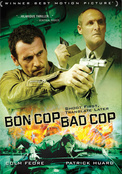
Bon Cop, Bad Cop (Quebec - 2006)
Starring: Patrick Huard, Colm Feore, Lucie Laurier
Director: Eric Canuel
Plot: Two detectives with very different methods from adjoining Provinces - one French Quebecker, one English Ontarian - are forced to partner in order to stop a deranged hockey fan from killing off key businessmen.
Review: Mixing culture-clash comedy with generic action, and all with local flair, the Quebec-produced Bon Cop, Bad Cop comes off much better than expected. As a modest budget cop-buddy movie, it works pretty well - the usual cop film clichés abound, of course, with the bloody murders, the cat-and-mouse games, the car chases, etc. What makes it special is pitting symbols of the two provinces against each other for comic effect. Playing to the cultural stereotypes, the Shakespearean trained Feore, as the straight-laced officer from Ontario, and comedian Huard, as the charming unkempt rogue from Quebec, make a great odd-ball team much like Gibson and Glover did in Lethal Weapon. Both complement each other perfectly and their altercations - be it on interrogating suspects, entering premises, or family life - make up for much of the fun, providing some nice insights into the film's main theme of French Canadian and Anglo Canada "meeting of the cultures". Touted as the first truly "bilingual" film (French and English dialog have even film time), the language issue that is so much part of the social landscape is made fun of, as are the cultural differences. As mild social commentary, it's all good fun with both sides getting their due - it may not have been the point, but the movie will probably help bring the two sides together better than 10 years worth of political speeches has. Add to that some major ribbing of the great Canadian pass-time (that's hockey, by the way), some sentimentality on divorced dads, and you've got a nicely rounded package. Local director Canuel, who made his name with local dramas such as Le Survenant and The Last Tunnel, proves that Quebec mainstream cinema can compete - and beat - most Hollywood offerings. Warning, though: the constant swearing, gritty murders and steamy sex scene rate this as an adult film. Of note, the supporting cast also provides some colorful characters, including cameos from Louis-José Houde as a fast-talking coroner, Pierre Lebeau as an English-challenged Lieutenant, and funny-man Rick Mercer as an obnoxious hockey commentator. If there's one gripe it's that the humor of the first half of the movie gets lost as the cops get closer to their quarry, and the film then follows the generic cop movie formula. Thankfully, even in these spots the tale is still better than the average fare. Though you might need to be Canadian to really get the most out of the film, even audiences who may not get the cross-cultural references or the French slang, Bon Cop Bad Cop is an amusing concoction.
Entertainment: 7/10

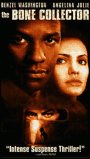
Bone Collector, The (1999) 
Starring: Denzel Washington, Angelina Jolie, Queen Latifah
Director: Phillip Noyce
Plot: A paraplegic New York forensics detective enlists the aid of a young, street smart female cop to help him catch a vicious serial killer who leaves a complex series of clues after each murder.
Review: The Bone Collector is a decent, well-paced, and entertaining mystery-thriller from genre director Phillip Noyce (Dead Calm, Clear and Present Danger). The film could have been edited a bit better, and some of the scenes lack the necessary tension for this kind of movie, but there's enough here to keep us interested. The plot itself is very formulaic, but actors Washington and Jolie make a great "odd-couple" pair and that helps raise the film above the typical Hollywood fare.
Entertainment: 6/10

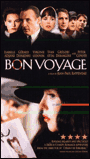
Bon Voyage (France - 2003)
Starring: Isabelle Adjani, Gerard Depardieu, Virginie Ledoyen
Director: Jean-Paul Rappeneau
Plot: As Germany invades Paris, a writer gets entangled in an old paramour's crime leading to a race to get a physicist and his experiment out of France before the Nazis capture him.
Review: A film that harkens back to the by-gone days of Hollywood's B&W era, Bon Voyage is a fanciful WW2 adventure yarn told with a distinctive French flavor. The story mixes in some serious commentary on the state of the French government and the hardships of the displaced population, yet buoys it with some light-hearted romantic comedy, playing well with the ensemble cast. If the change in tempo may sometimes be a bit extreme, it does breezily move along from one sub-plot to another, bringing his diverging characters from different social circles crashing into each other with amusing results. And even if the script takes a rather scattershot approach to the different storylines and relationships, it's all a delectable concoction. After the terrific Cyrano De Bergerac and The Horseman On The Roof, director Rappeneau has an easy time moving into a more modern era, shooting the film with masterful commercial flair. Showing off the solid production values (some effective shots of pre-war Bordeaux), he brings a very 1940's-styled approach to the film that will make one hard-pressed not to think of Casablanca - in a good way. It's unfortunate however that while hero Grégori Derangère and sidekick Yvan Attal have a certain easy charm that work well with this sort of affair, the big name stars like Adjani, as the pampered starlet, and Depardieu, as the minister, are less than convincing (or is that the point?). Still, as an expensive homage to the grand melodramas of old, Bon Voyage hits just the right notes.
Entertainment: 6/10

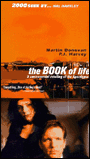
The Book of Life (1999)
Starring: Martin Donovan, PJ Harvey, Thomas Jay Ryan
Director: Hal Hartley
Plot: Having second thoughts on starting the Apocalypse, Christ joins the Devil in New York on the eve of the new millennium to discuss the coming end of humanity over a few drinks.
Review: Indy auteur Hal Hartley has cooked up a clever, made-for-TV feature as part of the international series "2000 Seen By...". The film was shot on a shoe-string budget, with a hand-held video camera, using strong backlighting, distinct colors, and many crooked camera angles giving it a harsher, more "music video" feel. The story itself promises much, but the characters end up seeming rather petty and a little too "human". There are some high points, as when the two supposed adversaries discuss theology in a bar, we discover that the Book of Life is actually an old PowerBook, and that a lawyer is helping bring about Armageddon. There just isn't enough meat to the film: we see the characters walk around in slow-motion a lot, the dialogues are rare, and though there are some witty repartee and theological ideas, the film doesn't really try to break new ground. An amusing, interesting exercise, but one that had the potential for more.
Drama: 5/10

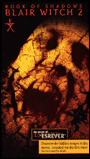
Book of Shadows: Blair Witch 2 (2000)
Starring: Kim Director, Jeffrey Donovan, Erica Leershen
Director: Joe Berlinger
Plot: After spending a strange night in the woods on the ruins of a famous haunted location, five thrill seekers discover that they have brought something evil back with them.
Review: After the amazing critical and box-office success of the independent production The Blair Witch Project, a sequel was inevitable. Aiming for something altogether different with more money, better actors, and slicker production values, however, does not mean a better film. The theme this time around is the distinction between our perception of reality and that captured by our own technology, of group hysteria versus actual supernatural events. These are promising ideas, and the mock-umentary beginning is hilarious, but unfortunately, the subject is given only passing development before taking a back seat to silly omens and plot twists. In fact the film falls into the tired teenage ghost story / slasher genre, with a cliché-ridden plot that borrows from past horror flicks to rather poor effect. Worse, by showing everything in graphic detail, by explaining events ad nauseam, the film loses the very essence of the original, that of the mystery and fear of the unknown. Whereas the three protagonists of the first film were believable and connected with the audience, making what was happening to them all the more horrific, the ill-fated group here is made up of ridiculous stereotypes (including a Goth and a Wiccan) that are wholly unsympathetic. Director Berlinger (Paradise Lost) drops the original's documentary style and opts for a more straight-forward narrative. He manages to get the eerie atmosphere right with a few well-mounted shots, and some moments are pretty effective, but ultimately these instances are minor and it soon feels like a tired re-hash of other films. Book of Shadows can't really hold a candle to the originality, creativity, or horror evident in the now-legendary first installment and, though there are some decent moments and ideas, ends up only as passable midnight fare.
Horror: 4/10

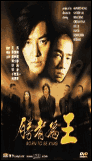
Born To Be King (Hong Kong - 2000)
Starring: Ekin Cheng, Jordan Chan, Hsu Chi
Director: Andrew Lau
Plot: After marrying the daughter of a Japanese crime lord, a young Hong Kong gang leader is set up for the murder of a rival for control of a Taiwanese syndicate and calls on his old pals for help.
Review: Born to be King, the sixth and last (to date) installment in the Young and Dangerous series, isn't nearly as satisfying or criminally intriguing as the cult-classic first three, and it's clearly showing signs of losing steam and interest. The story promises some interesting political machinations involving the triads scrounging for influence with the new Taiwanese government just elected to power, but soon dispenses with any cleverness and opts for the usual bland conspiracy stuff. This formulaic, unoriginal entry has the same general plot, twists and melodrama as its predecessors, only now it's approaching self-parody. This has become a laughable soap opera, with too many shallow characters and sub-plots to keep track of, going so far as recycling actors who played previously killed characters coming back in one form or another. Those who haven't followed the series are bound to be confused or wonder what the hell the fuss is about - only fans will really get one last kick at seeing these characters in action once more. Oops, sorry, did I say action? Scratch that: apart from a few gunshots and a short practice swordfight there's little action to be had anywhere. There's also a surprising lack of tension throughout, what with the same kind of confrontations, same type of back-stabbing, same plot conventions as before, only this time they're much too dragged out and self-important. More money was thrown into the production, and it is a good looking, well photographed product, but one with bigger and bigger scenes, larger crowds, and less actual story. The genre-acting is decent, and both Jordan Chan and Ekin Cheng are charismatic enough to keep our attention, even if they can now play these roles in their sleep. Hsu, however, is bloody annoying as Cheng's ditzy girlfriend. In the end, Born to be King is a tepid entry in the triad genre, and a disappointing final chapter to a fine series.
Entertainment: 4/10

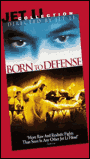
Born to Defense (Hong Kong - 1986)
Starring: Jet Li, Kurt Roland Petersson
Director: Jet Li
Plot: Returning home at the end of WW2, a Chinese officer discovers that his community is being overrun by abusive, brutal American soldiers and vows for revenge in and out of the local boxing ring.
Review: A surprisingly dark and violent starring vehicle for the popular Li that harkens back to HK films of old, Born to Defense is another fine showcase for his action-star talents, if not his directorial ones. The story has the same kind of dull, melodramatic filler that plagued 70's martial arts films - in this case, it's about the down-trodden Chinese war vets, their dishonored families, and the bullying, conquering US soldiers. What will probably be most shocking for Western viewers is the strong anti-American sentiment that runs throughout the film, a rationale that isn't really clear. Thankfully, though the story is rather trite the fighting is solid old-school kung-fu: the kick-ass boxing match at the center of the film against a towering opponent that goes from the ring to full-out brawl is terrific. Even better, the climactic showdown reminds one of Lee's Return of the Dragon, but with more inventive and dynamic elements mixed in with the excellent choreography. It may not be as slick or powerful as his later efforts (say like Fists of Legend) but there's a brtuality to them that makes it work. A young and virile Li does his best Bruce Lee impersonation and though he tries hard, he doesn't show the easy charm that the '70s icon had in spades. Yet if his acting is horrible, all is forgiven when he steps up for the action sequences as he's in great form. Remarkable only as being his only directing gig as well, he doesn't quite fare as well behind the camera and the film shows lots of rough edges even if he was aided by some long-time collaborators. Of note as well is the opening World War II sequence as Li and his company heroically repulse a Japanese tank attack; much effort was put into it but it's over-the-top and feels misplaced. Though Born to Defense does have its boring parts and isn't nearly as polished or stylish as his later films, the brutal action scenes easily make up for the film's other shortcomings. And for fans of Li, that should be enough.
Entertainment: 5/10

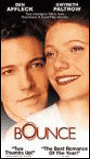
Bounce (2000)
Starring: Ben Affleck, Gwyneth Paltrow, Joe Morton
Director: Don Roos
Plot: An egotistical ad executive gives his plane ticket to a stranger stuck at the airport, but when the plane crashes killing everyone on board his guilt pushes him to find forgiveness from the man's widow.
Review: Writer / director Roos has gone mainstream with Bounce, a high-concept romantic drama that is aimed squarely at the widest audience possible. Gone is the wry, sardonic humor of his previous indie film The Opposite of Sex, replaced with a watered-down version of what could have been an ambitious drama. The plot proceeds exactly as one would expect, with little surprise or revealing social commentary, but then it's good enough to keep us watching, and the dialogue does have its moments. The first half of the film is rather involving as we get to know this jerk and see the ups and downs of his post-accident struggle, and then onto the first steps of his courtship with the widow. The story focuses on his guilt, his feeling responsible for the husband's death, and his fear that the secret of his connection to her will be revealed. The problem is that while the blossoming relationship is affecting and the characters as played by Affleck and Paltrow are endearing enough, most of the situations (especially in the second half) just feel unconvincing and manipulative. Worse, the film falls into the trap of overbearing sentimentality in its final segment, and really crashes when it forces Affleck into a live-TV court appearance where he apologizes for his mistakes as Paltrow watches - talk about contrived! Even the characters' lives seem limited to their relationship - they rarely work, the kids take up no time at all (feeling more like a plot device than anything). Still, Bounce does have its moments and for undiscriminating viewers it ends up a pleasant enough romantic drama, if a tad uninspiring one.
Drama: 5/10

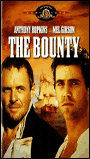
The Bounty (1984)
Starring: Mel Gibson, Anthony Hopkins, Daniel Day-Lewis
Director: Roger Donaldson
Plot: After an arduous expedition to the Polynesian islands, a ship's crew turns against its cruel captain in the hopes of staying with the inviting locals.
Review: A slick, if overlong, adaptation of Richard Hough's account "Captain Bligh and Mr. Christian", The Bounty has a lot going for it. For one, it has two bankable leads in Hopkins and Gibson; for two, the vibrant cinematography of the lush Polynesian islands and the magnificent waters is superb; and for three it's working from a solid script by Robert Bolt (Doctor Zhivago, Lawrence of Arabia). Yet despite Donaldson's (No Way Out, Thirteen Days) competent directorial effort the tale, though definitely modernized and embellished, keeps its audience at a distance, never quite grabbing one with the human drama. A tighter reign on some of the scenes' length would also have done wonders, and the minimalist score by Vangelis gets tiring after a while. Unlike the popular 1935 version of Mutiny on the Bounty starring Clark Gable, Hopkins' Captain Bligh is really the center of the film; he's portrayed as a rather decent man, just one conflicted and unsure of himself who ultimately tries to hide his own failings and fear of losing his command through acts of viciousness. Gibson's Fletcher Christian is turned into somewhat of a romantic, one who wouldn't convince any rabble to mutiny. Rounding off the cast is a young Day-Lewis as the pompous First Mate, as well as Liam Neeson and Laurence Olivier in a brief role. But while the casting is first class, the conflict between these men isn't quite as convincing as it should be. Still, The Bounty remains a timeless tale of human failing and strife, and with its pedigree of cast and visuals it's one that still works the way it was intended.
Drama: 6/10

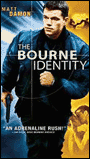
The Bourne Identity (2002)
Starring: Matt Damon, Franka Potente, Clive Owen
Director: Doug Liman
Plot: Saved by a fishing trawler off the Mediterranean, a victim of amnesia with some incredible abilities desperately searches for clues to his lost memory with the help of a German woman as CIA operatives try to assassinate them.
Review: The best-selling Robert Ludlum action thriller The Bourne Identity has always been a great choice for a feature film and, hoping to create a new franchise with a bankable star, the studio has opted for a modern remake. Unfortunately, for this second screen adaptation the intricacies of the book go by the way side. Instead of the mystery and rebounds of the original work, what we get here is a pretty straight-forward (and rather banal) watered-down story about a reformed assassin going against the "bad guys" of the CIA. It's been done before, and this version doesn't really provide any twists or surprises to make it original. However, director Liman (Swingers, Go) has got a definite verve and imbues the proceedings with an ever-present energy, and is particularly good at bringing the action sequences to life in an efficient, exciting manner. Some of the better of these scenes includes a well-done car chase through the streets of Paris, and some excellent hand-to-hand fighting sequences that make Damon look absolutely lethal. This isn't a slam-bang action flick, though, so there's lots of time spent on getting to know the characters, and elevate the tension, with the usual spy stuff thrown in for good measure. The performances from Damon and Potente are solid and believable, adding a good dose of dramatic weight but in supporting roles, Danes and Owen have only throwaway roles as CIA operatives and don't make much of an impression, which is too bad: a pair of such talented actors should have been given the chance to add a little more zing to the characters. Thanks to a smart script, efficient thrills, and two great leads, The Bourne Identity is engaging, if unoriginal, entertainment.
Entertainment: 7/10

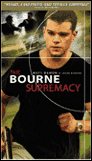
The Bourne Supremacy (2004)
Starring: Matt Damon, Franka Potente, Joan Allen
Director: Paul Greengrass
Plot: Still suffering from amnesia, an ex-CIA assassin is forced back into the espionage game after being framed for the murder of a field agent and becoming once again the target of an international manhunt. 
Review: The sequel to the adaptation of the Robert Ludlum spy thriller The Bourne Identity, The Bourne Supremacy knows well enough not to stray too far from the formula that made the first film a success. In fact, audiences are subject to pretty much more of the same, with the plot closely following the first's basic premise and approach, only with the same elements upped a notch. This is entertainment, with more emphasis on the thriller and suspense aspects than on pure stylistic exercises. Not to say this isn't a slick, efficiently paced package, but the film goes back to the movies of old, where story was king and action was done by stunt people not computers as Hollywood has churned out for its summer blockbusters. The search for our hero's identity is still very much a part of the story, only this time the tables are turned on the cat & mouse game with The Agency. The suspense is good, and the espionage elements are fun, but if there's one low point it's that the film remains as cold as the characters it portrays. In fact there's little drama here and even the calculated twist 20 minutes in to turn the film into somewhat of a revenge flick doesn't really hit the emotional mark. But though the script sometimes gets mired in the clichés of the genre (the taped confession, the corrupt agents, etc.) and Ludlum's book may be pretty far behind, the film does keep the spirit of the original work it also adds a fine sheen to the tried and true formula. There's crosses, double-crosses, lethal agents, globe-trotting through India, Berlin, and Naples, hi-tech gadgetry, and a peek at a secret service gone amok. And let's not forget the necessary main action sequences: an narrow escape on foot from a gauntlet of policemen, and intense hand-to-hand fight in closed quarters, and an extended climax involving a car chase through the streets of Moscow that's one of the best, realistic, and downright sensational car chases since Ronin and The French Connection. Having only done small-scale dramas, Greengrass (The Theory of Flight) may have been a strange directing choice but he sees his way handsomely through the sometimes convoluted turns and keeps events moving along and exciting; we know the hero will be victorious, but you can't wait to see what happens next. The star cast does well with the limited character development, and Damon makes for a believable, and even sympathetic, killing machine, though the talented Brian Cox and Joan Allen seem rather wasted here. In an era where James Bond has become just another freeze-packed video-game hero, it's nice to know some films are filling the gap. It's not perfect, but The Bourne Supremacy is a terrific ride and a solid summer hit that's actually superior to the original.
Entertainment: 7/10


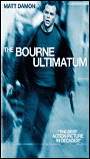
The Bourne Ultimatum (2007)
Starring: Matt Damon, Julia Stiles, David Strathairn, Joan Allen
Director: Paul Greengrass
Plot: A deadly agent struggling with memory loss tries to finally uncover his past while being hunted across the globe by a covert government agency working within the CIA.
Review: The third installment in suprisingly effective thriller / action series, The Bourne Ultimatum tidies up some loose ends but really shines when it sticks to the basics. Like the previous installment, the film has little to do with the original novel by Robert Ludlum except for the title and main character. The derivative script, about a rogue CIA covert ops group trying to cover its tracks, may be lacking but there's no denying the expert direction and general savvy of its filmmakers, bringing a sense of excitement and personal stakes. Globe-trotting through Europe, Morocco and New York, the action is realistic and brutal, relying exclusively on real escapades than CGI ones - a foot chase through Tangier rooftops, a close-quarter brawl and a car chase through Manhattan are memorable highlights. Greengrass (United 93) returns to the helm after his successful take on The Bourne Supremacy bringing back the in-your-face cinematics and handheld cameras, providing an in-your-face feeling of danger at every turn. Damon's CIA assassin doesn't take the mold of the typical action hero - he doesn't have a wisecrack, he's not infallible, and his pensive, sometimes intense stare bellies the efficient killer that he is - but he's perfected the role. A strong supporting cast including Strathairn, Joan Allen and Stiles as CIA operatives all looking for Bourne for different reasons helps move the usual cloak-and-dagger drama along. In the end, The Bourne Ultimatum is a smart, thoroughly engaging spy thriller that has more satisfying action sequences than most of the summer's blockbusters combined. If only it had a better script it would have been a real keeper.
Entertainment: 7/10

Bowfinger (1999)
Starring: Steve Martin, Eddie Murphy, Heather Graham
Director: Frank Oz
Plot: A cheap, talentless independent film-maker takes a last shot at hitting it big by shooting a bad science-fiction script and shooting a major action star without the star's knowledge.
Review: Steve Martin has always been at the edges of the comedy business, and with Bowfinger he's back in fine form. In the good-natured way it pokes fun at the film-making process, actors and the Hollywood life-style, and the way it always takes an endearing look at all its cavalcade of characters, the film is more a light-hearted farce rather than a biting satire of Tinseltown. Some of the scenes don't always work, but the the guerilla shoot is clever and amusing, showing off a good, if more than slightly ridiculed, understanding of the work involved in filming. The cheapie fictional film that is at the center of their endeavors is in itself a great ode to heartfelt, but bad, bad movie-making, and the concluding segment is just as much a clever, apt spoof of 70's chop-socky movies. Thankfully, the cast takes it all in stride, hamming it up to great effect. As Martin plays it, Bowfinger himself is a modern-day Ed Wood, while Murphy, in a great double role, plays both the paranoid action star trapped in a Scientology-like cult and his slow-witted, low-budget stand-in. In the end, with director Oz (The Score) at the helm, a clever Martin script, and two solid Murphy performances, Bowfinger may not quite be the hilarious romp it wishes to be, but it is an amusing, if shallow, bit of entertainment.
Comedy: 6/10

Bowling for Columbine (2002)
With: Michael Moore, Charlton Heston, Marilyn Manson
Director: Michael Moore
Plot: Through interviews, news footage and various antics, documentarian Michael Moore takes a hard look at the American love-hate relationship with fire-arms.
Review: From the opening moment that left-wing agent provocateur / filmmaker Michael Moore (of Roger & Me and TV Nation fame) walks into a bank that offers free rifles to anyone who opens an account ("Doesn't it seem strange to hand out guns in a bank?"), you know Bowling for Columbine is going to be more than a drab documentary on the U.S.'s fascination with firearms. While the manner in which the film tackles its subject might be tongue-in-cheek (and its exposition is often absolutely hilarious), the film asks some serious questions regarding America's gun culture. Using a fine mix of interviews, South-Park styled cartoons, news footage and old-fashioned provocation, Moore takes us on a harrowing trip, starting from the 1999 Columbine High School massacre, to discover why more than 11,000 people die from gunshot wounds in the US every year and why gun violence is so ingrained in the American character. The film clinically shoots down the various boxed reasons given for such behavior: violent films and video games? violent history? accessibility to guns? No, no, and no: other countries have the same, or worse, than the US and don't have the same death tolls. Moore blames the media (and especially TV news) for creating the present climate of fear that has turned us paranoid; add to that a deep-rooted xenophobia (historically towards Blacks and Hispanics), and you've got a dangerous mix. Some of the best moments are during the interviews with such diverse subjects as rocker Marilyn Manson (who impresses), Charlton Heston (the National Rifle Association president does not escape unscathed), and the intensely scary James Nichols, brother of the Oklahoma City bomber, who agrees people should be armed to the teeth with everything but atom bombs ("there are wackos out there"). It's unfortunate that after the first hour Moore shows off his tendency to wander off onto tangents that aren't quite as powerful as his opening statements, go on for too long to prove a point, or are just downright sloppy (a trip to K-Mart headquarters with bullet victims or his gushing on Canadian society). The doc also makes parallels between individual violence in the US and American state-backed violence, a leap that is rather tenuous though the details and facts are both horrific and thought-provoking. Yet the open structure of the doc allows for Moore to touch upon many different things and lets his blue-collar sensibilities shine through. In the end, the film isn't so much about guns as it is about a culture of fear and how that fear leads to violence, both here and abroad. Bowling for Columbine is meant to be both an amusing and downright scary look at America's obsession with guns, and more often than not it works in driving the point home in ways we won't soon forget.
Documentary: 8/10

Les Boys (Quebec - 1997)
Starring: Marc Messier, Rémy Girard, Patrick Huard
Director: Louis Saïa
Plot: A home-grown hockey team made up of die-hard fans of sometimes dubious talent from many different backgrounds must win against a semi-professional team or risk losing their coach's bar to a local hoodlum.
Review: The local box-office smash Les Boys is a fun-loving Quebec production that doesn't aim very high beyond its formula roots but manages to be an enjoyable bit of fluff. The cast is a veritable who's-who of local actors all playing to stereotypical type (the womanizing media guy, the gay lawyer, the swindling real-estate agent, etc.), and all surprisingly doing their own hockey plays. Some of the more clever, colorful dialogue and some of the general political and social points may not translate well to a non-Quebec, non-French speaking audience, but the charm and sense of camaraderie remains evident no matter the culture. Though the outcome is never in doubt, the final hockey match is still quite amusing as the home team tries every underhanded method of scoring, and director Saia creates enough tension to make for an entertaining confrontation. The most surprising moments, however, occur during the time off the ice, as the group of buddies who happen to see each other only for the game end up getting involved in each others lives. These surprisingly dramatic and affecting parts help raise the movie a notch above the usual sports flick. This is by no means a slick production, and the characters are as clichéd as they come, but with some solid performances, slapstick humor and some genuine laughs, Les Boys is a low-brow little comedy that's quite engaging.
Entertainment: 7/10

Les Boys 2 (Quebec - 1998)
Starring: Marc Messier, Rémy Girard, Patrick Huard
Director: Louis Saïa
Plot: A home-grown team from Quebec competes in an international amateur hockey competition in Chamonix, France and faces a series of worsening misadventures leading up to the finals.
Review: Slicker production values in this obviously bigger-budget sequel to Les Boys, with higher stakes, fiercer competition, and greater problems, of course, as required for a by-the-book sequel. The low-brow humor this time around is not limited to poking fun at each other, but at parodying the French as well. At least it knows to retain the elements that made the first one a hit, extending the scope of the story but keeping the laughs easy and peppering the film with the heart-tugging moments that its audience expects. The actors have improved on their playing technique which allows for more intricate hockey action here, but the characters haven't grown up a bit since last we saw them and are as thick as ever, but then why change a good thing, comedy-wise? In the end, Les Boys 2 is not as original or as developed as the first installment, but the laughs are there and the sense of camaraderie is still in evidence and for a sequel that's enough to make for a good time.
Entertainment: 6/10

Brainstorm (1983)
Starring: Christopher Walken, Natalie Wood, Louise Fletcher
Director: Douglas Trumbull
Plot: Two company researchers develop a virtual reality machine which records and vividly plays back people's actual experiences and feelings, attracting the interest of a shady government agency.
Review: Before the idea of computer virtual reality ever really came to life, there was the SF idea behind Brainstorm, that of recording real-life experiences on tape. The first half of the film is solid science-fiction, exploring the possibilities of a machine that could provide such "shared" experiences, emotions and memories, from playing piano, to hand-gliding, to (in a very human shift) having sex. The idea of it being a whole new instrument for mutual understanding is also well presented, bringing up the best sequence in the film when estranged husband and wife Walken and Wood discover their true inner feelings for one another and (of course) get back together. It's a bit smarmy perhaps, but its a terrific romantic piece. Even the computer "hi-tech" shown here, though terribly outdated, still works in the context of the film. Unfortunately the second half of the film, as the two researchers battle big-business and military pressures to use the device for profit and war, is routine. Worse, most of the budget seems to have gone into a long-winded scene of a robotic assembly line going haywire to mask some data theft, a scene that's both ridiculous and unintentionally hilarious. The final act wants Walken to get hold of a tape of his co-worker dying, to explore the real "final frontier". Too bad the climax then is way too outwardly spiritual and insists on a depiction of a religious "Heaven" (including flying angels collapsing into a colorful void). Wood, in her final screen appearance before her untimely death during production, isn't in top form but doesn't embarrass herself and Walken plays the hero as a rather sympathetic (if stoic) character. B-movie maven Fletcher as the lead scientist is a standout, however. Then again, it's not the performances that matter - the concepts and primitive special effects are meant to be the real attraction here. Director Trumbull (the special effects guru who did 2001: A Space Odyssey and Blade Runner, and who's only other directorial work is that 70's cult classic Silent Running) does well with the inter-personal scenes but seems to have wanted more to impress audiences with his visuals, something that gets lost on the small screen. As premises go Brainstorm had modern takes on VR such as The Matrix beat by 15 years. It's not quite a classic, but for fans of the genre, it's an interesting and mostly engaging 80's sci-fi flick.
Entertainment: 6/10

Bram Stoker's Dracula (1992)
Starring: Gary Oldman, Winona Ryder, Anthony Hopkins
Director: Francis Ford Coppola
Plot: The age-old vampire Dracula makes his way from Romania to 19th-century London to find the resurrected soul of his long-lost love, leaving a trail of blood and violence in his path.
Review: Bram Stoker's Dracula is a sumptuous retelling of the classic vampire tale, and one of the most impressive, and enthralling, adaptations yet. Parts of the narrative are straight out of the original Stoker novel, while others are pure fabrication, with a particular focus on the creation of a love story instead of the usual horror schlock. Not to say that the pleasures of the flesh and sudden violence don't intermingle to great effect; though limited in its excesses to maintain a teen rating, the blood does flow and the erotic elements are definitely still in place. Director Coppola (best known for classic, "serious" works such as Apocalypse Now and Godfather) shows an eagerness to have fun with the subject matter. Even technically speaking, the director has never been more inventive, showing off some beautiful, impressive cinematic juxtapositions, haunting imagery and inspired camera shots. Indeed, the overall surreal visual style is splendid, with some scenes helping make this the most eerie of vampire films, making even the Victorian London settings seem exotic. The brilliant imagery, top-notch art direction and lavish production values all help imbue the film with a spectacularly evocative atmosphere, one which is mysterious, foreboding, and where the backgrounds are alive with shadows. More than any other element, however, it's Oldman who steals the show. He is absolutely terrific as Vlad, combining the pathos of a tortured, lovesick soul and the evil relish of a damned one. His character, the real focus of the story, is shown as a complex personage and, once his sad story comes to light, actually comes off as a most sympathetic character. Hopkins, playing the classic Van Helsing role, is also delectable, playing his character with over-the-top abandon and irreverence. The rest of the cast, made up such recognizable actors as Keanu Reeves, is excellent in playing the part of what amounts to stock characters. After saying all this, it's too bad to say that the script can't help but fall into the usual trap of campy excesses at times, something that breaks some of the obvious tension of the film. All told, however, there's no doubt Bram Stoker's Dracula is grand, exotic, and thoroughly enjoyable big-budget spectacle.
Entertainment: 8/10

Breaking the Waves (1996)
Starring: Emily Watson, Stellan Skarsgard
Director: Lars Von Trier
Plot: After being paralyzed in an oil-rig accident, a man encourages his young, religious wife to seek out other lovers. Desperate to heal her husband, she obeys and soon finds herself at odds with herself, her family and her community.
Review: Breaking the Waves is a study of the sexual intimacy and relationship between a woman ready to sacrifice everything for love and her husband. The script doesn't compromise in its direction, showing often ugly, uncomfortable scenes. Excellent acting from all sides, especially by Emily Watson as the central character. Director Von Trier tries for intimacy here, as the subject matter requires, by using extreme close-ups, jumping the camera back and forth between characters, and never holding the camera steady for long, creating an almost documentary feel to the film but one that quickly becomes irritating as the film progresses. The story takes a turn into the fantastical at the very end, and loses some of its grittiness, but also ends on a high note after so much tragedy. A disturbing, courageous film, but not to everyone's taste.
Drama: 8/10

Bride & Prejudice (2004)
Starring: Aishwarya Rai, Martin Henderson
Director: Gurinder Chadha
Plot: An unlikely romance blossoms between a beautiful, independent Indian woman and a proud, arrogant American entrepreneur during a wedding reception, but one that neither of them is quite prepared for.
Review: Transplanting the plot of the classic tale of Pride & Prejudice to contemporary India could have been a brilliant idea, but Bride & Prejudice comes off as just another second-rate mainstream romantic comedy. On the plus side, the film is given the complete Bollywood treatment, breaking out in enthusiastic song and dance on the turn of a dime, showing off exotic locales - and no kissing on-screen. Perhaps it should have stuck to that: the musical parts are colorful, vibrant and well done, making the rest of the tired melodrama and easy comedy a let-down. This must have been a joyous endeavor that was probably lots of fun to do, but despite director Chadha's efforts it can't help but be disappointing after the irreverent and clever Bend it Like Beckham. The characters complain that Americans only want the "tourist" version of India instead of the real thing but - surprise - that's exactly what ends up being served by the movie, too. Even the heroine's struggle between traditional Indian culture and modern-day independence seems shallow. Blame it on the script: apart from the amusing titular pun there's little of the romantic and dramatic tension, or indeed of the social insights, of its Jane Austen-penned namesake. And forget any chemistry between the two leads: Indian superstar Rai is simply radiant but Henderson lacks the charisma required for the role and just comes off as a putz. The blossoming romance is as much an incomprehensible surprise to us as it's supposed to be to the characters. The rest of the cast is mostly made up of a eccentric, stereotypical characters provided for comic relief: the overbearing mother, the displaced LA Indian businessman looking for a traditional bride, etc. In the end Bride & Prejudice is an exotic enough confection for those new to the Bollywood genre, and there's enough energy to make it a fluffy date movie, but for those expecting a new twist to the classic tale will go hungry.
Entertainment: 5/10

Bride of Chucky (1998)
Stars: Brad Dourif, Jennifer Tilly
Director: Ronny Yu
Plot: Chucky, a supernatural homicidal doll, is brought back to life once again. Only this time, he's got a mate...
Review: As expected from this kind of film, lots of bloody deaths, terrible one-liners, silly plot. What makes this one better than the rest is the tongue-firmly-planted-in-cheek attitude combined with some romantic comedy (?!) elements to the horror. On an interesting note, director Ronny Yu is a veteran of some of the best Hong Kong productions (including The Bride With White Hair) and is severely under-used here. In any case, Bride of Chucky is mildly entertaining and well enough done.
Entertainment: 5/10

*Classic* The Bride of Frankenstein (1935)
Starring: Boris Karloff, Colin Clive, Ernest Thesiger
Director: James Whale
Plot: To retrieve his fiancée, Dr. Frankenstein must continue his experiments to create a mate for his lumbering, murderous monster with the aid of a nefarious, mad scientist.
Review: The huge box-office hit that was 1931's Frankenstein made a sequel inevitable, and a reluctant director Whales (best known for his monster films such as Frankenstein and The Invisible Man) agreed on the condition of having almost free reign, and it shows - readily defying the production house censors whenever he could, the tale is incredibly outrageous and subversive for its time, rife with tongue-in-cheek blasphemy, murderous violence, self-parody, and a gothic imagination on display that simply abounds. Ambitious in scope, the film is the most complex, brilliantly achieved of all the 1930's monster films, combining the horror and terror with a great deal of wit, humor, and even pathos. This is one sequel that easily surpasses the original in every way with a much more elaborate story, higher production values, and with effects that are pretty impressive for its time, as well as a fabulous, moody musical score. Indeed, all the various story, film, and artistic elements (sets, productions) from all the previous Universal monster movies all came to a head here. But even more important is the visual accomplishments, from the great art direction (the rolling fog over the cemetery, the mad scientists' laboratory, etc.) to the wonderful cinematography, great use of shadows and close-ups, and even the creative make-up, the look of the film is terrific. Some fine operatic performances by a great theatrical cast, especially from Karloff who won many accolades for his stirring portrayal of the monster, and the over-the-top Thesiger as the mad scientist Pretorius. More than any other Hollywood 1930's era film, the influential The Bride of Frankenstein captured the essence of the monster movie, and thanks to the bold, astonishing work by all involved, surpassed all that came before and remains a crowning achievement of the genre.
Entertainment / Horror: 9/10

The Bride With White Hair (Hong Kong - 1993)
Starring: Brigitte Lin, Leslie Cheung, Francis Ng
Director: Ronny Yu
Plot: During a time of civil war, two lovers from very different worlds, both master martial arts experts, fight for freedom from their respective rival clans with disastrous results.
Review: Loosely based on Chinese novel written in 1954 within the setting of the fall of the Ming dynasty, The Bride With White Hair is an interesting, engaging story about honor, loyalty and love that has already become a classic of the genre. It's like watching a myth unfold in an exotic fantasy world, with a feeling of displacement provided by some stylish direction by Ronny Yu, along with the simple yet evocative sets, great visuals, picturesque cinematography with a rich use of shadow and dark reds, elegant costuming, and a good sense of atmosphere. More than that, though, the film is also an excellent action / adventure yarn, with a good dose of imaginative wire-fu action choreography involving some energetic swordplay, dizzying martial arts acrobatics, and displays of magical powers. Especially memorable is Lin's enchanted hair used as a terrible whipping weapon to defeat multiple enemies, and the climactic confrontation between the lovers and the sect leader. Cheung and Lin are marvelous here, delivering some fine low-key performances when everything else around them is so over-the-top and show off a pretty hot-n-heavy Romeo-and-Juliet romance for a Hong Kong production, focusing on the personal, and internal, conflicts of these two protagonists. Ng and Elaine Lui, as two halves of a sorcerous monster, are terrific as an evil Yin and Yang, bickering, jealous, and lovelorn. The pacing is at times uneven between the battles and the romantic scenes due to the necessary exposition of the characters and historical significance of the events portrayed, but this is a minor qualm compared to its other strengths. Wonderful both as high-flying martial arts fantasy and as romantic melodrama, The Bride With White Hair offers up some of the best of Hong Kong filmmaking.
Entertainment: 8/10

The Bride With White Hair 2 (1993)
Starring: Brigitte Lin, Leslie Cheung, Christy Chung
Director: David Wu
Plot: A band of young warriors from different areas join forces to save a kidnapped bride and destroy the powerful white-haired witch who has vowed to bring about the clan's destruction.
Review: The sequel to the classic action/fantasy film The Bride With White Hair takes a different approach by adding touches of humor to the proceedings and by putting more emphasis on the action elements than the story. By doing so, the film ends up being more derivative of the Dirty Dozen than it does to the original. The fantasy elements are still there, though, the action sequences are good, and the story does continue to a satisfactory conclusion that ties the two films together. Not as impressive, romantic, or visually arresting as its predecessor, Bride 2 still has a charm and style of its own.
Entertainment: 7/10

The Bridge on the River Kwai (1957)
Starring: William Holden, Alec Guiness, Jack Hawkins
Director: David Lean
Plot: During the height of World War II, a large group of captured English soldiers are forced to complete a railway bridge in the Asian jungle for their Japanese captors.
Review: Legendary director David Lean (Lawrence of Arabia) is a master storyteller and his adaptation of Pierre Boules' novel, The Bridge on the River Kwai, proves it in spades. The first half of the film is gripping as the Japanese commander of the prison camp and the English are involved in a silent test of wills. The second half, meant to be more of an adventure yarn as a team of commandos is sent to blow up the bridge, may be less interesting but sets up the finale and makes it all the more suspenseful. Lean tries for authenticity throughout and it shows, not only in shooting on location in the Sri Lanka jungle but even in the building of a massive, working log bridge only to destroy it in one of the most impressive, classic war movie sequences ever put to film. The cast is mostly top-notch but it's the formidable performance by Guiness, as the uncompromising English officer, who easily steals the show in what may be the most memorable role of his career. With a strong anti-war theme, beautiful cinematography, good script and strong performances, The Bridge on the River Kwai is a definite classic. Oscar winner for Best Picture of 1957.
Drama: 8/10

Bridget Jones's Diary (2001)
Starring: Renee Zellweger, Hugh Grant, Colin Firth
Director: Sharon Maguire
Plot: A love-sick and socially inept secretary relying on her wit and charm finds her affections suddenly split between her charming, playboy-ish boss and a handsome but seemingly snobbish barrister.
Review: Based on the popular novel by Helen Fielding, Bridget Jones' Diary is a light-hearted romantic comedy that tries to be something different, but only partly succeeds in divesting itself of the standard conventions. A fine script from Richard Curtis (Four Weddings and a Funeral), who knows how to play with within the confines of the genre, allows for the best moments of the book to take flight. The story may surround a typical love triangle, but there's enough wit, good dialogue, and interesting situations to keep it all pleasant enough. There are obvious parallels to Austen's Pride and Prejudice in the story, and these are all intended, albeit with a more modern take to the proceedings. Bridget's narration throughout brings out not only a slew of great one-liners and many comic observations, but also some wry comments on single-life. In fact, the very first scene sets the tone of the film, and the opening credits in particular helps relate the heroine's plight to many (if not all) of us. It's especially nice to see a "normal" woman as the central character for a change, and Zellwegger manages to get the accent right, the body posture required, and be entirely endearing as a vulnerable, slightly overweight, alcoholic, chain-smoking Londoner who has a knack for humiliating herself in public. The two male leads vying for her affections, Grant and Firth, also bring some fine performances to the table, one as the sexy rogue and the other as the handsome but invariably stiff boor. The rest of the supporting cast is appropriately amusing, if not very well rounded. In the end, always funny and occasionally even charming, Bridget Jones's Diary may not be terribly original, but thanks to a good cast and some good dialogue, it's an entertaining effort by all involved.
Entertainment: 7/10

Bringing Down the House (2003)
Starring: Steve Martin, Queen Latifah, Eugene Levy
Director: Adam Shankman
Plot: A high-stakes white tax lawyer is surprised to find that his internet blind date is a large, loud black woman, escaped from the pen, who needs his help to clear her name while she takes over his household.
Review: That Bringing Down the House has no high aspirations is immediately obvious. This is low-brow farce at its most generic, milking laughs from the usual culture- and race-clash situations that have been done to death for more than 20 years. Indeed, it's surprising that anyone would still find material to laugh at from having low-class blacks one-upping the white rich elite. Not surprisingly, the script is generic and the situations predictable - there are some funny moments, but we've seen this all before. The one saving grace is that Martin and Latifah have some good chemistry going, and really give the slapstick some much-needed energy - one definite highlight is seeing milquetoast Martin hanging and dancing with "the homies". In fact, the leads are the only real reason to see this join-the-dots comic affair, though Levy (as the necessary comic relief supporting character) has some good lines. It's not a bad way to spend a few entertaining moments, but it's all very forgettable fluff.
Comedy: 4/10

Bringing Out the Dead (1999)
Starring: Nicolas Cage, Patricia Arquette, John Goodman
Director: Martin Scorsese
Plot: Forever stuck in the graveyard shift and unable to quit or be fired, a burnt-out, exhausted New York paramedic is haunted by the memories of the people he couldn't save.
Review: With his adaptation of the novel Bringing Out the Dead, acclaimed director Scorsese (Raging Bull, GoodFellas) offers up a strange, hallucinatory ride through the dark, bleak streets of New York as seen through the eyes of a damaged soul. In a similar vein to his own Taxi Driver, the story focuses on a protagonist who is at odds with society, and in this case even reality. With its eccentric characters and darkly humorous moments the film often moves away from its dramatic roots and flirts with the style of dark comedy Scorsese has experimented with in After Hours, but never does it diverge from the constant depressing view of its world or its inhabitants. The film is almost unrelentingly gritty, cold, with a definite sense of desperation in the air: the hospitals are impersonal, chaotic, the paramedics are uncaring, and every corner of the city itself is a place of disease and death. The pace is unrelenting, the atmosphere nightmarish, with the visuals reinforcing the surreal aspects of this tale, with bizarre camera shots, dark tones, stark lighting, and matted color scheme. Cage gives a solid performance as a man who has lost his way but seeking redemption, an optimist who has been shocked into the oblivion of the living dead, caught in a Catch-22 clause that keeps him working when he is an obvious danger to himself and others. The supporting cast, made up of his very different ambulance partners (with amazing turns by Goodman, Tom Sizemore and Vinge Rhames) seems to have been given free reign to give over-the-top depictions of co-workers who would drive anyone insane. Bringing Out the Dead is a bizarre exercise, for sure, and it doesn't quite sum up to a cohesive whole, but with Scorsese at the helm it's an interesting head trip.
Drama: 7/10

Bring It On (2000)
Starring: Kirsten Dunst, Eliza Dushku, Jesse Bradford
Director: Peyton Reed
Plot: The new captain of a high school cheerleading squad becomes desperate when she realizes that the routines that led them to five championships were stolen from a competing team.
Review: Instead of presenting its subject with the usual derision and parody, Bring It On tries to make cheerleading a cool affair, presenting mostly down-to-earth characters and focusing on the acrobatics, dance and team effort inherent in the "sport". And it usually succeeds, thanks to director Reed's easy manner and a zippy script that walks the fine line between tongue-in-cheek comedy and sympathy for its heroes. Sure, there are moments of intended hilarity and the usual high school ditzy stereotypes, but the energetic choreography shows off the sport's athletic skills to good effect elevating the material to a fun fluff piece. The inevitable confrontation at the national competition isn't quite up to the rest of the film, but by then we've accepted the stakes. The cast is well chosen playing typical cookie-cutter characters (though Dunst's brat brother is a standout), especially the wholesome Dunst in another charming wide-eyed role similar to her part in Drop Dead Gorgeous and the sizzling, sneering Dushku. It's a forgettable film, perhaps, but with its light tone, decent dance moves, and amusing team rivalry Bring It On has the verve and pep to be more watchable than most similar vacuous, teen spirit dramas.
Entertainment: 5/10


Brokeback Mountain (2005)
Starring: Heath Ledger, Jake Gyllenhaal, Randy Quaid
Director: Ang Lee
Plot: Two young modern cowboys fall in love while herding sheep in the 1960's but are driven apart by social conventions only to meet up again years later, now married and with children, to start their relationship anew.
Review: Let's get something clear: Yes, the premise of Brokeback Mountain, based on an E. Annie Proulx story, is about two gay cowboys. But forget any misgivings some might have: this is first and foremost a tale with all the trappings of a classic "forbidden love" story - that the two happen to be male adds an interesting twist to the social context. Indeed, from its rather innocent start of budding young love the film's attention turns to the sacrifices the two men must go through, living a daily family life ridden with lies in the expectation of fleeting