Movie Review Library - M

Make sure you see the Latest Video Reviews page as well!

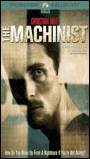
The Machinist (2004)
Starring: Christian Bale, Jennifer Jason Leigh, Aitana Sánchez-Gijón
Director: Brad Anderson
Plot: A factory machinist who suffers from severe insomnia starts doubting his sanity after accidentally maiming a co-worker.
Review: A surprisingly good-looking indie film that really hits the mark, The Machinist goes beyond the usual slick, well-produced psychological thrillers thanks to a stand-up-and-take-notice performance from its leading man. Much like his earlier work in Session 9, director Anderson creates an atmosphere of impending dread, a feeling that Something Bad is just around the corner. Shot in a world of washed-out colors with minimal decor, the film creates a truly oppressing, nightmarish place. The mystery surrounding the protagonist may become evident by the half-way mark, but there's an uncanny similarity to the thriller Memento in terms of red herrings and audience confusion, only with more first-person deceptions and hallucinations to enhance its psychological twists. The final payoff may be somewhat anti-climactic, perhaps, but the film's feeling of constant tension is real. But the real standout is most definitely Bale: Losing over 60 pounds for the role of the sleep-deprived protagonist, he is simply unrecognizable; in fact his physical appearance - looking like a Holocaust survivor - is absolutely shocking. Yet his character is only enhanced by this drastic self-mutilation, and his performance is simply mesmerizing. His struggle to understand what is happening around him, his sense of creeping paranoia and his slow descent into insanity are all brought to the fore with such intensity that it belies the otherwise average script. Unfortunately The Machinist will probably be relegated to only cult status, but for those adventurous enough, this is a real head-trip that will remembered as a showcase for Bale's talents. 
Drama: 7/10

Madagascar (2005)
Starring: Ben Stiller, Chris Rock
Directors: Eric Darnell, Tom McGrath
Plot: When a zebra decides to escape New York's Central Park Zoo in search of Wilderness, his urban friends - a lion, a hippo and a giraffe - break out to find him, only to end up as castaways in unfamiliar Madagascar.
Review: Another anthropomorphic animal cartoon, Madagascar doesn't quite bring anything original to the table but, done completely for laughs and lacking any sentimentality, it's a fun and light-hearted affair that's sure to please. The zoo animals are forced into a life in the wild they're not prepared for, allowing for the familiar morality of friendship and the fish-out-of-water jokes. Much like Shrek and Ice Age before it, the very self-conscious story really is only an excuse for the laugh-a-minute script, pop culture icons and referential visual gags of its computer-animated brethren. The plot moves along nicely, taking a page from The Lion King, throwing in some stereotype characters, predictable situations, clever winks to such diverse material as Castaway, Chariots of Fire and The Twilight Zone, and some slapstick in equal measures. Of special note are the commando-like Penguins who, in the few scenes they have, really steal the show. If the CGI isn't quite Pixar quality - the characters are blocky and stylized with some pretty scenery thrown in - at least it's clean and colorful, giving life to the skewed humor. Good voice acting from the team, especially top-billed comedians Stiller and Rock, as the neurotic lion and fast-talking zebra, respectively, both working to their strengths. Though not quite charming or memorable enough to be a classic, Madagascar is a fun family affair that will keep adults entertained and kids distracted for a few repeat viewings.
Entertainment: 7/10

Mad Max: Beyond Thunderdome (1985)
Starring: Mel Gibson, Tina Turner, Helen Buday
Directors: George Miller, George Ogilvie
Plot: After war has ravaged the Earth, a mysterious loner discovers a community of young children and tries to protect them from a vicious matriarch who runs Bartertown.
Review: A sequel to the smash Australian hits Mad Max and The Road Warrior, Beyond Thunderdome is a perfect example of how Hollywood involvement can break a film. The Road Warrior inspired a slew of post-apocalyptic action flick imitations, and this looks like one of those imitations. It feels like a derivative big-budget mainstream adventure, a re-hash of the previous films made for the family crowd. The violent tone of its predecessors has been toned down considerably, and gone is the gritty, gutsy filmmaking that made the first two so popular and that added a palpable tension to the proceedings. Mixing between campiness and melodrama, the story is weak and downright unsatisfying, lacking the suspense necessary to bring it to life. In fact, the ever-present humor is exaggerated and the events almost cartoon-like in their execution. The sets are grander and more lavish and the costumes detailed, but more money doesn't improve the look or the mood of the film, it just makes it look fake. Even the climactic battle, which simply retreads the action sequence of the previous film, lacks its exhilarating editing and feel. To be fair, there are some clever moments and inspired touches to be found, and the exciting, original fight sequence in a domed arena looks great. Gibson, as Max, is still fun to watch, however, and his performance of the character has the same quality as Eastwood had as the Man With No Name (a wink that's also alluded to in the movie). As for pop queen Turner, she's surprisingly good, and (off-screen) offers up two memorable 80's songs to the soundtrack. It doesn't mean it isn't occasionally fun in typical Hollywood fashion, but Beyond Thunderdome pales in comparison to the chapters that preceded it, and one can't help be disappointed by the concessions made to attract a younger crowd.
Entertainment: 5/10

Made in Hong Kong (Hong Kong - 1997)
Starring: Sam Lee, Yim Hui-chi, Lee Tung
Director: Fruit Chan
Plot: A youth, part of a local Hong Kong gang, has his life turned upside down when he finds the suicide note of a young girl who jumped off a building.
Review: Winner of countless HK and international awards, the low-budget independent film Made in Hong Kong is an intimate look at the problems of the city's under-privileged youth through the eyes of a well-meaning but moody young criminal. It takes a while to get going, but there is a lot to appreciate in director/screenwriter Fruit Chan's mesmerizing debut, especially during the gripping second half. Shot completely with a hand-held camera, it is a film that is accomplished both technically and stylistically, yet retains a certain grittiness that gives it a sense of cinéma-vérité, thanks especially to an excellent young cast. The well-rounded and dramatic story manages to avoid many of the clichés and use of melodrama of similar films, and vividly shows the dead-end life of these teens, the helplessness many of them face with few choices and no future on the dawn of the Chinese handover. A strong, and melancholic portrait of the glory and tragedies of youth.
Drama: 9/10

Magnificent Warriors (Hong Kong - 1987)
Starring: Michelle Yeoh, Derek Yee, Richard Ng
Director: David Chung
Plot: During the Japanese occupation of China during the 1930's, a female Chinese pilot joins a secret operative to stop an evil general from taking over a town and using it to manufacture a deadly gas.
Review: Magnificent Warriors is one of international star Yeoh's earlier films, and definitely one of her best action showcases. The script itself is usual for HK flicks, that is it has gaping holes, doesn't always make sense, and a very poor way of exhibiting some rather unnecessary (read poor) character development. But though the plot is typically minimal for the genre and occasionally prone to a certain drabness, it's also packed with rebounds and excuses for still more physical confrontations. Director Chung knows what audiences want in an action film, and delivers in spades. The whole affair is a continuous, impressive array of fights, stunts and general mayhem all impeccably choreographed and the limited wire-work means a generally more satisfying and enjoyable display. Indeed, a lot of work and special care obviously went into these sequences, and they're all top-notch. The main stumbling block is the usual forced comedy that leaves most North American audiences scratching their heads. There's a little too much of this sort of slapstick humor surrounding Ng as a bumbling cowardly con man, and it bogs down the pacing. Another sour point, surprisingly enough, is the climactic battle between the Japanese and the resistance forces inside the city walls which goes on for too long, and isn't that interesting; the gun battles, smarmy melodrama, and some explosions just can't compete with the energetic hand-to-hand combat that came before. At a time when female action stars were quite rare, Yeoh showed that women could hold their own in the martial-arts genre. Playing a mix of female Indiana Jones (she even uses a whip!) and no-nonsense Jackie Chan (minus Chan's slapstick), Yeoh's skills and athleticism are really given center stage. And that's when the film is at its best - and thankfully that's a large portion of the film. Though the whole isn't quite as good as its parts, Magnificent Warriors is another fine effort from the HK movie-making machine, high on entertainment and pure fun, one that really gives a chance for its star to shine.
Entertainment: 7/10

Magnolia (1999)
Starring: Tom Cruise, Julianne Moore, Ezra Buzzington
Director: Paul Thomas Anderson
Plot: Various down-and-out denizens of Los Angeles, including a grown-up kid-genius, a young addict, a dying patriarch and his trophy wife, a naive cop, and a self-help guru all find their lives inextricably mixed on a particularly eventful 24 hours.
Review: Magnolia, in both its contents and style, is very different from director Anderson's previous effort Boogie Nights, offering up a dark, bleak look at life Los Angeles. The story follows a varied collection of characters and how accidents and coincidences throw them together and change their lives. The film is full of multi-faceted characters, all of them psychologically scarred, with their intimate pains and sufferings laid bare. None of them are charming, indeed they range from the downtrodden to the pathetic, but even the vilest of them manage to somehow call up some sympathy. A lot of the credit for this is due to the impressive cast who all manage to give convincing performances, most surprisingly from Tom Cruise as a misogynistic motivational speaker. There's sometimes too many different stories going on at the same time, but the dialogue rings true and the events emotionally involving, and even though the film clocks in at over three hours, it always manages to keep our interest. The direction and production follows the bleakness of the storyline, with a great use of long takes and play of soft lighting and shadows. The ending, with its Act of God, manages to somehow break the spiral of self-destruction that they all have embarked on - it may seem out of place and surprising but it is in line with the type of coincidences and bizarre goings-on that are narrated throughout. In the end, Magnolia makes for a rewarding, and not slightly bizarre, ensemble drama.
Drama: 8/10

The Majestic (2001)
Starring: Jim Carrey, Laurie Holden, Martin Landau
Director: Frank Darabont
Plot: After an accident leaves him without memory, a blacklisted screenwriter finds himself amid townspeople who believe him to be a World War II hero missing in action years before.
Review: Though The Majestic wants to be a whimsical homage to legendary director Frank Capra, what the filmmakers have actually created is nothing but a bloated, self-indulgent fluff piece. To be fair, it's not bad fluff, and though it's languidly paced it's also never boring - it's just not that interesting either. Tackling small town life, McCarthyism, the suffering of World War II, Hollywood and 1950's nostalgia, the script takes on some important themes, but keeps the answers and character progression as clichéd and shallow as can be. Director Darabont, who impressed with other deliberately paced and long films such as The Shawshank Redemption and The Green Mile, seems to have gone overboard and lost his way in trying to capture our imagining of a bygone age that lived only on the silver screen. Indeed, everything looks and feels fake, from the one-dimensional characters to the impeccable sets. And the Mr. Smith Goes to Washington-type climax is as groan-inducing as it gets. For sure, it's capably directed and beautifully shot, and the cast is engaging and even charming, but if this was to be Carrey's third try at an Oscar, he's picked the wrong vehicle. There are some fun things, however, the best of which is the fake footage of the protagonist's efforts at a B-movie. In the end, The Majestic is quite watchable without being memorable but for better redemption stories, stick to the original Capra classics.
Entertainment: 4/10

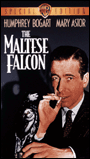
*Classic* The Maltese Falcon (1941)
Starring: Humphrey Bogart, Mary Astor, Sydney Greenstreet
Director: John Huston
Plot: After accepting a bogus missing-persons case from a classy dame that gets his partner murdered, a rough private detective becomes embroiled in the deadly search for a priceless black bird.
Review: The third adaptation of The Maltese Falcon proved to be not only the most faithful adaptation of mystery writer Dashiel Hammet's 1929 book, but one the most influential of American films. Huston's directorial debut shows the assured hand of the creator of such classics as The Treasure of the Sierra Madre and Key Largo, from the studied cinematography, the dark, claustrophobic atmosphere, and the composition of the scenes, all put to great advantage by the excellent camera work and his close attention to detail. More than its visual look, however, the film establishes the bleak cynicism, the moral corruption, the murderous greed, the double-crosses, and the violent flashes that became characteristic of the genre. Add to this some clever dialogue, the constant intrigues, the stylish look, and the production, though perhaps a little dated, still satisfies modern audiences. Bogart embodied the smart, cool, and dangerous hero, a role that formed the template for many a character that came afterwards, one that also happened to be his break-out performance leading him to become Hollywood's biggest star. All the stereotypical denizens - the cynical tough-as-nails private eye, the alluring femme fatale, the eccentric villain, the dangerous minions - are on hand, and with such a great cast including Peter Lorre as a sleazy, effeminate gangster, one can hardly see anyone else play the roles with equal panache. The one sore spot is in the quick attachment between Bogart and the lying Astor - do they really love each other or is this a game both are playing? Their final parting would be that much more powerful, and descriptive of Spade's character, if we were certain, but this is a minor point - plot is secondary to the moment. The Maltese Falcon doesn't stand up as well as some of the other film noirs, perhaps, but as the one that started the genre, and the one that helped push Bogart into stardom, this one is a definite classic.
Entertainment: 8/10

Mambo Italiano (2003)
Starring: Luke Kirby, Ginette Reno, Paul Sorvino
Director: Emile Gaudreault
Plot: A young gay Italian man living in Montreal's Little Italy moves in with a lover, a childhood friend, but struggles in finding the best means to admit his sexuality to his conservative family. 
Review: Unoriginal but never dull, Mambo Italiano is an amusing comedy that milks its laughs by embracing all the Italian family stereotypes. Most people will come to this expecting an Italian version of My Big Fat Greek Wedding and its good-natured parody of the culture, and indeed it plays to that hype - think "My Big Fat Italian Family". Tackling both cultural heritage and sexual orientation, the film is meant as a story on love and acceptance. As such, the drama aspects are actually well played out and the characters are pretty sympathetic, and though there's the requisite happy ending it's not quite what you'd first suspect. As for the comedy, it's pretty much based on the expected reactions of the players more than on any situation. Obviously, none of this is meant to be taken seriously but like most parodies some of the caricatures are evidently extreme and might give offense. Cinematically-speaking, its theatrical roots are obvious and apart from the overacting there's a bright, surreal color scheme throughout which enhances the feeling of watching a sitcom. Still, it shows off a nice Montreal flair and for a low-budget local production it's actually quite accomplished. A possible stumbling block is that most of the "Italians" are played by French Canadian actors, yet to be fair they do a great job in terms of playing to the stereotypes, especially big-time singer Reno as the matriarch teaming with real Italian actor Sorvino. Another exception is Claudia Ferri as the neurotic, pill-popping sister. Despite its familiar storyline and exaggerated theatrics, Mambo Italiano ends up being an amusing and undemanding comedy.
Comedy: 6/10

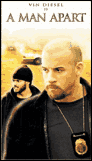
A Man Apart (2003)
Starring: Vin Diesel, Larenz Tate, Timothy Olyphant
Director: F. Gary Gray
Plot: After seeing his wife killed by a vengeful drug cartel, an undercover DEA cop takes the war back to South America and tries to find the trail to the mysterious, ruthless leader only knows as "Diablo".
Review: A Man Apart is yet another generic effort from the revenge / action genre, and though it has a few redeeming qualities, is a film that just didn't need to be made. On the plus side, the action sequences are well orchestrated and appropriately chaotic, though some may get dizzy by the music-video pace and cutting. Director Gray, who made the tense enjoyable thrillers The Negotiator and The Italian Job, has a good grasp of the material and ensures the film is always quite watchable but it's obvious the script isn't up to the job. In fact, this is one of the more derivative efforts to come out of Hollywood in a while, and its desperation to provide some unexpected twists makes it, when the climactic revelation of who "Diablo" real is, just plain dumb and illogical. There are some good ideas hidden here that want to remind audiences of better films such as Traffic or Narc (including the same style of gritty cinematography and film stock), but without allowing for the dramatic moments to take effect. Maybe the real story got lost in the editing or, more likely, was remodeled as a purely action vehicle for its star. Whatever the case, the film does move along at a blistering pace and though there's little to recommend it, it's never boring. Vin Diesel comes out mostly unscathed from the effort and, though there's no real dramatic range here, shows off the macho persona that has made him a household name to good effect. Even apart from the gaping plot holes and uninspired premise, A Man Apart has little really going for it, but genre fans looking for some late-night kicks might still enjoy this redundant crime thriller.
Entertainment: 4/10

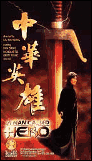
A Man Called Hero (Hong Kong - 1999)
Starring: Ekin Cheng, Shu Qi, Francis Ng
Director: Andrew Lau
Plot: A young Chinese martial arts master immigrates to America in the 1920's and goes to work in a slave mine before a tragic event convinces him to disappear for 16 years in preparation for a challenge with his old master's Japanese rival.
Review: Adapted from a popular manga, A Man Called Hero is the big-budget follow-up from the makers of the blockbuster The Stormriders but one that is dreadfully inconsistent. Those expecting another rousing tale will be disappointed. The story wants to be an ode to The Godfather, Chinese-style, from a tragic killing to a trip through Ellis Island, to common hardships, but these scenes (which take up the first half of the film) are so badly realized, so melodramatic and downright boring that the only real hardship is sitting through them. The script is simply atrocious, and the film requires some major editing to avoid putting its audience to sleep. Thankfully the film picks up mid-way through and goes off on a welcome tangent with an imaginative fight scene against supernatural ninjas. From this point on, the film offers what its audience expects - some comic-book style adventure, inventive magical fight scenes, and larger-than-life characterizations. There's also the exciting effects-laden finale atop the Statue of Liberty that precedes, and is far better, than the one seen in the X-Men. The leads are pretty wooden and rather unconvincing, but one definite treat are the extensive cameos, including ones by Anthony Wong, Francis Ng, Qi Shu and a welcome one by Yuen Biao. All said and done, A Man Called Hero does provide some excellent entertainment in the form of some impressive effects and amazing fight scenes in its second half, provided you can endure or fast-forward the mind-numbingly boring, talky filler.
Entertainment: 5/10


*Classic* The Manchurian Candidate (1962)
Starring: Frank Sinatra, Laurence Harvey, Angela Lansbury
Director: John Frankenheimer
Plot: After a hero's return from the Korean War, an intelligence officer realizes that his captain has been brainwashed into becoming an assassin under the control of Communist agents.
Review: Based on the novel by Richard Condon, The Manchurian Candidate is a terrific psychological thriller filled with layers of lies and deceptions, conspiracy, 50's McCarthyism paranoia and Cold War political intrigue. This is sophisticated, intelligent entertainment, with a first-rate script that's laden with traces of black humor and some disturbing elements, from the subtle hints of a incestuous relationship between Lansbury and Harvey to the ruthless assassinations. Director Frankenheimer's (The Train, Ronin) famous visual style is also clearly in evidence, from the unusual camera angles and fluid camera movements to the increasing tension and feeling of unease that permeates the narrative. There's a particularly riveting, imaginatively filmed sequence as the brainwashed American soldiers are put on display in front of their Communist controllers, even going so far as having one strangle another, yet hypnotized to see only a gathering of house-wives at a garden party. There's an additional level of deceit, perhaps, in the relationship between Sinatra and new love Janet Leigh, one that is never fully formed yet adds an interesting note to the proceedings. Clearly, this was a daring film for its time, both cinematically and in its controversial subject matter. Excellent performances from all involved also help bring all these well-defined characters to life. Suppressed for decades after the assassination of JFK before finally being re-released in the late 80's, The Manchurian Candidate is a true American masterpiece, a tantalizing, exciting thriller that shows its filmmakers at the height of their game.
Entertainment: 9/10

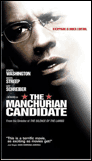
The Manchurian Candidate (2004)
Starring: Denzel Washington, Meryl Streep, Liev Schreiber
Director: Jonathan Demme
Plot: An Army officer has recurring nightmares of having been brainwashed while on duty in the Gulf War along with his then-subordinate, a war hero who has just accepted a Vice-Presidential nomination.
Review: A solid remake of the classic 1962 B&W thriller, The Manchurian Candidate gets the plot and paranoia down pat but misses the more interesting subversive elements and wit that made the first one special. Now only loosely based on Richard Condon's book, the feature zips through the original's details and provides a much more snazzy presentation. Despite the fact that the characters' parts have been altered (the mind-controlled son-in-law is now Veep himself, the hero's girlfriend is more than she seems, etc.) many of the main plot points are still remarkably faithful to its source material. To keep up with the times, the threat of Communism has been replaced with that of the 21st-century boogeyman, Terrorism and the villain is no longer the Manchurian nations but the rather faceless and powerful multi-national corporation Manchurian Global (a ruse simply to keep the film's title intact). The film still has the familiar jabs at the whole election showmanship that made the first so watchable even in the JFK era, but it's all rather muted. In fact, the film doesn't really have much more to say regarding the sell-out of the nation's politics or of mega-corporations' over-reaching powers other than what we've seen in other mainstream flicks. Gone as well are the dark satire that made its precursor so subversive, and its effective development that made its characters actions so shocking. What it does do well is create a very tangible, X-Files-like sense of paranoia and an occasional feeling of apprehension. If some of the more interesting artistic flourishes of the first one are abandoned here for the sake of a more straight-forward thriller (the brain-washing sessions come to mind) it does provide a tight pacing filled with the usual big-budget flourishes, while never quite upstaging the story. In fact, not since The Silence of the Lambs has director Demme been in such control of his material, and it's nice to see him back in form. Part of a limited main cast, Washington and Shreiber are impeccable and believable in their larger-than-life roles, though neither of them really garners much warmth from the audience. As the evil mother, however, Streep is delightfully diabolical and just steals the show. All told, it might not fare as well when compared to the Cold War classic, but taken on its own this new Manchurian Candidate is an effective Hollywood thriller.
Entertainment: 6/10

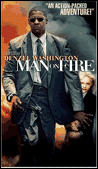
Man on Fire (2004)
Starring: Denzel Washington, Dakota Fanning, Christopher Walken
Director: Tony Scott
Plot: A burned-out, alcoholic former Special Forces operative goes on a rampage in Mexico City when the 10-year old girl he's been assigned to protect is kidnapped by organized crime and crooked cops.
Review: The latest version of Man on Fire, based on the novel by A. J. Quinnell, has much more fury and gritty violence than its predecessor, the 1987 version starring Scott Glenn, but it's the quieter, more dramatic moments that make up most the film that makes this special. Indeed, though the last third of the film is devoted to violent acts perpetrated by our "hero", one would be hard pressed to really call this an action flick. The "righteous" revenge that takes place, though filled with the usual ably handled explosions and gunfights, is not done so much for thrills as it is a means to an end - as such there's nothing to cheer or relish, only another deserving target to be checked off the list. And what a list: from organized crime to crooked cops to shady lawyers one would think Mexico City is a Den of Thieves. Yet the camera captures the city's exotic flair to give us a feel of a different place. But what makes this flick stand apart from the genre is the time it takes to set up its situation, to establish the father-daughter-type relationship that grows between the disillusioned soldier and his charming young charge. The filmmakers never miss an opportunity to manipulate its audience but it comes off as sincere enough thanks to the skills and screen presence of leading-man Washington and the surprising performance from the spunky young Fanning. It's this relationship that makes the rest of the film tick, and makes the events at the mid-way point believable enough to get by the story's more predictable moments. Thankfully the original tragic ending is also kept in place which on its own elevates the film from usual Hollywood fare. Director Scott is the epitome of slick filmmakers (Spy Games, Enemy of the State) and invigorates an otherwise banal plot with some terrific cinematography and an impeccable visual sense. Though it's involving enough, the script isn't particularly special and only Scott's flourishes and commercial direction ensures that the film always keep our attention and the narrative moves along at a brisk pace. If there's one thing to complain about, it's the insistence on the occasional frenzied editing of shaky, over-colored camera shots which are downright irritating. As a side note, character-actor Walken gets a chance to play a sympathetic role, for once, and its a pleasant surprise. Despite some issues, Man on Fire is a solid, engaging mainstream thriller - it might not hold any surprises but thanks to some slick camera work and some fine performances by its two protagonists it's a worthy blockbuster effort.
Entertainment / Drama: 7/10

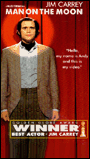
Man on the Moon (1999)
Starring: Jim Carrey, Danny DeVito, Courtney Love
Director: Milos Forman
Plot: A dramaticized account of real-life eccentric comedian Andy Kaufman's roller-coaster professional career and personal relationships.
Review: Director Forman has a knack for choosing strange real-life characters as his subject matter (The People vs. Larry Flynt), and his choice of doing a biopic of avant-garde comedian Andy Kaufman seems even stranger. And yet in this portrait he meditates, as his subject must have done, on the very concept of comedy and entertainment. The creative narrative of the film plays out like one of his acts, with a great beginning that sets up the whole mood of the film and continues throughout. Kaufman was indeed more a performance artist than a stand-up comedian, and his form of humor wasn't for everyone, something that is also made quite clear in the film, making the audience privy to the inside-jokes behind his outrageous skits as well as to some of his disasters. As such, there are many moments that are hilarious, most especially the scenes of Kaufman playing his alter-ego Tony Clifton, a blazingly untalented lounge singer, while others simply fall flat. Funnyman Jim Carrey seems to hit the role right on the head, and it's hard not to see Kaufman instead of Carrey there on screen. This feeling is heightened by the use of the actual people who surrounded Kaufman's life in the film and the re-enactments of his public appearances such as scenes from Taxi, the sitcom that made him a household name, to the David Letterman interview where he got punched out by a wrestler. Many events have been fictionalized for dramatic purposes the point being that the film isn't looking to lay bare Kaufman's soul as much as show a perception of him, eccentricities and all, and find if indeed there was someone behind all those facades and illusions. Lunatic or comic genius, Man on the Moon is a touching and revealing description of a life cut short, and thanks in large part to Carrey's performance, well worth watching.
Drama / Entertainment: 7/10

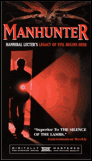
Manhunter (1986)
Starring: William Petersen, Kim Greist, Tom Noonan
Director: Michael Mann
Plot: A psychologically scarred ex-FBI profiler is induced to return to the field to track a brutal, deranged serial killer with the help of a brilliant but dangerous inmate.
Review: Based on the best-selling novel by Richard Harris, Red Dragon, Manhunter's claim to fame is as the little-seen prequel to the Oscar-winning The Silence of the Lambs but it's a fine, if unimpressive, film in its own right. Director Mann, who was then at the height of his popularity with the hit TV show Miami Vice, shows the same production mode here with slick visuals, a surreal sense of tones and almost electric colors, and a definite preference for style over substance. The story is also more cerebral than most genre thrillers in that it plays a lot on the psychological aspects of the case, especially that of the FBI agent losing himself in the psyche of his prey. The main problem here is that the cat-and-mouse game being played in the background (the battle of wills between the cop and the imprisoned entity that is Hannibal) is much more interesting than the chase for the killer on the loose. The other problem is that while the film might have been slick and thrilling in the 80's, it will seem quite dated to modern eyes and, though the storytelling aspects are solid, it's never quite as engaging (or quite convincing) as it should be. The low-key approach to the material (and the undeniably lame climax), also just doesn't quite do it, especially compared with the more recent remake, Red Dragon. The cast is solid if uninspired, though Cox does a good turn in the skin of the genius villain Hannibal the Cannibal, a role made popular by his successor Anthony Hopkins. Another issue is that it all feels too impersonal, too stoic, the characters moving around like pawns instead of people, as if the emotional requirements were unnecessary to the film's thrills. All that said, there's still a good dose of suspense to be had, as well as some decent thrills and a mostly involving plot. And one can't help be taken in by the cool and now-retro 80's visuals. Despite its faults, Manhunter is an interesting take on the subject and an entertaining, stylish crime thriller from a showy director.
Entertainment: 6/10

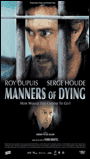
Manners of Dying (Quebec - 2004) 
Starring: Roy Dupuis, Serge Houde
Director: Jeremy Peter Allen
Plot: Trying to decide whether to agree to a prisoner's last wish, a warden encounters difficulty when preparing a letter to the mother of the convict who has just been executed.
Review: Based on a short story by Yann Martel (who wrote the award-winning The Life of Pi), Manners of Dying is a low-budget effort that may feel very theatrical in its approach at first, but quickly captures us with morbid interest. The warden recounts, in flashback, the last twelve hours of one man's life, trying to decide what version to keep for posterity on his tape recorder. Going through the gamut of sometimes radically different versions, the film offers nine distinct variations on the prisoner's last hours and execution from dignified, to the impatient, to the downright vicious, with some absurd cases in between. Novice director Allen keeps the intimacy in the proceedings and makes sure that each re-telling adds something new to the overall story, something that ensures the narrative gimmick stays fresh. The details of the crime for which he is committed are kept under wraps; the idea behind the film seems to be on how a human being might approach his impending death more than a commentary on capital punishment like the powerful Thou Shalt Not Kill or the emotionally deft Dead Man Walking, films that tackled the same subject matter but had a more direct agenda. As the title implies, every individual will face his impending end in his own way. Capturing such varied personalities and the plethora of emotions that such a situation may engender - fear, anger, pity, desperation, denial - Dupuis shows off his acting skills like he hasn't in quite some time, making each case, each variation of events its own. He's lucky to play off Houde who, as the by-the-book warden, is the straight-man of the duo. All told, despite its modest means, Manners of Dying ends up being quite an effective exploration on human nature.
Drama: 7/10

Mansfield Park (1999)
Starring: Frances O'Connor, Hugh Bonneville, Jonny Lee Miller
Director: Patricia Rozema
Plot: In the early 1800's a poor young girl is sent to live with her wealthy cousins, in the hopes of educating her a finding her a position in high society. She grows up into an educated and very spirited young woman and is soon torn between the man she loves, and the man she is to marry. 
Review: Said to be Jane Austen's favorite novel, Mansfield Park starts off in a similar vein as other Austen stories such as Sense and Sensibility and Emma, describing a handful of high class, very British characters acting out their roles as forced upon them by society, each trying to garner an engagement to another. But this particular story has a little more bite to it, and bit more drama, dealing on its fringes with black slavery, class bias, and a touch of scandal that helps raise this adaptation above some of the more recent ones. The acting is superb, especially from Frances O'Connor, but the production, and the film itself, ends up seeming a little bland. 
Drama: 7/10

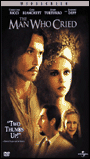
The Man Who Cried (2001)
Starring: Christina Ricci, Cate Blanchett, Johnny Depp
Director: Sally Potter
Plot: Escaping the Russian pogroms, a young Jewish girl joins an opera house in Paris in the early days of World War II in the hopes of making her way to America to find her father.
Review: The director of the brilliantly realized Orlando offers up a rather ho-hum saga with The Man Who Cried, one that's great to look at but is emotionally empty. The film wants to be an epic story of loss and a journey of redemption, one that wants to show that gypsy's were as persecuted as Jews, but it feels like a rehash of other movies and, though mostly well executed, it's never quite engaging enough to capture our full attention. There's nothing in the script to make us emotionally connect with anything going on-screen, with events simply falling on the protagonists as they are buffeted about by history. Even the final reunion feels like the worst kind of soap-opera catharsis. The dialogue is limited as well, Potter relying more on the visual impact of her settings and longing looks of her actors to convey mood. The splendid cinematography is about all that really keeps us going, and some of the scenes are indeed splendid. That, and the wonderful moments when the film bursts into music, with a mix of operatic bits, gypsy rhythms, and Eastern European ballads makes up for a lot. Unfortunately, the worst aspect of the film is Ricci; as the wandering heroine caught up between two worlds, she has the look for the role but appears mostly lost here and utterly unconvincing. Depp, after a wonderful performance as a gypsy in Chocolat, plays this generic one with silent panache. The two are supposed to make a statement on love lost, but there's little chemistry between Depp and Ricci and their final farewell is emotionally empty, as is most of the film. Blanchett saves much of the film, hamming it up for the camera as a displaced Russian dancer, but displaying the frailties of an old soul, but her relationship with Ricci seems forced and awkwardly one-sided. Cold and minimalistic, The Man Who Cried is best seen as a visually creative, but ultimately disappointing, melodrama.
Drama: 4/10

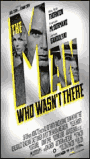
The Man Who Wasn't There (2001)
Starring: Billy Bob Thornton, Frances McDormand, Tony Shalhoub
Director: Joel Coen
Plot: In the early years after World War II, a taciturn California barber decides to blackmail his wife's lover to get the capital his needs for a dry cleaning business, but his plans soon devolve to murder.
Review: Director Coen, who shared the Cannes 2001 Best Director prize for his work here, and his brother have always been known for their clever, original, bizarre films (Fargo, Blood Simple), but with The Man Who Wasn't There, they have opted for an homage to Hollywood's noir era. In a terrific, quietly intense performance, Thornton, as the deadpan narrator and hapless instigator / victim, is as the title suggests something of a non-entity, an emotionally hollow man who suddenly, desperately needs a change and who, in typical noir fashion, ends up embroiled in a situation that goes from bad to worse. The story, full of blackmail, lies and murder, captures the essence of such genre classics as Double Indemnity and the early Hitchcock suspense, and then adds a very Coen twist with a touch of Lolita and UFO conspiracies. The pace may be slow and deliberate, but the narrative is always intriguing and surprising in its twists and turns. In true Coen fashion, there also many instances of dark humor throughout, especially in the form of Shalhoub as a slick, egocentric lawyer with a win-at-all-costs attitude. The real stand-out however is the beautiful, carefully composed black-and-white cinematography that transports us into the world of the film noir, with every new scene a wonderfully atmospheric production. There's no denying as well the tense dialogue, fabulous attention to detail, and great cast of eccentric characters (including a wonderful McDormand and a bullish James Gandolfini), but there's still a sense of formality present, a sense of cold focus that keeps us removed from the proceedings. Regardless, The Man Who Wasn't There is bent on evoking the essence of the dark, noir thriller, and in that it succeeds brilliantly.
Entertainment: 7/10

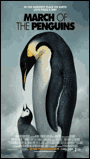
March of the Penguins (2005)
Narration: Morgan Freeman
Director: Luc Jacquet
Plot: A close look at the Emperor penguins of Antartica as they make their dangerous annual pilgrimage to their traditional breeding ground at the very height of winter.
Review: At times dramatic, in others just plain funny, March of the Penguins conveys the intensity of penguin life like few documentaries ever have. Shot over a period of a year by a pair of French cameramen who endured grueling conditions in one of the coldest spots on Earth, the film condenses the months long mating and breeding cycle into a spellbinding 80 minutes. It's simply an amazing journey into one of the planet's last untouched places, and most of the credit for its success goes to the stunning cinematography that superbly captures the wildlife in its habitat, up close and personal, as well as the incredible, otherworldly vistas. The penguins waddle, swim, eat and huddle together, facing natural perils from killer blizzards to terrifying predators in their treacherous task of protecting eggs and hatchlings. If the editing does, of course, dramatize and sentimentalize events it doesn't need to do so often for the fate of these social animals to be poignant. The Discovery-channel narration by Morgan Freeman actually elevates the film from its French counterpart, a version that straddled the animals with silly anthropomorphic dialogue. This is a true adventure that's right for the entire family and even as the credits roll the imagery will still linger.
Documentary: 8/10

Mars Attacks! (1996)
Starring: Jack Nicholson, Glenn Close, Annette Bening
Director: Tim Burton
Plot: Martians invade and find Earth easy pickings for their war machines, as the inept White House staff tries to decide if the aliens are peaceful or not.
Review: Mars Attacks! is director Tim Burton's homage to science-fiction films of the '50s. Many of the more bizarre images of the film, and in fact the idea for the film itself, are actually inspired by the over-the-top 1962 Topps card series of the same name. Burton has also tried to capture the feel of those old '70s disaster movies by showing a huge cast of big-name stars involved in their own private dramas as the world is crumbling around them. The problem is that the characters, though fun to watch, aren't as interesting as the Martians. But things quickly get into gear as the Martians invade Earth, with many scenes of destruction and all-out war clearly inspired by The War of the Worlds and Earth vs. the Flying Saucers. The film is great fun, and full of wicked, often very twisted humor, and is definitely not to everyone's taste. With great special effects and a good cast, if you can take a little zest with your laughs then Mars Attacks! is sure to please.
Entertainment: 8/10

Mary Shelley's Frankenstein (1994)
Starring: Robert De Niro, Kenneth Branagh, Helena Bonham Carter
Director: Kenneth Branagh
Plot: Having been brought to life from dead body parts, a creature escapes his creator only to seek him out to take revenge after being misunderstood and mistreated by the townspeople.
Review: After his successful adaptation of Bram Stoker's Dracula, producer Francis Ford Coppola set his sights on modernizing another creature feature, Mary Shelley's Frankenstein. Despite the large budget, impressive cast, and having a Big Name at the helm, the film however is a disappointment. Trying to tread the material with his usual theatrical, Shakespearean-trained panache, actor / director Branagh (Hamlet, Henry V) actually creates a movie that is more high-brow camp than he probably intended. As entertainment, this will probably amuse those willing to sit through a lavish B-movie, though the film does have more to offer. Points definitely go for what is the most faithful adaptation of Mary Shelley's classic gothic novel to date, most importantly taking the monster as an intelligent creature who is pushed away from society and his maker, and seeks revenge on his creator. Unlike the popular lumbering Boris Karloff version, the monster here is quick, cunning, and has definite intelligence and real emotions. There are many things outright inventions but the middle part, where the creature hides in a shack and, hidden, helps a young family is a highlight. The book's themes of birth and death are hinted at, all shown here as graphic metaphor with lots of fluids, as is of course the one of Man's hubris at playing God, a theme that has been a staple of the genre. On the plus side, the film does try to play it all straight and serious, with little intentional humor, often delivering some solid horror-film moments. The opening and closing sequences in the Arctic, acting like book-end sections, adds a definite flavor to the story and are the best bits, really focusing on the relationship between creator and creation. On the down side, though it's a lavish production it all looks terribly fake. The narrative takes way too long to set up its confrontation, especially since most audiences know what to expect, and bringing Frankenstein's creation to life is also more detailed (and New Age-y) than is really required, though the sets and ideas to bring this about shows a genuine gothic sensibility. The acting is terribly theatrical from all involved, none worse than Branagh himself, though De Niro does an impressive job as the creature without the use of his trademark mannerisms, and Bonham Carter proves game for some required excesses. The film has also amassed some great actors in supporting roles such as Ian Holm, Tom Hulce and a surprisingly dead-pan, serious John Cleese as the doctor's mentor. All told, despite Branagh's good intentions and it being an interesting take on the classic character, this Frankenstein adaptation just doesn't quite cut it.
Entertainment: 5/10

The Mask (1994)
Starring: Jim Carrey, Cameron Diaz, Peter Riegert
Director: Chuck Russell
Plot: A shy, inept banker accidentally gains super-powers when he dons a strange mask which he uses to get the girl of his dreams, but a vicious gangster has ideas of his own for the mask.
Review: Based on the comic series by the same name, the green-faced human tornado The Mask is an unlikely film hero: anarchistic, chaotic and out for his own selfish benefit, and yet the premise works by imbuing its character with every person's dream: to hide their identity and become the extrovert they've always wanted to be. The real entertainment value, however, is in the Looney Tunes-esque world that he creates in his wake, from his impossible antics to the surreal, colorful set pieces in the Coco Club. Director Russell (Eraser, The Scorpion King) channels the manic energy and inventiveness of Warner Bros. cartoons to great effect, never missing a beat between the sad-sack's life and the crazy skits that make the heart of the film. It helps that the script does anything for a visual gag and they're quite successful in providing absurdist chuckles and slapstick laughs. The use of primitive computer animation still works the way it was intended: eyes bug out, tongue rolls out, and the impossible elastic body of our hero follows the expressive stretches of its star. Indeed, the film wouldn't be half as much fun without the inimitable Carrey. Coming off the popular Ace Ventura, he solidified his comic credentials here, playing both the sympathetic loser with a soft side and his frenzied alter super-ego, a creature who's a supernatural force for anarchy. As for Cameron Diaz, making her first major appearance, she definitely turns heads. A hoot-and-a-half while it lasts, The Mask is for the most part inspired crowd-pleasing lunacy.
Entertainment: 7/10

The Mask of Zorro (1998)
Starring: Antonio Banderas, Anthony Hopkins, Catherine Zeta-Jones
Director: Martin Campbell
Plot: After being imprisoned for 20 years, an aging California nobleman takes a bandit under his wing and trains him to be the masked vigilante Zorro to defeat a villainous governor.
Review: An energetic, light-hearted revitalization of the classic character made popular by Douglas Fairbanks and Tyrone Powers in the B&W serials of old, The Mask of Zorro is a fine mix of well-choreographed action, costume drama and tongue-in-cheek humor that is rarely seen nowadays. What's most impressive is that there's an easy-going charm to the proceedings amongst all the swashbuckling to be found, and the amusing training sequences (seemingly out of a Kung Fu movie) are worth the price of admission alone. Director Campbell (Goldeneye, Casino Royale) has a fine eye for the theatrics, swordplay and a sense of panache that goes well with the cliff-hanger fare. And if the plot and sumptuous production values have a sense of being a throwback to another era, the film itself is thoroughly modern and the execution is top-notch. It sure helps that there's a terrific romantic (and often adversarial) chemistry between then-revelation beauty Zeta-Jones and a cheeky Banderas; tying the "old" Zorro to the "next generation" is the stead-fast Hopkins, who seems to be having more fun here than he has in ages. A rousing tale in the style of the Hollywood adventures of old, The Mask of Zorro is contagious clean fun for the whole family that will sweep you off your feet.
Entertainment: 8/10

The Master (Hong Kong - 1992)
Starring: Jet Li Lian-Jie, Yuen Wah, Jerry Trimble
Director Tsui Hark
Plot: While visiting Los Angeles, a martial arts student becomes embroiled in a fight with an American master and his school after his Chinese teacher gets viciously attacked.
Review: The Master is a light-weight, rather low-budget kung-fu affair highlighting the first Hark / Jet Li pairing. The story is routine and just engaging enough to keep our attention between action scenes, immediately reminding us of the classic 70's Bruce Lee plots, one that occasionally veers towards the humorous bordering on the slapstick but that never lets the "dramatic" or silliness get in the way of good clean fun. This is not nearly as interesting, visually or thematically, as acclaimed director / producer Hark's other productions (Once Upon a Time in China, Legend of Zu) but it's still a Hark effort, and as such it's much better shot and more polished than the typical chop-socky fare, with some good dynamic camera work and cinematography, effective narration and fine pacing. Jet Li also plays his character with the affability and charm that were his early trademarks. Most importantly, the film includes some solid fighting sequences and more than almost any other, this is a terrific showcase for Li's amazing martial arts skills, unaided by the usual plethora of wires. Yuen Wah, in a rare good guy role (and acting as fight choreographer), also shows his impressive abilities as his master. The finale on top of a skyscraper will definitely not disappoint fans of the genre. It might be only a minor effort from director Hark, but The Master is a breezy, enjoyable kung fu flick highlighting its expert lead.
Entertainment: 6/10

Master and Commander: The Far Side of the World (2003)
Starring: Russell Crowe, Paul Bettany, Billy Boyd
Director: Peter Weir
Plot: Under orders to stop one of Napoleon's flagships from tipping the balance of power in the Pacific, a respected British Captain steers his ship and crew against a more formidable adversary despite having been damaged by their initial confrontation.
Review: An adaptation of the popular historical novels by Patrick O'Brian, Master and Commander: The Far Side of the World is a not only a great, exciting and satisfying adventure, but it's also an intelligent and vivid depiction of another time and place. It's always hard to adapt beloved novels to the screen, but the script does a fine job of bringing these characters and the seafaring way of life to the big screen. Those expecting constant action will undoubtedly be disappointed as the middle portion is more low-key and deliberate in its pacing, but the amazing attention to detail, and the interaction between the officers and crew, makes the film absolutely enthralling. It helps that these moments also have their share of suspense as well, with the crew facing the brutal elements (including an impressive typhoon sequence) as well as the tensions created by men living in such close quarters, all the while playing a dangerous game of cat-and-mouse with a more powerful enemy. It should also be noted that the film is also bookmarked by two spectacular, exciting battle scenes. The first is a quick, one-sided affair, but the climax is spectacular - canons blazing, wood splintering, men battling in close quarters - and makes for a satisfying conclusion. Best known for smaller dramas such as Witness and smart crowd-pleasers such as The Truman Show, director Weir (who also co-scripted) brings all his dramatic skills to bear here and does a great job of bringing a forgotten era to life. This is one of those rare cases where substance beats over style - the solid visuals, editing and directorial approach never displaces the attention from its subject. Of particular note is the absolutely gorgeous production values, including a full-scale replica of the HMS Surprise and some appropriately gritty costumes and decor. As for its lead, just like his role demands Crowe is a very charismatic presence showing off both confidence and authority, as well as a definite elite Brit culture touched with humor. Brittany makes a fine foil as the ship's doctor with a penchant for being a naturalist, and the friendship between the two very different men, along with their fine dynamic repartee, adds a lot to the flavor of the film. Made for a more mature audience than those for a usual big-budget blockbuster, Master and Commander is nonetheless a rousing adventure yarn for those willing to be taken in.
Entertainment / Drama: 8/10

The Matador (2005)
Starring: Pierce Brosnan, Greg Kinnear, Hope Davis
Director: Richard Shepard
Plot: A veteran hit-man going through a mid-life crisis in Mexico City strikes a strange friendship with a open-hearted down-on-his-luck businessman.
Review: The indie buddy-comedy The Matador is one of those easy-going films that unfortunately rarely see the light of day. For sure this is a low-key affair, as far as these things go - there's no action, no amazing sets, and no particularly exotic locales unless the few scenes of a Mexican hotel and a bullfight count. Even the humor is more good-natured than laugh-out-loud, something that was clearly intended and is quite refreshing. But where it really hits the mark is in its character study of a hit-man past his prime, and the unlikely camaraderie between two men who are far apart both socially and morally. Brosnan plays with his own movie image to portray a distinctly anti-Bond assassin, one that's unshaven, drunk, uncouth, immature and depression-prone, but he brings to the screen a performance filled with such zest and vitality that one can't help but be seduced by this strangely pathetic, sympathetic character. Kinnear, as his new mate, proves a great straight-man to Brosnan's excessive personality and Davis, as his understanding wife, often steals their thunder with just a few lines. Writer / director Shepard brings a note of humanity, sadness and surprising zest for life to the trio's friendship, and despite the swearing, the fucking and the off screen killings (all of which there are enough of to give the film its R rating), this is a surprisingly light-hearted flick. It may not be a cult classic in the making, but thanks to its two leads and a solid script, The Matador ends up being a surprisingly engaging comedy thriller that's sure to please.
Entertainment: 7/10

Match Point (2005)
Starring: Scarlett Johansson, Jonathan Rhys-Meyers, Alexander Armstrong
Director: Woody Allen
Plot: A former tennis pro turned instructor in a posh club befriends a wealthy young man and starts dating his perky sister, but things get complicated when he falls for his friend's luscious fiancée and must decide between love and social position.
Review: In a change of pace, Allen breaks his love affair with Manhattan to land in English territory with Match Point, a sordid tale of adultery and upper class society. The oft-repeated motto here is that being lucky is better than anything else, and the "match point" of the title is really the final outcome of fate. Hard to believe it's a film from writer / director Allen (Hannah and Her Sisters, Annie Hall): gone is the Jewish-centric humor (in fact all humor) and his usual nerdy presence. Instead what we get is a relationship-based romantic drama that succeeds in being an erotic affair, but whose characters remain rather banal (and unsympathetic) in a familiar situation. Familiar at least until the final act, when it effectively becomes a nasty thriller, playing on the themes of Dostoyevsky’s Crime and Punishment. It’s always interesting, the film flows well, the dialogue is good, and the visuals are imbued with warm cinematography and nice locales, but it could have been edited down to make it more effective. As it stands, the film goes on a bit too long; while the ending is solid, everything that came before seems to be too long-winded for its final conclusion. The intended send-up of high society, how it’s decadent and in-bred, ends up looking at its subjects a bit too lovingly. Worse, perhaps, is that as played by Rhys-Meyers, the protagonist seems cold, shallow, and never quite honest making us doubt his motives even when he's conflicted between wife and mistress, but it’s an impression that is never brought to fruition. The sultry Johansson, however, is terrific as both seductress and deceived girlfriend. For those patient enough to sit through the first acts, Match Point can be an effective romantic thriller; it just could have gone there a little quicker.
Drama: 6/10

Matchstick Men (2003)
Starring: Nicolas Cage, Sam Rockwell, Alison Lohman
Director: Ridley Scott
Plot: On the verge of a major swindle, a con man suffering from anxiety and compulsiveness sees his life suddenly take a strange turn when his newly discovered 14-year old daughter makes an appearance at his doorstep.
Review: An interesting and (quite literally) rose-colored glimpse of the world of con artists, the sly Matchstick Men ends up being more a dramatic - if light-hearted - character study than another take on The Sting. Oh, the capers are almost as convoluted and the mechanics of the cons are fascinating to watch, the film capturing the nuances with care, but for the most part it's a clever comedy that's at times touching and bitter-sweet. Such a small-scale, light drama is not what one would expect from the director of such big budget effects-laden fare as Alien, Gladiator and Black Hawk Down, but Scott manages to expertly piece together the elements required to make for an intimate very much character-driven story. His slick cinematic touch is clearly evident in every scene and, like all his films, the cinematography is simply gorgeous. The growing father-daughter relationship is the real heart of the movie and Scott shows a startling control over his actors in such an intimate setting. In fact, this energetic and sentimental effort works so perfectly you won't know you've been so easily manipulated until the final wrenching resolution, as the final con plays out. In this very human, very vulnerable character Nicolas Cage has found another interesting, eccentric role and his performance is excellent and wholly believable as an obsessive-compulsive controlled by his idiosyncrasies. 21-year old Lohman plays the 14-year old daughter with perfection, infusing the role with just the right amount of whimsy, chutzpah and strength as to make her irresistible. Rockwell, as the partner, adds a dash of danger and mirth. Throughout the twists & turns and past the final revelation, Matchstick Men engages thanks to a strong script, its winning actors and slick production - and that's what counts.
Drama / Entertainment: 8/10

The Matrix (1999)
Starring: Keanu Reeves, Laurence Fishburne, Carrie-Anne Moss
Directors: The Wachowski Brothers
Plot: Neo, a small-time hacker, joins a small band of rebels after waking up to the realization that the world around him is a sham, a complex illusion created by an artificial intelligence that has enslaved humanity.
Review: Taking inspiration from comic books, Hong Kong films, cyberpunk, and conspiracy theories, The Matrix is full of incredibly impressive, inventive action sequences and in-your-face special effects. The real surprise, though, is its involving, complex storyline that is just as captivating. The actors (yes, even Reeves) do a convincing job of kicking and punching their way through the film, and give even the talkative scenes some genuine intensity. Filling every sequence with interesting camerawork and style to burn, the Wachowski brothers (who's only other work is the terrific indie film Bound) manage to mix different genres into one exciting package. A thoroughly entertaining movie experience.
Action: 9/10
Entertainment: 9/10

The Matrix Reloaded (2003)
Starring: Keanu Reeves, Laurence Fishburne, Carrie-Anne Moss
Directors: Larry and Andy Wachowski
Plot: As the last human city is threatened by an army of war machines, a small group of freedom-fighters enters the virtual-reality world of an all-encompassing computer program to find a mysterious individual who can gain them complete access.
Review: The Matrix Reloaded has, ironically, become much like a machined product itself: slick and cool to watch, but cold and lifeless as well. Like all big blockbusters, it suffers from sequel-itis: everything is bigger - more action, more characters, more production values, but also more attention spent on the effects and the spectacle to the detriment of the story. Everything from the first film is taken for granted now, and the enchantment is gone, as is (it seems) much of the creative sense. As an action flick, though, this breaks the boundaries; the extended free-way car chase, the centerpiece of the movie, is a masterpiece of automotive choreography and editing and pushes the limits of the genre. In general, the action sequences are that much more impressive, frenzied, and spectacular, for sure, but gone is the emotional need for them. In fact, the martial artistry and fight scenes go on for much too long and quickly become repetitive. Most surprising is the dismal use of the famed "bullet-time" sequences, particularly during the Neo's fight scenes with the Smiths where the characters are badly rendered by videogame-worthy computer graphics. Without doubt, much attention has been paid to the visuals, and there are some beautifully structured and exciting set-pieces to be found. Yet something is clearly missing here, as the film lacks the urgency, imagination and story-telling abilities witnessed in the first installment. Worse, without an emotional bond to what's happening, it all just feels flat. Story has been replaced by way too much paperback meta-physical double-talk, and these moments just grind the movie to a halt. It all feels like half a movie that's been stretched out, like an unfinished product, which may well be the intent. As to the depiction of Zion, it feels like a bad Sodom and Gomorrah recreation. Most of the performers are back, but without any new characterization to help them out they barely hold their own. In fact, here they act more as props to the story than actual people. Audiences may be scratching their heads over the final revelations implied here but we'll have to wait for the sequel to see how it all comes out. As an action showcase The Matrix Reloaded shines, but for true smart entertainment, stick to its more successful predecessor.
Entertainment: 7/10

The Matrix Revolutions (2003)
Starring: Keanu Reeves, Laurence Fishburne, Carrie-Ann Moss
Directors: Andy Wachowski, Larry Wachowski
Plot: In a dark future where machines rule the world, the fate of the last human city rests on the powers of one man who can stop the onslaught.
Review: The Matrix Revolutions, the conclusion to the big-budget trilogy, wants to end with a pulse-pounding bang but only ends up as the weakest part of the series. Whereas The Matrix was a mature piece of filmmaking that managed to be smart, stylish and still provide an awesome action fix, this time around they've dumbed down the concept and aimed the film squarely at the teen crowd. Reeves' Neo is no longer the centerpiece, nor are any of the original characters who barely show up on screen - this may not be a bad thing as the acting has become mechanic. The real hero here is the computer effects which take over the concept and original plot completely (indeed two thirds of the film is pure animation) making this a completely artificial (and positively lifeless) construct. There's an obvious lack of story this time around, as if the whole film was but the climax to the second installment, The Matrix Reloaded. The film is a set up for two staggering, but long-winded action sequences: the first is the battle over Zion with mechanoids battling hordes of warbots, and the other an epic hand-to-hand fight between Neo and Agent Smith. Both are extremely well done, but both get monotonous after a good 20 minutes. Worse, the story even flirts with melodrama, but it just comes out laughably fake because there's simply no emotional resonance to be had in the proceedings. The dialogue is again ridiculous, and the characters and situations have become parodies of those in the first film. Indeed, it all comes out as pretty pretentious what with its high-school level philosophizing and self-importance. All this is not to say there isn't some redeeming value here: it's undeniably a triumph of techno-geek computer animation and seen on its own it's a marvelous visual feast, with some fantastic art direction and terrific effects. For the most part, it will keep one's attention until the climax. But the thrill is definitely gone, and all the promise of the Wachowski's original work has disappeared in a flurry of cool imagery. There's no denying the accomplishments of the technical team, and the visuals are indeed far out, but without a heart or a brain The Matrix Revolutions just comes out as a mundane epic with lots of empty eye candy, a video game looking for an audience. A disappointing ending to the series.
Entertainment: 5/10

The Medallion (Hong Kong - 2003)
Starring: Jackie Chan, Claire Forlani, Julian Sands
Director: Gordon Chan
Plot: After being killed saving a young Buddhist child, a Hong Kong cop is resurrected and endowed with supernatural powers thanks to an ancient amulet, a relic that is also being sought by an evil collector seeking power and immortality.
Review: In terms of the talent that collaborated here, The Medallion should have been a slam-dunk what with Chan on-screen, Sammo Hung as the action choreographer, and Gordon Chan directing, but all that comes out is a tired mess that's a poor example of their usual outputs. Described as the most expensive Hong Kong film ever made, none of that budget appears on-screen, nor does any of the usual vigor and energy found in similar productions. Aiming for Hollywood-style high production values means it also works and moves like one, and all the flavor of a real HK film is lost in favor of reaching the widest audience possible. This means it's laughably derivative, silly, and boring. Indeed, five writers are credited with a lame plot that comes straight out of a timid cop TV show, which is never a good sign. Is there any doubt, then, to end up with a blend of all the bad elements of Eddie Murphy's Golden Child and Chan's own Police Story, without the humor of the first or the energy of the second? The film also doesn't know if it's meant to be taken semi-seriously (cue-in stoic Julian Sands as the villain) or as a comedy (see the uptight comic relief of Lee Evans). Worse, the romantic love interest is rather ill-conceived and the two leads lack any chemistry whatsoever. Chan might not do all his own stunts anymore, but those he does show he still has what it takes - his acrobatic and fighting skills are still good, it's just too bad his choice of material hasn't improved, Unfortunately, this is a sad use of Chan's talents and, in fact, there's little action to be had, barely three or four set pieces tied around lots of useless talk-talk and immature comic antics. All we get from The Medallion is a rather generic, slow-going and un-interesting action flick that only comes alive for its rare action sequences. For Chan completists only.
Entertainment: 4/10

Meet the Parents (2000)
Starring: Robert De Niro, Ben Stiller, Nicole De Huff
Director: Jay Roach
Plot: During a weekend at his girlfirned's parents, a male nurse comes at odds with her difficult ex-CIA father and finds himself in many embarrassing situations that promptly degenerate into catastrophe.
Review: With Meet the Parents, director Roach (Austin Powers) manages to imbue his latest comedy with a good blend of comic angst and mainstream slapstick. The comedy here is based on the innumerable, embarrassing blunders caused by Stiller's constant, increasingly outrageous lies used to extricate himself from ill-advised thoughtless comments, as well as the multitude of well-set-up household disasters. Though the events and situations are quite funny, if rather predictable, it's really the mounting tension between the two main protagonists (father and future son-in-law) that makes up the funniest and most interesting element of the film. Ben Stiller has now been typecast as the ultimate good-natured goof-ball, and his role takes a large cue from the one in There's Something About Mary. Faced with Robert de Niro, playing once again a slightly psychotic role but as the straight-man, the two butt heads in a battle of wits and wills in a nightmare version of a meeting with the in-laws. As comic adversaries, Stiller and De Niro are terrific, and make what could have been an otherwise bland effort into a rather amusing, good-natured comedy.
Comedy: 6/10

Memento (2001)
Starring: Guy Pearce, Carrie-Anne Moss, Joe Pantoliano
Director: Christopher Nolan
Plot: A former insurance fraud investigator suffering from chronic short-term memory loss searches for his wife's killer, compensating for his disability by relying on notes, Polaroids and tattoos.
Review: With his sophomore independent film Memento, director Nolan has brought to the screen a top-notch suspense thriller, a well executed murder-mystery, and an intriguing character study all rolled into one. Here it's the story that takes front seat, not only in its rebounds, twists and turns, but also in the way it is told. And in all these things, Memento pleasantly surprises and keeps us guessing. Progressing backwards from the end in 5 to 10 minute segments, where every scene starts where the preceding one ended, makes for a fascinating narrative style. Instead of lessening the impact it instead makes the events all the more interesting. We are in a sense as clueless as the protagonist, thrown into situations that we can't make heads or tails of, surrounded by new-found strangers who are never what they seem, and is all the more exciting for it. The film is also different from the typical genre in that it remains unpredictable, doesn't telegraph its answers and doesn't spoon-feed its revelations. This is a complex, well scripted film, and careful attention is required to get the most out of the sometimes convoluted situations, but the effort is well worthwhile. The main theme here, of course, is the treachery of memory and the manipulation of said memories, but it doesn't end with an exploration on our failed senses. Indeed, there are moments when the film almost turns into the surreal, with dabs of psychological horror and existential suffering. With so much focus placed on the characters and dialogue, the cast's performances are critical to the success and believability of the proceedings, and all of them do an admirable job, especially Pearce as the memory-handicapped husband, exuding that sense of vulnerability, paranoia and an edge of psychosis. Clever in structure, bold in execution, full of black humor, intelligence, and real suspense, Memento is quite simply a terrific neo-noir thriller.
Entertainment: 9/10


Memoirs of a Geisha (2005)
Starring: Zhang Ziyi, Gong Li, Michelle Yeoh
Director: Rob Marshall
Plot: Ripped from her peasant family, a young girl is taken in as a servant but is soon trained in the arts of the geisha, becoming the talk of the city.
Review: Based on the best-selling novel by Arthur Golden, Memoirs of a Geisha is nothing if not a beautifully realized adaptation, full of colored Kimonos, subtle sensuality, and warm interiors. Its reliance on spectacle and generalities, on splendor over substance makes it feel a little cold, but perhaps this is because of the absence of much of the ritualistic details that made this exotic world so rich, the texture and hidden emotions that made the tale so touching. Also director Marshall shows the same style and visual pizzazz he brought to Chicago - albeit more demure and fluid in its pacing - but he doesn't quite fare as well in presenting the culture, and the obvious sentimentality is approached in a way that Americans can easily swallow. Still, all that doesn't change the fact that this is an engrossing, visually magnificent coming-of-age tale, and though the film stops short of the final act of the novel, the main story is pretty much all there, from our heroines difficult beginnings to her training and ascension in social circles, all the while longing for a man she cannot have. The decision to use Chinese actresses instead of Japanese ones may have been controversial, but non-Asian audiences will probably not notice the change and it allows for a trio of fabulous Chinese actresses to work together: Ziyi is wondrous as the innocent heroine and Yeoh is dignified, but it's the acclaimed Li who really steals the show as the passionate and temperamental nemesis, showing poise, spite, and deep pain for a character that could have been easily dismissed. This romanticized adaptation of Memoirs of a Geisha may not be as intricate or heart-felt as its source material, but in its grace and splendor it does manage to carry us to another time and place.
Drama: 7/10

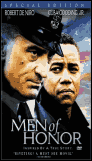
Men of Honor (2000)
Starring: Cuba Gooding Jr., Robert De Niro, Charlize Theron
Director: George Tillman
Plot: During the 1950's, a black Navy man decides to become the first African-American to become a Master Diver, but has to face military prejudice in the form of a violent, embittered trainer and the other trainees.
Review: A rather simplistic dramatic retelling of the true-life exploits of Carl Brashear, Men of Honor focuses on his battle against personal and institutional racism in the Navy of the '50s and '60s as he tries to train and become the first black Master Diver, and how he overcame these barriers as well as a debilitating injury. Yes, we've seen it all before in other military dramas, but director Tillman (Soul Food) manages to make the cliché-ridden script agreeable as well-paced entertainment and grand melodrama and keeps the narrative interesting enough to keep our attention. The highlight of the film is really the relationship between the two "men of honor", and any success the film has really rests on the solid performances by the two leads. Gooding Jr. is decent in the hero role, though his hard-headed nobility becomes irksome at times, but De Niro, as the bigoted, alcoholic master diver / trainer is consistently fascinating, playing an unsympathetic character and breathing life into him, making him a flawed but honorable figure. Of course, these two will end up with grudging respect for one another, and, of course, everything will turn out for the best - this is a "feel-good" drama after all. Theron, as De Niro's young wife, also does a great performance with the little screen time she has. Unfortunately, the last scene, a court battle for re-instatement, is manipulative in the extreme and leaves a sour taste after an otherwise acceptable story. Though Men of Honor isn't very original and way too predictable, it is captivating enough and does tread the fine Hollywood line between entertainment and drama well.
Drama / Entertainment: 6/10

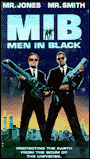
Men in Black (1997)
Starring: Tommy Lee Jones, Will Smith, Rip Torn
Director: Barry Sonnenfeld
Plot: A young NYPD cop gets in way over his head after being recruited by a mysterious government organization that controls the secret flow of extra-terrestrial alien immigrants on Earth.
Review: Based on the comic book series of the same name, Men in Black is a fresh comedy that plays on the paranoia of secret government agencies and UFOs, stuff that has always made great fodder for this type of film. What really makes the film such a delight is the clever, fast-paced, tongue-in-cheek script full of funny (heck, even hilarious) moments, and for once the amazing special effects really help the comic elements and the story instead of hindering it. Sure, some of the proceedings are expected and some clichéd, but there's a lot of original, inventive details and there's no denying the candid energy displayed on screen. In fact, one can't help but think this is all going too fast and that the film only barely touches on the possibilities of the material. If there was ever a picture dying for a sequel, this is it. Of course, much of the success also lies in the cast and the team-up of Smith and Jones is a perfect match - Smith is at his peak here in both charm and comic timing, and Jones proves he can do comedy as well as everything else with a terrific no-nonsense performance. With its frenetic pacing and great mix of comedy, sci-fi and action, Men in Black rightfully deserves its Hollywood blockbuster entertainment status.
Entertainment: 8/10

Men in Black II (2002)
Starring: Will Smith, Tommy Lee Jones, Lara Flynn Boyle
Director: Barry Sonnenfeld
Plot: An agent from a secret agency charged with tracking aliens on Earth must find a way to get his old partner's memory back as he's the only one who has the knowledge to save the planet from a dangerous she-creature.
Review: Men in Black II suffers from the usual sequel-itis, where everything is bigger but not necessarily better: the stakes are higher, the aliens more dangerous, the alien-busting paraphernalia is slicker, but everything else is lacking. The story starts with an amusing, cheesy "In Search Of..." spoof and goes downhill from there, with a script that contents itself to going through the expected motions with a plot that is rather uninspired and is at a loss to fill it's abbreviated running time. Gone is the chutzpah and giddy amusement of its predecessor, and no matter what is thrown on-screen, the film can't recapture that sense of surprise and freshness. Even the easy camaraderie between the two leads, though still in evidence, isn't nearly as pronounced or as effective as before with Smith now playing the straight man to both a tired-looking Jones and a talking alien dog (who actually has some of the biggest laughs). As for Boyle, as the multi-tentacled villain, she plays the role without the necessary campy energy. Still, director Sonnenfield knows to move things along in good summer-blockbuster fashion, the familiar characters are all back in action, there are some great one-liners, a few witty moments, and of course there's always the fun Stan Winston creature effects. Men in Black II is light fluff that's instantly forgettable, but for those in need of an MIB fix it's an enjoyable enough time-waster that does offer a few good chuckles.
Entertainment: 5/10

The Messenger: The Story of Joan of Arc (1999)
Starring: Milla Jovovich, John Malkovich
Director: Luc Besson
Plot: Haunted by divine visions, Joan of Arc leads French troops in the 15th century to push the English invaders from the conquered lands of France. But her victories are short-lived, and her faith is put to the test when she falls into English hands.
Review: Director Luc Besson (The Big Blue, The Fifth Element) takes his turn at adapting the story of Joan of Arc and has created a film that is more akin to Braveheart than it is to the classic The Passion of Jeanne d'Arc. Using artistic liberty in portraying historical events, the film tries to show how Joan of Arc was but a confused young woman with no divine inspiration who, by her strength of will and false faith, managed to inspire French soldiers to victory. Putting aside the constant anachronisms, as a grand "show" The Messenger succeeds admirably, using stunning, beautiful imagery and scenes of huge deployments and bloody battles. As a drama, though, it falls short. Milla Jovovich plays the title role convincingly, and the rest of the all-star American cast and the secondary French one do a fine job as well. Where it misses the mark is in its failure to keep the pace going: the battles become too long and the main character becomes secondary to the vast array of characters. The real problem arises two-thirds through, during the heroine's trial as a heretic, where the film tries to give us an intimate portrayal of Joan and ends up manipulating the audience's feelings, turning the picture into melodrama. A beautifully shot, exciting film that aims high, but ends up being a little long, and a little shallow.
Drama: 6/10

The Mexican (2001)
Starring: Brad Pitt, Julia Roberts, James Gandolfini
Director: Gore Verbinski
Plot: A hapless mob errand boy is forced to take an accident-filled trip into Mexico to recover an antique cursed pistol and ends up with relationship problems when his girlfriend is kidnapped as insurance.
Review: The Mexican, an obvious light-hearted vehicle for its two main stars, is a veritable mix of genres, combining romantic comedy, melodrama, and a crime caper. The story almost seems like two films spliced together, its two narrative tracts with very different flavors linked by the long-distance relationship struggles of its protagonists. Amazingly enough, director Verbinski (Mouse Hunt) manages to keep all these elements in play and find just the right balance of genres throughout the proceedings. Surprisingly, Pitt and Roberts share little screen time together, and they don't quite have the chemistry the audience might expect from them. Individually, though, they manage to capture our attention, especially Pitt who does a great turn as the likeable loser who always attracts trouble. Gandolfini, as the sensitive mob enforcer, is the only complex character and he does a fine job in the role. The budding friendship between Roberts and Gandolfini which make up most of the middle act of the film is typical Hollywood fare, well done and charming thanks to its two stars. But it's really Pitt's often hilarious misadventures, with its dash of action and an edge of black comedy, all shot in warm, sun-drenched colors, that really makes the film worthwhile. The script does show some excesses, and some slow spots, but with so much going for it one can excuse some of the meandering of the plot. It also provides a shocking turn of events at the three-quarter mark that raises its "offbeat" factor by a notch. Yes, it owes much to its star cast, but even without them The Mexican would still be a smart, funny and entertaining diversion.
Entertainment: 7/10

Miami Vice (2006)
Starring: Colin Farrell, Jamie Foxx, Gong Li
Director: Michael Mann
Plot: Two veteran undercover vice detectives infiltrate a vicious South American cartel but things get dangerous when one of them falls for the drug lord's wife.
Review: A big-screen and big-budget update of the trend-setting 1980's TV series, Miami Vice returns to the violent and tragic stories of old, mixing police procedural, sense-altering night-life, and doomed romance, a blend that the show was renown for. A surprising amount of the film captures the essence of the show, and some of the familiar themes of the show are definitely back: the allure of the jet-setting life with the fast cars and speed-boats, the steamy sex, the expensive suits, as well as the danger of falling into the life-style too deeply that you "don't know which way is up". But where the original was all about style over substance, this version is all about capturing a gritty, dark realism. Creator / writer/ director Mann returns to the fictional setting that made him a household name and shoots the film with the gritty video realism he brought to Collateral, but with the scope of Heat. Hat's off to him for producing a film that will defy expectations; this isn't typical summer action entertainment and some may be sorely disappointed by the dramatic drive of the story and how seriously the events are portrayed, or they might be pleasantly surprised at the down-to-earth approach and complex narrative. The climactic showdown though, a bullet-ridden gunfight to the finish, is as thrilling as anything we've seen and reminds one of the set-pieces in Heat. The problem is that there isn't anything new to add to the table that hasn't been better captured in Traffic or countless other films on the drug trade. The script does play with the idea of its hero getting lost into his role, but it doesn't go far enough. But the movie's worse offender is the pounding soundtrack; it might be another staple of the show, but here it's continuously jarring and ear-deafening. As the Crockett and Tubbs team, the leads are OK, if unimpressive - Farrell seems ill at ease in the role, and Foxx is just rather dull. Gong Li, however - in a surprisingly different turn from her usual art house pics - comes off best of all as the love interest torn between two worlds. All told, Miami Vice is an interesting, surprisingly mature adaptation of the original show that's perfectly crafted and paced - too bad Mann didn't have something more to say after 20 years.
Drama / Entertainment: 6/10


Michael Clayton (2007)
Starring: George Clooney, Tom Wilkinson, Sydney Pollack, Tilda Swinton
Director: Tony Gilroy
Plot: A burnt out high-priced fixer for a corporate law firm gets entangled in a conspiracy when a colleague, the top litigator for a bio-conglomerate, goes off the deep end.
Review: Taking its own tagline theme that "The Truth Can Be Adjusted", Michael Clayton is a nicely-paced legal thriller that doesn't provide many surprises but still manages to satisfy. For one, after such an array of films exploring the "good guys", here's an opportunity to see the other side of the coin. For once the "hero" is actually the villain of most of the legal-genre films (like A Civil Action or Class Action), the fixer who works for the big law firm that specializes in keeping Big Industry in business by hiding the nasty secrets from the public eye. The script and direction by first-timer Gilroy (the same one who penned the frenetic Bourne trilogy) is more adult than the usual fare and manages to capture some personal nuances that aren't usually seen in this kind of legal thriller. The cinematography and editing are also polished, making for a slick affair. With familiar elements of the "Evil Corporation" and its misdeeds that might have come out of a John Grisham novel or any of its film kin like The Rainmaker or The Firm, the tale itself comes off as rather banal and shallow. That's not to say its lengthy or boring, however: the pace is well set, and the script mines the right stuff. The big plus though are the fine, engaging performances from the main cast. Of course this is Clooney's show and he's perfectly cast as the suave but burnt out lawyer trying to pick sides. Just as effective are Wilkinson as the batty-but-brilliant litigator with a secret agenda, Pollack as the level-headed law firm boss, and a superb turn by Tilda Swinton as the insecure chief counsel for the mega-corporation who will do anything to defend her employer. These great turns add the needed heft to make the slick but otherwise average, mainstream Michael Clayton into something that's sure to please.
Drama / Entertainment: 6/10

Mighty Peking Man (Hong Kong - 1977)
Starring: Danny Lee, Evelyne Kraft
Director: Meng-Hwa Ho
Plot: A young hunter / explorer searches the Himalayas for a legendary giant, terrifying ape to bring it back to Hong Kong and falls in love with a jungle princess who was raised by the monster.
Review: Combining elements of Tarzan, the Japanese Godzilla / disaster movies, and (of course) King Kong, Mighty Peking Man was obviously made to capitalize on the success of the 1976 U.S. remake of King Kong. This is as cheesy a film as you'll ever likely to find, with bad acting, terrible dialogue, laughable extra-cheap special effects, and a story that will make you roll your eyes in disbelief. But this Shaw Brothers production knows it is pure kitsch and is more than happy to push it to the limits: there's a love story with a scantily-clad jungle woman with perfect make-up, there's elephant stampedes and leopard attacks, there's an earthquake scene, there's the greedy unscrupulous entrepreneurs, and there's a giant gorilla wrecking havoc on Indian villages and, finally, on Hong Kong itself, destroying buildings, crushing crowds, etc in the best monster-movie manner. What's not to like? A ridiculous, hilariously bad production, Mighty Peking Man has enough stuff blowing up and toy tanks blasting away to make any kid-at-heart nostalgic for the trash cinema of the '60s and '70s.
Entertainment: 5/10

Million Dollar Baby (2004)
Starring: Hilary Swank, Clint Eastwood, Morgan Freeman
Director: Clint Eastwood
Plot: An elderly boxing trainer with his share of personal demons reluctantly agrees to take a tough, determined woman under his wing to bring her to the international stage.
Review: Based on a series of stories from novelist Rope Burns, the premise of Million Dollar Baby might have one thinking of the indie flick Girlfight, but the film goes out of its way to make itself into a gritty, no-holds barred account of a woman with nothing to lose. Though not as masterful as his own Mystic River, actor / director (and composer) Eastwood (Unforgiven) brings another perfectly executed tale to the screen with an eye for each scene, a pacing that's just right, and a shadowy, green-tinged cinematography that's fabulous. In the end despite its attention to athletic details, the occasional genre clichés, the grueling training and the rousing (and very bloody) bouts, the boxing is only the medium for the story about two lonely, broken souls trying to connect with the world around them. Indeed, the father-daughter relationship between the two leads is splendid and never forced as the two slowly share their hopes but are confronted by their own inner demons. Swank seems completely committed to the role and is completely convincing in and out of the ring, though she doesn't get much of a chance to try out a lot of range. Eastwood and Freeman, however, as grizzled old veterans of the sport, are very comfortable together and the tight bond between their two cranky characters is terrific to behold. The rather unexpected tragedy in the final act, and the moral dilemma that goes with it, is perhaps the whole point of the picture - how far are they willing to trust each other when all the cards are down? Unfortunately, marring the tale is a jarring sense of emotional manipulation during these moments that does get a bit crude, such as the clash between our heroine and her white trash family or the constant reminder of her final fate. The story, narrated by Freeman, was powerful enough without these dramatic liberties, and it's too bad the script couldn't find a better way around them. Despite this, Million Dollar Baby remains another solid achievement for Eastwood, a strong drama that's worth the effort.
Drama: 8/10

Millionaire's Express (Hong Kong - 1986)
Starring: Sammo Hung, Yuen Biao, Cynthia Rothrock
Director: Sammo Hung
Plot: A shady businessman decides to derail a train carrying many wealthy people near his hometown to bring in much needed income. Unfortunately, a gang of thieves also targets the train forcing the villagers and the train passengers to combine their efforts to stop them.
Review: Millionaire's Express is a wonderful collage of many different movie genres: classic western, martial arts, adventure and slapstick comedy. Amazingly enough, it works! The action scenes are amazing, especially the ones with Yuen Biao, the story zips along, and there are enough zany characters to make your head spin. All in all, a very entertaining film.
Action: 8/10
Entertainment: 8/10

Millions (2005)
Starring: Alex Etel, Lewis McGibbon, James Nesbitt
Director: Danny Boyle
Plot: Following the death of his mother and his move to another community, a troubled young boy is surprised to have a bag full of pounds literally drop into his lap, forcing him and his older brother to spend the money in secret before the country switches to Euros.
Review: A light-hearted, gentle comedy, with a nice little drama at its core, Millions is a shining example of a family film done right. Based on the old moral that money doesn't solve everything, the film is told as a modern fable as narrated from the point of view of an 8-year old. Keeping that premise in mind, the film examines religious faith, loss, and the power of money with the imaginative and eye-opening logic turns only a child could come up with. Despite these many flights of fancy, the story remains surprisingly down-to-earth which means it stays believable enough to keep us grounded in the characters' plight. Sure, there's the usual sentimentality we've come to expect from family fare, but it's under-stated and well-placed in the context of the story. Who would have thought that the director of such hard-hitting, violent and often harsh films like Trainspotting, Shallow Grave or 28 Days Later could actually give us such a high-spirited and charming family film? Gone is the grim edge showing the worst of human behavior - what hasn't disappeared is the clever scripting, the clever ideas, the stylish direction and the impeccable cinematography. But much of the success also goes to young Etel who is just terrific as the boy who sees visions of the (very hip) Saints telling him how best to use the money to help the poor, with often hilarious results. A restrained McGibbon as the older, more capitalist-minded brother makes a fine straight-man and provides some pointed commentary on the state of present middle-class society. The main adult influence, made up of dad Nesbitt and new girlfriend Daisy Donovan, make do with broader performances, as does the supporting cast made up of school friends and some eccentric neighbors. All told, Millions brings together various elements into one nice package: rich visuals, warm sentiments, humorous touches and a smart script - what else could you want from a family flick?
Entertainment: 7/10

Mindhunters (2004)
Starring: Val Kilmer, Christian Slater, LL Cool J
Director: Renny Harlin
Plot: Dropped in an isolated island training ground, a group of FBI trainees discover that their practice session has turned deadly when it turns out that one of their numbers is actually a vicious serial killer.
Review: There's no real wonder the formulaic serial-killer thriller Mindhunters was left on a shelf for almost two years before being jettisoned into theaters. The B-grade high-concept affair could have been an interesting entry in the genre but the script is mired in a narrative that only lives for misdirection, keeping audiences guessing with continuous twists and mind games, all logic be damned. At least the method of each one's death is morbidly intriguing, but it's no Saw or Seven. And if these paranoid, uninteresting characters are the cream of the psychological profiling division crop, it's a pretty sad day for the FBI. In fact, it takes more than half the film for any of their training to actually kick in - and when it finally does it's presented in such a ludicrous manner that it would make even CSI viewers cringe. Still, commercial director Harlin (Die Hard 2, Deep Blue Sea) knows his stuff and can even make sub-standard material workable on