Movie Review Library - F

Make sure you see the Latest Video Reviews page as well!
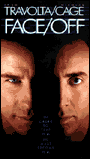

Face/Off (1997)
Starring: Nicolas Cage, John Travolta, Joan Allen
Director: John Woo
Plot: A special agent agrees to undergo breakthrough surgery to take the face and identity of a psychotic international terrorist to infiltrate a high security prison but soon discovers that the criminal has taken over his face and his life as well.
Review: One of the most intelligent and exciting action films in years, Face/Off demonstrated what acclaimed Hong Kong director John Woo (Hard Boiled, The Killer) could really do with a good script and a Hollywood budget. The direction, camera work, cinematography and editing are superb. The countless hyper-kinetic action scenes are amazing, with stunts that would make any other action flick green with envy. The story itself is just as interesting, keeping the audience on its toes as it takes twists and turns, and deals with mature situations in a manner that is quite refreshing for the genre. Of course, much of the success of the film is due to the terrific casting of Travolta and Cage, who perform with all the frenzy and debonair charm of actors who are really having fun with the material. Highly recommended.
Entertainment: 9/10

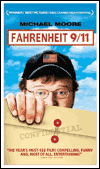
Fahrenheit 9/11 (2004)
Director: Michael Moore
Plot: Documentary look at the aftermath of September 11 and the invasion of Iraq, especailly the ties between Saudi Arabia and the Bush Administration.
Review: Incredibly biased, inflammatory, and thoroughly fascinating, Fahrenheit 9/11 is a 90-minute character assassination of current president George W. Bush, taking audiences from the electoral "theft" of 2000, to the chaos that was 9/11, and to the ensuing "war on terrorism" and invasion of Iraq. The real meat of the film is the revelation of the tight links between the Bush family and several wealthy Saudi Arabian clans (including the Bin Ladens), and how the Bush family and friends' private business dealings has affected America's politics. He makes a strong case, as well, over the way that the Republican government has spread fear-mongering over terrorism and kept Amercian society in such a state of chaos and paranoia that has led to some very un-democratic (the word "fascist" is heard) way at which 9/11 has been used to gnaw away at our rights. Going off on a tangent, it also shows us the "other" face of the war, the one we don't see on the major networks: the cindered corpses of US soldiers being dragged by cars and hung in Fallujah, burnt children filling up hospitals, and other atrocities. This part gives us the feeling of seeing the guerilla reporting that was so effective in ending the Vietnam war at home. The film falters when Moore tries to milk the grief of a mother from his hometown. By trying to put a "human face" to his diatribe, he's actually at his most exploitive, obviously trying to hit the most shallow, easy emotions of his audience. Though this part is undeniably heart-breaking for his subject, it's not quite as effective in getting us riled up. And that's what Moore wants most of all: agree or disagree, he wants to force the issues to light and toppling Bush is the main concern. Though some of his comments and opinions aren't quite followed-through with absolute journalistic integrity, and much of the film feels like filler once the initial surprise is dealt with, there's no denying that Moore is a perceptive rabble-rouser who knows how to be a popular entertainer and how reach the masses. His leanings are definitely to the left, but none of his messages are anything but patriotic - he just doesn't believe in Bush and is using his favored medium to say it. Isn't that what free speech and "the American Way" is all about? There's less of the humorous parodies and sequences than his previous success, Bowling for Columbine, but some comedy still appears as stock footage (mostly embarrassing moments by Bush and colleagues). Other moments, such as a skit with Bush and friends as the characters of Bonanza, are laugh-out-loud funny. Indeed, throughout there are many instances where some might guffaw while others will be shocked, the humor indelibly mixed in with horror at the events, schemes, and connections between all these players. Though there might be some dissenting opinions on the manner in which he presents his case, and on his leaps and connections, Moore sets forth a convincing arguments and there's no doubting the facts that are presented. Fahrenheit 9/11 is at its best when it pummels the Bush administration over its actions and hypocrisy post-9/11, but by blurring the notion of entertainment and documentary Moore has created the first truly "pop" diatribe - and what a show it is. Winner of the Palme d'Or at Cannes.
Documentary: 8/10

Fail-Safe (2000)
Starring: Richard Dreyfuss, Brian Dennehy, Noah Wyle
Director: Stephen Frears
Plot: During the height of the Cold War, a computer error accidentally sends a U.S. bomber squadron on a mission to nuke Moscow forcing the Americans and Soviets to cooperate to have any chance at stopping them.
Review: The latest adaptation of the novel Fail-Safe is a rightly plotted remake of the 1964 original, which pays homage to its precursor by using the same stark black and white presentation, identical setting, and complete lack of musical scoring. The twists and turns of the plot are mostly consistent with the original, and the outcome is still as shocking and terrifying as they were during the Cold War. Much has been touted about the fact that this was aired "live" on TV and, though the feel of the film is at times theatrical, the production is first-rate given the inherent limitations of the medium. Despite these restrictions, the efficient camerawork and set shots, as well as the inventive live editing, only add to the great dialogue and narrative. The impressive all-star cast manages to give performances that are subdued but still intense, particularly Dreyfuss as the president and Harvey Keitel as an even-headed general. Providing an intelligent script, nail-biting suspense, and good production values, this new live version of Fail-Safe proved to be one of the best television events of the year.
Drama: 8/10

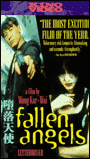
Fallen Angels (Hong Kong - 1997)
Starring: Leon Lai Ming, Takeshi Kaneshiro
Director: Wong Kar-Wai
Plot: The story of two Hong Kong men and their relationships with the people they meet during their nocturnal wanderings.
Review: Director Wong Kar-Wai continues his twisted views of love and relationships started in Chungking Express and Happy Together. The film is shot using only a hand camera, and it captures the hectic nature of Hong Kong, balancing it with quiet, almost static moments. The film is a slow, sweet, and often depressing look into the lives of some eccentric, confused characters. Not as successful, nor as original, as the first two, but still fascinating to watch.
Drama: 7/10

Fame (1980)
Starring: Irene Cara, Lee Curreri, Paul McCrane
Director: Alan Parker
Plot: A new group of students enters a New York performance academy and spend four difficult years 
aspiring to transcend their roots and become a star.
Review: Many remember the popular 80's teen-spirit musical Fame not from the movie but from the hit title song by actress / singer Irene Cara. The strong points, of course, are the energetic (if badly inserted) musical numbers with their catchy '80s tunes, including the now-famous dance on top of NYC taxi cabs and some impromptu jam sessions. The film focuses on the ordeals in school and the sometimes terrible difficulties in the student's home lives; there's a bleakness in the portrayal of their social environment which they are desperately trying to escape from that hits home, and the nasty social elements that will test them. The obvious message is that the world of fame is a ruthless and fleeting one; it takes more than mere talent, and only the most persevering make it big. Of course, we get a wide range of backgrounds: from the mousy Jewish girl, to the loud-mouthed jerk with a heart of gold, passing through the necessary gay character as well. All these protagonists are dying to show their intensity and will to succeed but, despite the charismatic young cast, the acting isn't quite up to par. It doesn't really help that the fragmented story only offers a Cliff's Notes version of four years in the lives of these teens, showing only the more melodramatic highlights. Still, these scenes are never long enough to be tiring, skipping from one group to the next rather quickly. Director Parker (who went on to do other, better musicals such as The Wall and The Commitments) actually does quite well with the mainstream material and keeps things moving along to ensure audience attention. An '80s American pop culture icon, Fame may be a bit dated for modern tastes, but it still hits the right notes.
Entertainment / Drama: 6/10

The Family Stone (2005)
Starring: Claire Danes, Diane Keaton, Rachel McAdams, Dermot Mulroney 
Director: Thomas Bezucha
Plot: An uptight businesswoman agrees to spend the Christmas holidays with her fiancée only to realize that integrating with his free-spirited, outgoing family won't be easy.
Review: Another entry in the Christmas-family-reunion dramedy genre, The Family Stone ends up only being slightly above-average. It's a breezy affair from the start, but there are so many family members, each vying for screen time, that it takes a while to really get going. Writer / director Bezucha does know his stuff when it comes to building up his ensemble cast, though, and he makes an easy-to-like picture even if the complications that start stacking up (from a terminal illness to sudden attractions that are more convenient than believable) border on the absurd. It's all pretty familiar, and though there's the occasional stab at drama, it's too full of easy sentimentality to be affecting. If there's one thing it succeeds at, however, it's showing a tender side to the comedy, a family that loves and cares for each other despite their differences. The fish-out-of-water humor gets a tad repetitive, but the final act, where all the goofiness, mix-ups, misunderstandings and true feelings finally come out in a chaotic, slapstick series of mishaps and embarrassments is worth the wait. Parker is effective if not quite sympathetic in a stereotypical stuck-up role, but Mulroney as her fiancée barely registers here. Thankfully the rest of the appealing cast carries the film, from Keaton's good-willed matriarch to Luke Wilson's hippie-like bro', but it's Danes, as Parker's younger charming sister, that really lights up the screen. The Family Stone is easily digested, the cast is engaging, and there's enough good-natured humor to make it appealing, if not memorable - just what a family reunion should be.
Entertainment: 6/10

Fantasia 2000 (1999)
Director: Gaetan Brizzi, Paul Brizzi
Plot: A series of short animated productions are presented to accompany a wide range of classical orchestral music.
Review: This new version of Fantasia has much more mass-appeal than the original. Gone are the heavy, dark, and ballet-based segments replaced by seven brand-new productions full of color, movement and humor. The variety of musical selections is interesting, including Gershwin's Jazzy Rhapsody in Blue and some unfamiliar classical compositions such as Respighi's Pines of Rome. Each of these is presented with a different style of story-telling and animation, from simple line-drawings based on Al Hirschfeld caricatures, to dazzling colorful geometrical dances, to computer-enhanced sequences, presenting a real evolution from the animation first shown in the 1940 version. The final segment, a beautifully created opera-like production of Stravinsky's The Firebird Suite, is particularly enchanting. The only odd note is the inclusion of the original number The Sorcerer's Apprentice on an IMAX presentation: with such a large canvas it shows its age and the grainy quality of the existing stock. That aside, Fantasia 2000 is truly a visually magnificent production that justly deserves to be seen on an IMAX screen.
Entertainment: 8/10

Fantastic Four (2005)
Starring: Jessica Alba, Ioan Gruffudd, Michael Chiklis
Director: Tim Story
Plot: After being exposed to cosmic radiation, four scientists / astronauts gain incredible powers and must face their financial backer who, also affected by the storm and spurned by his ex-fiancé, is bent on destroying them.
Review: Based on the long-running series created by Lee and Kirby, Fantastic Four was a long time coming and the end result is a minor success. Though not in the league as the best of Marvel screen efforts such as X-Men or Spider-Man and despite the frenzied criticisms piled on by comic fans, the adaptation is still nicely above average and provides some good, clean fun. Though a more serious take on the story would have probably been better received, this light-hearted adaptation with its good-looking cast will probably prove to be more popular with mainstream audiences. Having had experience with such ensemble comedies as Barbershop it's no surprise to see director Story helming the tale more as comedy, mixing in the dramatic elements with slapstick. Sure, there was humor in the books, but the film is often too much tongue-in-cheek, as if the filmmakers required it to be dumbed-down for pre-school levels or as if winking that even they think this is all just too silly. Still, distilling 40 years of comic book history into 90-odd minutes is always a challenge, and as is the case with these movies some things are surprisingly faithful to the comic books while others are not. For the most part the many effects work well and bring the astonishing events and heroics to life. If the movie is a little bare on action until the final act (the inevitable high-powered fight with Doom), it has judiciously focused on the real appeal of the books, and that's the character dynamics. They're a dysfunctional family, and this aspect is captured well: Reed's guilt, Ben's loneliness, Johnny's hot-headedness, Susan's frustrations... If the script sometimes devolves these clashes into teen-level bickering, at least it keeps things lively (such as the antics between The Thing and The Torch). The lead cast won't win any awards for their acting, but there are two performances of note: Chiklis as The Thing manages to bring pathos to the role despite being fitted with a bulky rock-costume, and Alba actually gets a chance to be more than a swimsuit model, though she never quite convinces as a scientist. If there's one disappointment it's that Doom, relegated to a spurned lover and amoral business-man, is nowhere near as terrifying or tragic a figure as he should be, coming off as a lightweight challenge instead of a true nemesis. This isn't quite the Fantastic Four of the comics and it's nowhere near the potential fans were hoping for, but there's a definite energy and likable demeanor that makes one actually look forward to the inevitable sequel.
Entertainment: 6/10

Farewell My Concubine (China - 1993)
Starring: Leslie Cheung, Zhang Fengyi, Gong Li
Director: Chen Kaige
Plot: During a time of great change in 20th-century China, two apprentices become famed performers of the Peking Opera and have a tumultuous relationship over a fifty-year period.
Review: With Farewell My Concubine, director Kaige (King of the Children, The Emperor and the Assassin) has brought an era to vivid life with a drama that successfully balances the epic and the intimate with seeming ease, bringing the backstage intrigue of the Peking Opera to life. Through the eyes of the two performers and the woman that comes between them it attempts to give us a glimpse at the varied, turbulent 20th century China, their private lives playing out on the backdrop of Chinese history. For them, the line between the harsh reality and the stage has become blurred, and their faces and actions convey a quiet urgency underneath the calm exterior. Kaige creates a fine tapestry of the various relationships with depth and sensitivity, and the characters come out of it fully formed, believable, and all too human. There's also a visual splendor throughout, with every moment filled with lavish details, costumes, and interesting color schemes. Though no part of China's history is spared a critical eye, the Communist movement especially is denounced as a soulless regime, which would probably explain the film being banned in its own country. In fact, the sequence where the the three are forced to denounce one another while taken in by a throng of a crazed mob during the Cultural Revolution is one of the most emotionally-devastating scenes ever put to film. Throughout these scenes, the film manages to stay firm and true in its narrative goals, never veering into easy melodrama, and its careful attention to detail and its atmospheric approach it provides a very affecting portrait of a world few of us know or remember. As for the cast, it is uniformly excellent, and Li and Fengyi perform brilliantly in bringing their complex characters to life, but it is Cheung's masterful portrayal of the stage actor assigned to play the role of the transvestite concubine that really leaves an impression. Farewell My Concubine is an ambitious, memorable undertaking, one that deservedly won the Grand Prix at Cannes.
Drama: 8/10

The Fast and the Furious (2001)
Starring: Vin Diesel, Paul Walker, Michelle Rodriguez
Director: Rob Cohen
Plot: A young cop goes undercover to infiltrate a gang of truck hijackers but soon gets caught up in the drag racing scene when he finds himself enjoying the sport and the company.
Review: The thrill of racing is primordial, and the filmmakers have succeeded in producing a rather enjoyable, if dumb, racing flick with The Fast and the Furious. Moving things along at a breakneck pace, from some adrenaline-pumping car chases and spectacular crashes to a finale that's straight out of The Road Warrior, director Cohen (The Skulls, Daylight) manages to imbue the film with a great sense of speed. Though the story is rather banal and predictable and includes some plot holes big enough to drive a semi through, it's a pretty slick production, one that's well shot and well edited, reminding one of similar recent flicks such as Gone in 60 Seconds. It's enough to allow us to suspend our sense of disbelief and simply enjoy the ride. Sure, lead man Walker reminds one of a Keanu Reeves clone, right down to the vocal inflections, and Rodriguez who was such an inspiration in Girlfight is wasted in a snarling role, but Vin Diesel does another charismatic performance with little to work with. This is a racing car flick, however, so the souped-up imports the real stars and in its presentation of them the film never disappoints. Fast cars, cool looking people - that pretty much sums up the The Fast and the Furious, but it's surprisingly effective fare for a shot of testosterone-fueled entertainment.
Entertainment: 7/10

Fast Food, Fast Women (2000)
Starring: Anna Thomson, Jamie Harris, Louise Lasser
Director: Amos Kollek
Plot: A waitress at a local diner filled with eccentric characters tries to revitalize her social life after realizing her married boyfriend will never commit to her.
Review: Fast Food, Fast Women is a romantic-comedy specifically tailor-made for director Kollek's leading lady Anna Thomson, and it shows. Their past collaborations have been emotionally intense, powerful, bleak works (Fiona, Sue in Manhattan), and here they have decided on a very different path. The story tries to add a touch of depth and to the standard cookie-cutter romantic comedy, and should be applauded for presenting a burgeoning relationship with an older couple, as well as its young one. The multiple inter-connected stories and quirky characters are occasionally quite charming and some of the moments between them clever, revealing, and even touching. However just as often the events seem very forced, relying on ridiculous coincidences to make its point, with character interactions that are just plain silly. Despite these awkward moments, the film does entertain and does try to provide some insights into the idea of romance. As for Thompson, she is a remarkable presence, both odd and charming in a carefree sort of way, and on her own makes the whole proceedings worthwhile. Fast Food, Fast Women has its merits and is quite a change of pace from Kollek's previous works, but it's a rather unimpressive effort.
Drama / Comedy: 5/10

Fast Times at Ridgemont High (1982)
Starring: Sean Penn, Jennifer Jason Leigh, Judge Reinhold
Director: Amy Heckerling
Plot: Different high school seniors discover the problems involved in relationships, sex, and (in one case) how to get by when you're perpetually stoned.
Review: A precursor to many of the biggest teen comedy hits of the 80s and 90s, Fast Times at Ridgemont High was a surprise hit when it first arrived in theatres and is still admired by some, but it just can't help feeling already dated. The denizens live in a perfect teen world: shiny shopping malls, outdoor pools, fast-food jobs, and no parents to be seen anywhere. The biggest concern is sex; sex is on everyone's mind, especially the 15-year-old heroine who can't decide between experimenting sex with older men or starting a relationship. Apart from a quickly and easily remedied abortion issue, nothing really bad happens here, and there are no "bad" people per se. How things have changed: in the early 80's this movie was probably a good indication of what movie-goers expected (or remembered) high school should be. These days, it seems nothing if not quaint and rather silly. The kind of down-played humor and low-key sentimental longings found throughout probably won't do for modern audiences expecting "real" drama or hearty laughs. But this effort was made by director Heckerling (Look Who's Talking, Clueless) who ably captures the caricatures and comedy of teen life, and by first-time writer Cameron Crowe (who went on to write and direct, most notably, Jerry Maguire and Almost Famous) who shows off his ease in capturing the sentiments and young relationships better than most Hollywood scribes. But the most interesting aspect of the film is the cast of then-unknowns, led by stoner Penn capturing the essence of the "yo, dude" attitude in his first starring role and cherubic young Leigh as the innocent girl-next-door. The cameos included appearances by Eric Stoltz, Forest Whitacker, and even Nicolas Cage (in a brief throw-away scene). In the end, Fast Times at Ridgemont High is a sweet little coming-of-age comedy that may have grown old but that still has some appeal left to it.
Entertainment: 5/10

Fear and Loathing in Las Vegas (1998)
Starring: Johnny Depp, Benicio Del Toro, Christina Ricci
Director: Terry Gilliam
Plot: A two-bit journalist and his bottom-basement lawyer take a drug-binge trip to Las Vegas to find the "American Way of Life" with a trunk-load of every conceivable type of dope to help them on their way.
Review: Making a film based on Hunter Thompson's free-flowing hallucinatory novel is almost impossible, something immediately noticeable with director Gilliam's (Brazil, Twelve Monkeys) adaptation of Fear and Loathing in Las Vegas - an interesting experimental film trying to grasp the mind-altering '70s acid culture, but one bound to failure. As pure Art, the film has much going for it - from the psychedelic sets to the in-your-face cinematography, all accompanied by a classic soundtrack, it manages to put us into the mind-set of a real bad trip brilliantly. It may not be realistic, but it terms of imaginative excess, the film really takes the cake. Indeed, in a perverse sense, this whole degrading trip is fascinating, but there's only so much that an audience can take of this Dada-inspired frenzy. If all these scenes were at least interspersed with some kind of story that would glue it all together, or at least balance them with some moments of sanity, we could have appreciated the instances of doped-up excesses. Instead, Gilliam provides one crazy, disgusting, confusing, headache-inducing moment after another, providing lots of disjointed, non-linear sequences without providing any cohesive center except for the narrator's quips and witticisms to give it all some false sense of focus. As for the two main actors, Depp runs around in a forced goofy-like, and very self-conscious, performance but Del Toro, playing the faithful sidekick, is splendid within the limits of the script. As it stands, Fear and Loathing in Las Vegas is a bizarre, whacked-out trip that is interesting to watch in small doses, but becomes very repetitive very quickly and ends up only as sensory overload.
Entertainment: 3/10

Fearless (Hong Kong - 2006)
Starring: Jet Li, Betty Sun, Shido Nakamura, Yong Dong
Director: Ronny Yu
Plot: At the dawn of the 20th century, an arrogant young martial arts master faces personal tragedy when he kills an opponent in a drunken duel, leading him to find peace within and a new goal in creating a national sports school.
Review: Fearless marks a great return to true martial-arts form for star Jet Li in a lavish, big-budget Hong Kong production with Hollywood backing. Though the film is (surely loosely) based on the true life story of Chinese Master Huo Yuanjia, the founder of the international Jin Wu Sports Federation, it is surprisingly clichéd; how much of it was modified for dramatic purposes is open to debate, but it's clear that the script's intent is more entertainment value than historical document. Facing colonialist pressures, Huo was also a hero for the Chinese everyman and, though based on the early 20th-century social context, the film delivers a jingoistic message, a call to arms for the Chinese against the invading Western world (none were more so than Li's own Born to Defense). Yet, the dramatic elements are way too blunt and not quite as effective, and the cast stretches their acting abilities - for actions fans the middle section where our hero learns monastic serenity will be slow going. Thankfully, the melodrama is kept secondary, giving reign to loads of grand kung fu fighting, from the village competitions for local champion, to a bone-crunching battle between two masters, right down to the four-against-one climax. Back to true martial-arts form, Jet Li swaggers, kicks, and lets loose better than he has in years in a performance that sits somewhere between his classic stints in Fist of Legend and Once Upon a Time in China. Sure, there's some obvious use of wire effects to enhance the choreography (done by none other meister Yuen Woo Ping) but his martial arts skills are still very much in evidence, and it looks 10 times better than anything Hollywood has managed to produce in that area. Director Yu (The Bride With White Hair) has also gone back to his roots after his last American excursions (Formula 51, Freddy vs. Jason), and it's great to see him back in the fold. Technically speaking, the production is top notch and the film very slick, enhancing the look and feel that will be very familiar to anyone who has experienced HK period films. If Fearless is Jet Li's Swan Song he couldn't have picked a better venue for his action-retirement bash.
Entertainment: 7/10

Felicia's Journey (1999)
Starring: Claire Benedict, Bob Hoskins, Arsinee Khanjian
Director: Atom Egoyan
Plot: A young Irish woman comes to England to find her estranged lover only to fall into the clutches of a lonely middle-aged caterer who spends his nights watching tapes of an old TV chef. 
Review: On the surface, Felicia's Journey could be seen as another psychological suspense and horror film, but this would be an injustice. Like his other features, Atom Egoyan tries to delve deeper, providing a dramatic story that is not formulaic and hinting at subjects that Hollywood would shy away from. The film's protagonists are also complex, emotionally scarred, real characters that are neither stereotypes nor predictable, and both are played admirably. Egoyan uses his familiar approach of repeated flashbacks and interesting camera work to slowly unfold the story and the character's backgrounds. Where the film loses its power, though, is in its ending: by taking the easy road out of the successful narrative, it seems to cheat the audience from an otherwise fine film. An interesting, well-made film, but not quite on par with the director's latest efforts like Exotica and The Sweet Hereafter.
Drama: 7/10

Female Convict Scorpion (Japan - 1974)
Starring: Meiko Kaji 
Director: Shunya Ito
Plot: Refusing to break under torture, a strong-spirited female prisoner escapes alongside some fellow convicts and is chased through the countryside by an obsessed warden.
Review: Female Convict Scorpion, the second and arguably the best installment of the cult "women in chains" series, takes its cue from the very worst of exploitation flicks (including the use of gunfights, sickening violence, and gruesome, appalling scenes), but soon surprises. The film manages to evade most of the misogynistic trappings inherent in the genre. Indeed, hidden beneath the surface is an interesting political and social commentary on "modern" Japanese culture, that is on women trapped in a social system that sees them as far less than equal. The film also has aspirations towards being an Art film, and some of the visuals and cinematography are quite impressive. Indeed, the fact that such modern film-making techniques, great use of colors, and even social commentary was passed on as entertainment in the early 70's is a feat in itself. Another reason for its success is actress Meiko Kaji, doing a great Clint Eastwood impression - with little dialogue, a tough-as-nails attitude and lots of glaring, her character is just as mesmerizing and mysterious as The Man (Woman?) With No Name. Fantastically bizarre, Female Convict Scorpion is one of that rare breed of films that manages to be both grossly exploitive and vastly entertaining, and still leave a strong impression with its audience.
Entertainment: 8/10

Femme Fatale (2002)
Starring: Rebecca Romijn-Stamos, Antonio Banderas, Peter Coyote
Director: Brian De Palma
Plot: After a heist goes bad, a female jewel thief tries to escape her vicious French partners by leaving for America but when her new husband is stationed in Paris a photographer forces her to face her past.
Review: One would guess that Femme Fatale is perhaps meant as a modernizing of the Film Noire thriller, or at least a parody to the genre, but though it has its titillating moments it's never quite convincing or engaging enough to get us involved. The film seems to take a good 45 minutes to start: the opening sequence, a messed up heist during the Cannes film festival involving a diamond-studded dress and a lesbian bathroom scene (all done with little dialogue) sets the tone of the film immediately. The plot is convoluted, schizophrenic, and - in a surprise twist - veers at one point into almost pure fantasy. It's obvious De Palma and company are having fun with the concept, keeping audiences on their toes guessing what will happen next. The whole affair has the feeling of a very slickly made, campy excess, and the occasional humor works to make it at the very least intriguing. On the downside, it also seems to take itself too seriously to be straight camp and it's too silly to be an homage to the director's obvious muse, Alfred Hitchcock. Not to say it's not interestingly shot, but the pacing is never quite right, the story feels like a hodge-podge of different cool sequences, and the ... This is really second-rate De Palma, who's films have veered between terrific (The Untouchables), to classically over-the-top (Scarface) to the ludicrous. Here he's in full exploitation-flick mode, much akin to his own 1984 Body Double which then starred a young Melanie Griffith as the femme fatale. As for the cast, Romijn-Stamos was obviously chosen for her body more than her acting skills, and there are many gratuitous instances where this is made obvious. Also devoid of any of his usual charisma is Banderas, as the rather bumbling photographer caught in her clutches, who makes little impression here. Femme Fatale will probably have its share of admirers, and as a big-budget exploitation flick it might be worth a look but the better parts just don't make up a fulfilling whole.
Entertainment: 4/10

La Femme Nikita (Nikita) (France - 1990)
Starring: Anne Parillaud, Jean-Hughes Anglade, Jean Reno
Director: Luc Besson
Plot: A secret organization gives a condemned murderess and junkie another chance at life by forcing her to become an assassin for the French government.
Review: Nikita offers something that's usually missing from action films: a great, involving story with some good actors. You can't help but be charmed by the heroine, played marvelously by Parillaud and feel for her situation. Director Luc Besson knows how to give heart-wrenching portrayals of his characters and liven things up with intense, exciting action sequences. A great film topped off with a wonderful appearance by fan-favorite (and Besson icon) Jean Reno as "the Cleaner". Vastly superior to the poor American remake Point of No Return.
Action: 8/10
Entertainment: 9/10

Fifth Element, The (1997)
Starring: Bruce Willis, Gary Oldman, Milla Jovovich
Director: Luc Besson
Plot: In the 23rd century, an ex-commando must join forces with the female embodiment of the fifth element to fight against a villainous tycoon and his alien mercenaries to stop the arrival of an Anti-Life entity ready to destroy the universe.
Review: A true space opera in both style and scope, The Fifth Element delivers incredible special effects with an entertaining romp into a future only European illustrator Moebius could invent. Director / screenwriter Luc Besson also has a lot of fun with the material and meticulously re-creates a European-style SF graphic novel to good effect. But while the film is beautiful to look at, it lacks in the story department and never reaches a point where you really care for the characters or for the plot.
Entertainment: 7/10

Fight Back to School (Hong Kong - 1991)
Starring: Stephen Chow, Cheung Man, Ng Man-Tat
Director: Gordon Chan 
Plot: To recover his superior's beloved pistol, stolen during a high school visit, a brash police officer must go undercover as a student, but with local gangs and homework he soon has his hands full.
Review: Fight Back to School is another mixture of genres for Chow, combining a situational, fish-out-water comedy, a bit of romance and a good dose of martial artistry. Chow is much more subdued here and the comedy isn't over the top as in his other comedies (such as God of Cookery) and this actually makes it the better for it. There's still many moments that stretch usual credibility, but it's so amusingly silly that, from the opening action sequence when Chow takes the time to put lip balm and eye drops as his SWAT team prepares to storm into a building, one quickly accepts most of the goings-on for the sake of being entertained. The film is filled with hilarious back-to-school gags mostly regarding the bullying at an all-boys school, his lack of discipline and his terrible level of education, including a hilarious instant as Chow tries to cheat on a surprise test with the help of the whole police department. There are also some very good fight sequences against the triads muscling into the school proving that Chow is also an accomplished physical actor. In some instances the comedy elements aren't as funny or original as they could have been, or some scenes are simply stretched a little thin and the story loses its inertia. Still, it's always consistently entertaining, and there's enough going on, and enough typical Chow energy throughout, that Fight Back to School is a light-hearted romp that's definitely worth the effort.
Entertainment / Comedy: 7/10

Fight Club (1999)
Starring: Edward Norton, Brad Pitt, Helena Bonham Carter
Director: David Fincher
Plot: An insomniac and a fast-talking salesman, disenchanted with their life and society, try to redeem their existence by starting an underground fighting club and plunge into a life of violence and anarchy. 
Review: Fight Club is a trip through the dark psychological recesses of these men's minds, where violence is the ultimate release from the crass consumerism that passes for individualism in our society. It is a jab to the jugular of conventional Hollywood movie-making, and is doubly impressive because of the stellar cast, crackling dialogue, and the chances it takes with the audience that would probably even daunt some independent film-makers. It's an extremely violent, thought-provoking film, full of animal rage, dark humor and cynicism that tries, and mostly succeeds, in peeling away the veneer of our modern life-style. The film stumbles a bit at the very end, but by then it's gotten under your skin. The audacity of the subject matter and delivery, including the dark, gritty film-making style that have become director Fincher's trademark (Seven, The Game), have combined to produce one of the most intense, fascinating and shocking film experiences of the year. Very highly recommended.
Drama: 10/10

Final Destination (2000)
Starring: Devon Sawa, Seann W. Scott
Director: James Wong
Plot: After saving his friends from a doomed plane on the merits of a particularly vivid dream, a teenager must now find why each of them is dying off one by one.
Review: Like many other recent films, Final Destination plays on the idea of a group of teenagers being killed off by a mysterious killer but its distinct step into the supernatural gives it a slight advantage. Writers / producer / director Morgan and Wong have learnt a lot from their long stint on the TV series the X-Files, from playing out the suspense in a scene, to the constant misdirection of the camera, to the camera-work and the dark tones of the sets to provide a spine-tingling, generally unpredictable, and entertaining ride. The story itself has very little going for it - the characters are un-interesting and bland, and the plot moves ahead only as an excuse for the suspense and the imaginative death scenes. But, surprisingly it's enough as most of the gruesome fun of the film is in trying to guess how each character is going to meet their end. Final Destination is an above-average addition to the horror-thriller genre first brought about by Scream, and one that will keep even the most jaded fans guessing.
Entertainment: 7/10

Final Destination 2 (2003)
Starring: A.J. Cook, Ali Larter, Michael Landes
Director: David R. Ellis
Plot: After foreseeing a terrible highway disaster, a young teen ends up saving the lives of a group of strangers but when bizarre accidents start claiming them one by one, they realise that Deeath has come calling.
Review: Even more so than its predecessor, Final Destination 2 is a glossy, special-effects-driven amusement park ride, and little else. Though it tries to tie its plot to the first film, forget the story, which only strings the death sequences together; forget the throw-away B-movie cast of cardboard characters; forget even any sense of logic, as none of it really holds together. All of that doesn't matter - what it promises are more nasty, intricately-plotted and choreographed death sequences involving everyday items, and more graphic, gaudy and horrific chills (with lots of computer graphics enhanced help), and it delivers all this in spades. Director Ellis plays the thrills straight-up and makes sure there's always the right amount of tension to be had, even though we're all cheering to see the cast bite it in some imaginative way. Unfortunately, the movie sequences seem to be going backwards in terms of scope, starting with an impressive, visceral (and hugely silly) chain-reaction car and large logging truck crash and ending with what amounts to a whimper. The question might be why do we, as audiences, find so much fun in watching these movies; is it the tongue-in-cheek happenings? is it because we know it's not happening to us? because everyone wants to see someone cheat the inevitable (here Death incarnate)? Who knows? What can be said is that there's always a place for this kind of entertainment, and within its narrow range Final Destination 2 is better than most.
Entertainment: 5/10

Final Destination 3 (2006)
Starring: Mary Elizabeth Winstead, Ryan Merriman
Director: James Wong
Plot: After a student's premonition saves a group of teens from a fatal roller-coaster crash, a mysterious force starts killing off the survivors one by one in spectacular accidents.
Review: Another decent entry in what promises to be a lively franchise, Final Destination 3 doesn't change the winning formula of its predecessors, even rehashing the same plot. With little to add to the previous entries the real interest lies in the spectacular mechanics of its protagonists' demise. With long-time writing partner Glen Morgan, director Wong returns to the popular franchise they began and throw at it their complete bag of cinematic tricks. Their aim: the much-used genre fears of amusement parks and carnivals. For sure, the team that brought us some of the more interesting X-Files episodes are in cruise mode here, throwing in a tired "teens-in-peril" plot filled with unconvincing and hard-to-care-for characters, but what it lacks in substance it sure makes up in tight pacing, vicious inventiveness and gallows humor. Though the opening roller-coaster disaster sequence is by far the most interesting set piece, the Rube Goldberg-like series of events leading up to each and every death (from freak vehicle accident, nail-gun, tanning machine, and others) keeps us guessing as to exactly the "how" of it and provides some good gruesome fun, especially since most of the shallow survivors deserve their fate. The exception is Winstead who elevates the material somewhat as the tough-minded heroine, trying to take charge to save the rest of her classmates. Not quite as gory as most and quite indecently entertaining in its carnage, Final Destination 3 isn't terribly original but it's clever mainstream horror fare that's clearly above the Hollywood average.
Entertainment: 6/10

Final Fantasy: The Spirits Within (2001)
Starring: Ming-Na Wen, Alec Baldwin, Donald Sutherland
Director: Hironobu Sakaguchi
Plot: To save what is left of the ravaged Earth from destruction by alien phantoms, a female scientist and an elite team of foot soldiers must find eight living spirits to counter the threat.
Review: Final Fantasy is a ground-breaking technical work, a feast for the eyes, and a surprisingly mature and eminently masterful combination of Japanese anime productions and big-budget effects. The film is more akin to a straight sci-fi film with fantasy elements than the typical action-fest, though the action scenes are as thrilling as any summer event movie with the "Wow!" factor cranked way up. The story is rather intriguing, if a tad simplistic, and progresses well mixing the typical anime sensibilities to spiritual / environmental mumbo-jumbo and the fantastic, and is all an obvious excuse for some awesome imagery. There's only one really slow, banal moment in the film, a dragged-out B-movie sequence as the expendable soldiers die off one by one, but thankfully the rest of the film moves along at a good pace. For most of us, though, the real attraction are the graphics, and it is indeed hard not to marvel at the dazzling effects on display, even if it sometimes feels as though almost every scene was created to impress audiences with the filmmakers' skills at creating beautifully rendered shots, with its creative use of camera angles and stunning backgrounds. And, yes, the textures, fluid movements, and animation effects are a generation ahead of anything ever put to screen - the backgrounds, scenery, lighting effects, cityscapes, and especially the fantastic dreamscapes are all dazzling. Even the stylish, exquisitely detailed environments put most other similar-themed films to shame. Obviously the computer rendering of human characters isn't perfected yet, but there are many instances when it is so well done that you will be fooled into thinking it's real - just seeing Aki's hair moving in the wind is impressive! The characters, voiced by some familiar names, are all pretty one-dimensional cookie-cutter types. Yet the use of digitized people ends up being not a gimmick but a necessity to bring the rest of this exciting world to life. Imaginative in its details, at times even spell-binding, Final Fantasy is a delightful flight of fancy that will leave its audience spell-bound by its imagery, if not by its story.
Entertainment: 8/10

Final Justice (Hong Kong - 1988)
Starring: Danny Lee, Stephen Chau
Director: Parkman Wong
Plot: A small time car thief is torn between his loyalty between a band of ruthless, well-armed criminals and a veteran street cop who needs his help to bring them down.
Review: Final Justice was made in the worst of the '80s made-for-TV manner: quickly, cheaply, with absolutely no charm, style and little of interest happening on screen. Populated by a handful of terrible uninteresting stereotypes, it has, indeed, little action, little drama, and no suspense. The film picks up a bit towards the end with a ridiculous scene of macho-posturing by Danny Lee. Lee has turned some good performances in the past (The Killer, City on Fire) but here he's almost unwatchable. A generic thief-in-the-middle film that fails to raise any interest.
Entertainment: 2/10

Final Option, The (Hong Kong - 1994)
Starring: Michael Wong Man-Tak, Peter Yung Kam-Cheung, Chan Kwok-Bong
Director: Gordon Chan Ka-Seung
Plot: After seeing his partner shot down by heavily armed thieves, Wai joins a Hong Kong special police force, the SDU, that will give him the training and opportunity to stop the killers.
Review: The film is a straightforward police drama with some good (but by no means spectacular) action sequences. The film tries to make the characters more interesting by showing the relationships between the policemen and their friends, and the pressures and difficulties they face, but it all seems a bit flat. Neither a drama nor an action film, The Final Option is a decent, entertaining film, but also a forgettable one.
Entertainment: 5/10
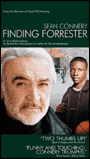
Finding Forrester (2000)
Starring: Sean Connery, Rob Brown, F. Murray Abraham
Director: Gus Van Sant
Plot: A young African-American basketball player aspires to be a writer and inadvertently finds a mentor in a famous reclusive author.
Review: Finding Forrester is an uninspiring, even banal, feel-good story that comes off like a watered-down version of director Van Sant's own Good Will Hunting. Whereas the Damon character in the latter film showed a genius that was at least believable, here it's all done in a very shallow manner - things come to the protagonist too easily, there is little real challenge, the racial tensions are barely alluded to, and all important comments are spoken in Zen-like one-liners. It doesn't help that Brown's emotive skills are quite limited, making it hard to find anything more than general sympathy for his character or his predicament. What does make the story interesting is finding out what makes the ornery author tick thanks to an always-welcome performance by the charismatic Connery. He may not be giving his acting skills much of a stretch, but it's a comfortable role to watch him in. As for the odd pair's blooming friendship, it's well crafted, if lacking in any real complexity, but it's rarely convincing. There is unused potential here, but Finding Forrester ends up only as predictable, even forced, melodrama, with easy to chew emotional pieces and a typical applause-filled climactic scene. It's all well produced and well shot, but one can't help feeling that we've seen this all better done before.
Drama: 6/10

Finding Nemo (2003)
Starring: Albert Brooks, Ellen DeGeneres, Alexander Gould
Director: Andrew Stanton
Plot: After seeing his only off-spring caught by a Sydney-based scuba-diver looking for another exotic item for his aquarium, an overprotective clown fish and an amnesia-prone blue Tang cross the ocean in search of his son.
Review: Finding new life in the old fish-story, Finding Nemo is another fine computer animated offering from the people at Pixar, just as family-oriented as their last offerings, and just as adventure and humor-filled as ever. The animation and backgrounds are superb; it's often a remarkable achievement, and the colorful scenes of marine life and reefs makes it a visual treat. Though the film takes a little while to get going, after a truly heart-wrenching tragic beginning (at least for an animated film), once the search for Nemo starts, it's a non-stop quest with one clever thing after another. In fact, much like its previous siblings, the script is full of amusing situations (such as the chaotic climax at the dentist's office), clever dialogue, and humorous finds. It's also packed to the gills (pun intended) with eccentric characters, such as a trio of sharks trying to kick the habit of eating other fish, a pack of surfer-dude sea turtles, and some dim-witted birds. But the funniest bits are, of course, the myriad of dangers the poor fish must face, from a sea of jellyfish, to the threat of predators, to being swallowed up by a whale. The voice actors, from the neurotic Brooks to the spacey DeGeneres, are all terrific, and well chosen; in fact the fish look remarkably like them, too! Willem Dafoe also has a terrific supporting role as a scarred Angel fish who leads his aquarium mates to freedom, as does Geoffrey Rush as a wise pelican. Like any other family film worth its salt, there's a moral behind the story (how parents can estrange their kids by being too protective), and surprisingly it feels quite natural. Yet, despite all it has going for it, the film somehow isn't quite as memorable, or perhaps as as some of the previous Pixar efforts such as Toy Story and A Bug's Life. Still, as family fare it's definitely the movie of the summer, and is solid entertainment for kids and grown-ups alike.
Entertainment: 8/10

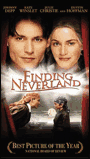
Finding Neverland (2004)
Starring: Johnny Depp, Kate Winslet, Julie Christie
Director: Marc Forster
Plot: In 1904 London, author J.M. Barrie is inspired to write his most popular novel, the children's book Peter Pan, from the experiences with a widow and her four young sons which he has befriended.
Review: Freely inspired by "true events", Finding Neverland is a gushy, unabashedly sentimental journey through author J.M. Barrie's creative process, and experiences, that led him to write the classic tale of Peter Pan. The film, with its light-hearted narrative and easy-going charm, is a tender homage to a beloved author, but the script short-changes the audience by keeping him confined to being a slight eccentric longing for a return to childhood. The theme of resisting the confines of "proper" society has been breached before, and here it's just given a cursory look, as is the theme of lost innocence given form with a few coy scenes and lines. Taking a completely different direction than his previous gritty, harsh drama Monster's Ball, director Forster manages a nice, quietly engaging effort here that's perhaps at times too syrupy yet always remains buoyant thanks to a no-nonsense direction, a fairy-tale like charm and a terrific cast. There's little depth in the straight-forward script, and the characters remain pretty much one-dimensional, but one cannot fault the actors: Depp is at his whimsical best, and Winslet is simply radiant as the young widow. Newcomer Freddie Highmore as one of the boys, and a supporting role by Dustin Hoffman as a long-suffering theater producer, round out a solid cast. Thanks to them, the (supposed) platonic friendship with a widow and her young children is a lively exercise, but one that stays within the confines of melodrama. The final scene, as the entire cast sees the world of Neverland through the magic of theater, is an affirmation of the power of imagination and is easily the high note of the film. Finding Neverland is an enjoyable little period drama, for sure, it's just too bad it wasn't aiming very high.
Drama: 6/10

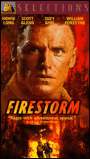
Firestorm (1998)
Starring: Howie Long, Scott Glenn
Director: Dean Semler
Plot: A firejumper, a fire-fighter who can parachute into forest fires, takes on a band of escaped convicts led by a ruthless killer amidst the flames of a huge forest blaze.
Review: Great idea, bad execution. This is supposed to be an action film, but the producers seem to have forgotten to actually leave any of it in. The film also promises great scenes of pyrotechnical destruction, but delivers few, unimpressive computer-generated ones. All we get is a lot of talk, close-ups, and a bland, by-the-numbers story involving the escape attempt of a caricature villain. Scott Glenn, the only good actor of the bunch, is severely underused here. Howie Long's starring vehicle ends up all washed out, which is unfortunate as he has what it takes to be a good action star. If you want impressive blazes and fire-fighting action, go see Glenn in Backdraft again and leave this one to burn.
Entertainment: 2/10

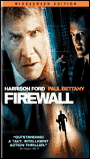
Firewall (2006)
Starring: Harrison Ford, Paul Bettany, Virginia Madsen
Director: Richard Loncraine
Plot: A high-tech security specialist is forced to help criminals rob $100 million in virtual money from his own bank when they take his family hostage.
Review: Despite its name, Firewall is a too-straightforward potboiler with little action, few thrills and even less suspense that has little to do with cyber-level shenanigans. Meant to be "master" criminals, the lame bad guys fall into all the common genre traps and get caught unawares by the simplest of things - worse, they're meant to be violent and cruel, yet can't seem to find it in them to really hurt our little family, all the better to have an easy happy ending. And that's part of the real problems here: the lazy script leaves too many "convenient" openings, the grand robbery scheme is full of holes, and the pedestrian direction by Loncraine (Wimbledon) does not provide any suspense whatsoever. When a kid getting an allergic reaction is the film's idea of a highlight, you know you've got a problem. Not to say it's not watchable: there are a few decent rebounds, if not real twists, and the cast does its best with the slim material, but there's nothing original or special enough to make it any different from anyone of the dozens of direct-to-video or made-for-TV movies out there. Ford is still a decent leading man and is always enjoyable to watch on screen, but it's clear he's past his prime here, playing a role that requires a much younger man. As it stands, he's unconvincing as either a genius techie or a distraught father; the mildly exciting climactic fight with the virile villain stretches credibility. Firewall just fails by being similar to too many "family in peril" films, and one that's just as un-engaging. For Ford completists only.
Entertainment: 4/10

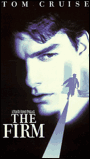
The Firm (1993)
Starring: Tom Cruise, Gene Hackman, Jeanne Tripplehorn
Director: Sydney Pollack
Plot: A young, eager lawyer slowly comes to realize that the generous new Southern law firm he's employed with is owned by the Mob and that they have no intention of letting him go.
Review: It's a rare thing when a movie manages to outdo it's origins, but that's exactly what the legal thriller The Firm manages to do. The script doesn't necessarily carry any surprises, but the narrative flows well, and the revelations - though expected - still pack a certain punch. Indeed, though the conspiracy idea isn't a new one, the insidious way in which it is presented (and how close to home it hits) make it feel persistently tempting and dangerous. One thing's for sure it's that Grisham knows his legal stuff and the reversals, including the nice final twist, is much more satisfying (and original) than that of most mainstream films. By concentrating on the suspense and motivational aspects of the story over the requisite action ones it's an effective movie adaptation and certainly the best one of the author's works to make it to the screen. Director Pollack (Out of Africa) has had a lot of experience making films with a strong sense of characters and situation (albeit with a very commercial slant) and he knows how to create believable tension. He also makes every scene as efficient as possible, allowing everything to move at a good pace and to create a good dose of suspense when it's required. Apart from the slick look and feel of the film, a lot of the enjoyment comes from the terrific choice of cast: Cruise portrays the naive young lawyer to perfection; his boyish charm and eternal smile makes him quite believable in the role. Hackman also is a revelation, playing a man outwardly confident but with deep internal scars, while Tripplehorn give a definite touch of class to the whole affair. The rest of the supporting cast, made up of some familiar faces like Holly Hunter playing a "white-trash" broad with a heart of gold (which earned her an Oscar nomination) and Ed Harris as a tough cop, is also effective. All the necessary ingredients for a fun, smart thriller are here and, combined in a confection that's well-produced, makes The Firm a cut above the rest.
Entertainment: 8/10

First Option (Hong Kong - 1996)
Starring: Michael Wong, Gigi Leung, Damian Lau
Director: Gordon Chan
Plot: During a routine Customs raid, the Special Duties Unit finds itself facing an organized team of ex-American special forces who are looking to steal a major drug shipment.
Review: This sequel of sorts to Final Option chucks the ethical dilemmas in favor of a more militaristic and action-based approach to the heavily-armed HK special police force. The tired, generic plot leaves a lot to be desired and seems to avoid building on the characters and situations. With little dramatic intensity and no memorable action sequences, the film just doesn't really hold up well compared to its predecessor. The saving grace is that director Chan does know how to film decent action sequences, and the SWAT-like operations, though not very realistic, are exciting. The big disappointment though, is Wong, all beefed up and snarling, whose acting just doesn't convince and whose constant switch between English and Cantonese tends to be annoying. Still, with two intense confrontations, some decent editing and good pacing, First Option manages to be entertaining enough.
Entertainment: 5/10

*Classic* A Fish Called Wanda (1988)
Starring: John Cleese, Jamie Lee Curtis, Kevin Kline
Director: Charles Crichton
Plot: A repressed English barrister becomes involved in a jewel heist when his defending a thief in court brings the crook's double-crossing cohorts upon him hoping to find the location of the key to the loot.
Review: With A Fish Called Wanda Monty Python writer / actor Cleese creates an uproarious film using elements from American and English comedies, blending broad humor, British wit, clever farce, amusing sight gags, and truly uproarious slapstick, to make it one of the most delightful comedies in a long time. The film starts with a straight-forward heist, but the situation becomes more convoluted as time goes on, and the rebounds and twists of the story are cleverly realized and brilliantly executed. Indeed, the narrative zips along from one hilarious instance to another, filled with clever, funny dialogue that's delivered with impeccable comic timing. Of course it's all helped by the talents of Brit director Crichton who's own classic 1950's caper comedies The Lavender Hill Mob and The Ladykillers was the inspiration for much of the film's main plot. The best parts are based on the dire, panicked embarrassment of the main characters, making for some of the best set-up, funniest scenes in movies, and none more so that the one where Cleese is surprised by his wife while his would-be mistress Curtis is hiding behind the couch. A lot of the success is also due to use of such eccentric characters played by a wonderful comic cast, especially Kline (who won a Best Supporting Oscar) as the caricature of the macho hitman. Monty Python veteran Michael Palin also makes a mark as the stuttering animal lover who, trying to kill a witness, accidentally kills off her pet dogs one by one instead. Intelligent laughs, great cast, vastly entertaining comedy, A Fish Called Wanda is easily one of the best British films of the '80s and one of the best modern comedies, period.
Comedy: 9/10

The Fisher King (1991)
Starring: Robin Williams, Jeff Bridges, Mercedes Ruehl
Director: Terry Gilliam
Plot: After having inadvertently caused a terrible accident, a DJ is brought out of his self-destructive path by a deranged hobo who seeks the Holy Grail.
Review: Director Gilliam is best known for his amazing forays into the surreal and the dark fantasy (12 Monkeys, Brazil), but with The Fisher King he has chosen an eccentric mish-mash of drama, adventure and romantic-comedy. As his previous films, the use of imagery is well done, specifically as the perception of the fantastic embodied in the Red Knight that haunts and makes real William's tortured soul. Unfortunately, there aren't enough of these moments and the story, implying supernatural elements such as the Grail, never delivers anything beyond another relationship story. That said, Bridges and Williams are quite watchable as the two main characters whose paths for their own individual quest for redemption intersect, and their friendship, based on guilt for one and hope for the other, is an often touching display and helps buoy the film. There are some amusing moments, such as the double-date Chinese dinner scene, and some poignant ones, but other times the story just jumps around and feels like its forcing feel-good sentiments on us. The role of the zany homeless man is tailor-made for Williams and his flights of insanity follow the flights of fancy of the film, but it occasionally gets to be too much. Ruehl, who won an Oscar for her role here, does a convincing performance as the emotional anchor and is easily the most interesting character. The Fisher King is interesting and inventive, but its tangled story-line and unconvincing quiet moments makes for a pleasant, but ultimately disappointing film.
Drama: 6/10

Fist of Legend (Hong Kong - 1992)
Starring: Jet Li, Nakayama Shinobu
Director: Gordon Chan, Yuen Woo-Ping
Plot: During the Japanese occupation of China, a student returns to his martial arts school and vows revenge on the Japanese authorities that murdered his former teacher.
Review: Fist of Legend is a revised (i.e.. politically correct) remake of the late Bruce Lee's The Chinese Connection (also known as Fists of Fury here), and one that quickly surpasses the original. The main reason for this is the absolutely incredible fight sequences, some of which repeat the original ones, plus some amazing additional ones as well. The excellent martial arts choreography, directed by fight choreographer supreme Yuen Woo-Ping (The Matrix, Iron Monkey), stays mostly away from fancy special effects and wire work to enhance the fights and lets Jet Li and the talented cast loose on screen. The climax against the formidable Billy Chow is definitely one of the best martial arts fighting sequences ever put to film.
Action: 9/10

A Fistful of Dollars (1964)
Starring: Clint Eastwood, John Wels, Gian Maria Volonté
Director: Sergio Leone
Plot: A mysterious stranger, a gunslinger extraordinaire, arrives into a town on the Mexican-American border and pits two rival gangs against one another.
Review: This landmark "Spaghetti Western" (so called for being an Italian production of a very American genre) by director Sergio Leone revitalized the western in the early '60s with its blend of stunning visuals, violent gun battles, mythical-type storyline and atmospheric musical score. A squinting, tough-as-nails, slow-talking but fast-drawing Clint Eastwood made his first appearance as the "Man With No Name" here with a performance that ensured his future stardom. Basically a remake of the Kurosawa samurai film Yojimbo, A Fistful of Dollars is a vastly entertaining, beautifully shot western, and one of the best of the genre. Followed by two successful sequels of sorts, For a Few Dollars More and The Good, The Bad and the Ugly.
Entertainment: 8/10

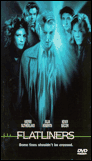
Flatliners (1990)
Starring: Kiefer Sutherland, Julia Roberts, Kevin Bacon
Director: Joel Schumacher
Plot: A group of medical students force themselves to experience longer and longer periods of "death" to explore the mysteries of the afterlife only to realize they might have brough something back with them.
Review: The stylish, cool Flatliners looks and feels very much like a wannabe blockbuster product of the '80s, a supernatural thriller with psychological implications that drifts into predictable territory. The premise of an exploration into the final voyage, Death itself, is full of potential and the film actually starts off with some genuine creepiness. Unfortunately, by the time the second of these maverick students goes under and comes back, all that promise is quickly squandered. For one, it's the familiar "science vs. religion" theme, with the "mad scientists" getting their due for trying to discover things best left unknown. Even the film's ideas about life after death are limited to recurring childhood memories, life's moments flashing by, and other derivative elements, too easily avoiding the questions raised by its premise. Worse of all is the script's insistence on a Christian view of atonement, a theme that only becomes sillier as things progress. All this said, it's not a bad popcorn film - it has its share of moments, and for half the film at least, while things are still uncertain, it's quite engaging and even suspenseful. Director Schumacher (Batman Forever, Phone Booth) handles the mainstream material well, and cinematographer Jan De Bont does a great job of creating an eerie atmosphere in the Gothic-like sets full of shadows and garish, primal colors. That it all devolves into the usual problem of style over substance and feels, in fact, much like Schumacher's own coming-of-age fluff St-Elmo's Fire with a horror twist may be in large part a fault of the script, but it's still pleasing to the eye if not the mind. The young star cast (sort of like an aging brat-pack), play well against each other, especially Sutherland and the terrific Bacon, but Roberts really doesn't give much of a stretch. Flatliners may not be quite successful as either horror or thriller, but for some indiscriminate late-night viewing it still does the trick.
Entertainment: 5/10

Flight of the Phoenix (2004)
Starring: Dennis Quaid, Giovanni Ribisi, Tyrese Gibson
Director: John Moore
Plot: Returning from a closed-down oil field, survivors from a plane crash in the Mongolian desert must work together to face the brutal elements and build a new plane from the wreckage of the old one.
Review: With its pedigree, the adventure flick Flight of the Phoenix could have been a real contender; too bad it ends up as a predictable exercise in style over substance. The film follows the basic premise of the 1965 original starring James Stewart, albeit with improved effects and added spectacle (even managing to show an explosion or two). The cinematography makes it all look terrific, capturing the feeling of heat and desolation emanating from the Gobi desert. Director Moore showed much promise with the engrossing, fun Behind Enemy Lines, and his style is just as clearly evident here, setting up the different plot highlights with skill. But more than all the ingredients expected from a typical survival film - battling the elements, facing dwindling rations, etc. - much of the tension is supposed to come from the interaction between the different antagonistic players. The ensemble cast is fine, despite Ribisi's annoying turn as an egocentric engineer, but though we do see them fighting to survive, getting out of various scrapes and getting on each other's nerves, the characters are never quite developed beyond their stereotypical attributes. Thankfully this is a vehicle for Quaid and his gruff, honorable role anchors the film and our attention. Done in grand old style, Flight of the Phoenix has its moments and does remain watchable throughout - too bad it just fails to really get its wings.
Entertainment: 5/10

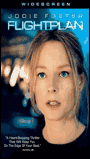
Flightplan (2005)
Starring: Jodie Foster, Peter Sarsgaard, Sean Bean
Director: Robert Schwentke
Plot: A grieving widow embarks on a transatlantic flight to bring her husband's casket to New York only to find that her daughter has gone missing in mid-flight and evidence is mounting that she was never on the plane to begin with.
Review: Akin to a modernized, commercially-slick version of Hitchcock's mystery The Lady Vanishes, Flightplan has lots going for it, none more than it's leading actress. The script is pretty much standard fare, but as a psychological / techno-thriller it works pretty well - at least for the first half. Even if the expected feeling of claustrophobia doesn't really work in a two-decker plane that's the size of a boat, there's a fine sense of suspense and paranoia that builds to what promises to be a nerve-wracking final act. German director Schwentke (Tattoo) knows how to shoot a movie, though, and he gives the entire production just the right edge and cinematic appeal to make it work. As an example of fabulous art direction and design, the interior of the make-believe jumbo jet is pretty impressive; though with its luxurious spaces, and ample aisles and leg-room, it's obviously not based much on reality, its confines are well exploited. Unfortunately, after such a careful set-up the film completely unravels, the mystery once revealed falls flat and is dammed anti-climactic. Worse, there are too many logical inconsistencies and plot holes in play to make it all work smoothly, and the tale requires too much suspension of disbelief. Even the final confrontation, a test of wills that becomes only a rather lame chase inside an empty plane, fails to keep it all aflight. The one redeeming feature throughout, however, is Foster: she is always good in the roles she chooses, and she's believable as a grieving mother who is ready to go the distance in search of her missing daughter. despite the odds. Sarsgaard, however, as the sympathetic US Marshall looks like he's literally sleep-walking, going through the motions of the character with little care, ending up as one of the more irksome aspects of the film. Flightplan ends up being too flimsy to be a stand-out, but for the first part at least it's worth a look.
Entertainment: 6/10

The Flowers of Shanghai (1998)
Starring: Tony Leung Chiu Wai, Michiko Hada, Carina Lau
Director: Hsiao-hsien Hou
Plot: In the late 19th-century Shanghai, the male elite meet in the city's elegant bordellos, or "flower houses", accompanied by their favorite courtesans, women whose grace, education and beauty were prized above all.
Review: The Flowers of Shanghai is a fascinating look at the daily life of the Chinese elite at the turn of the century, and at the intrigue that parallels other, more Western films, such as Dangerous Liaisons, but in a much more exotic setting. The film portrays a very restrained, honor-bound society and, as such, no real passion is shown in the film, no scenes of nudity or eroticism, only the complex, subtle game of social maneuvering and sexual politics. The narrative unfolds into a story of the flower girls' aspirations, from one of simple luxury, to that of freedom, to a life outside the closed structure of the brothel. The film style imitates its subject with very intimate cinematography, the camera moving slowly across the room, almost as if filming a theatre scene, letting the audience take in the beautiful interior decor, the soft lighting and the intricate costumes.
Drama: 7/10

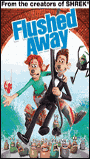
Flushed Away (2006)
Starring: Kate Winslet, Hugh Jackman, Ian McKellen
Directors: David Bowers, Sam Fell
Plot: A pampered uptown mouse living in luxury gets flushed down into the sewers where he discovers an entire city of underground rats living under London, all of whom are in peril of falling to the machinations of a diabolical frog crime-lord.
Review: Another fine addition to the Aardman Sudios canon (the people who brought us Chicken Run and The Curse of the Were-Rabbit), Flushed Away is a comic action-adventure that is pure, spirited fun. Though completely computer generated, the anthropomorphic characters and landscape are very reminiscent of the Aardman stop-motion claymation style made so popular by the Wallace & Gromit series. The addition of the smooth CGI process allows for some thrilling and imaginative sequences that would otherwise be impossible, like a boat chase that's right out of a James Bond film with kitchen appliances taking the place of speed boats, to name but one. Sure much of it feels somewhat familiar with the expected fish-out-of-water situations and the "upstairs-downstairs" moralizing - in that it doesn't really break any CGI-feature boundaries - but thankfully the mix of sentimentality, adventure, and comedy moves like clockwork. The rest of the gags work rather well, the humor is family friendly and, in fact, quite witty for those with more mature tastes - who can resist the hilarious rendering of popular musical numbers by the ever-present slugs. Some good voice acting by the A-list leads Jackman and Winslet rounds out the affair, but especially McKellan as the villainous, English Royalty-infatuated master-mind Toad, and by Jean Reno as spy-master Le Frog, both of whom poke fun at their respective countrymen. Though not quite up to par with their previous efforts, Flushed Away is easy to like and breezily paced making it an adventure that's sure to please.
Entertainment: 7/10

The Fog of War: Eleven Lessons from the Life of Robert S. McNamara (2003)
Director: Errol Morris
Plot: A revealing interview with Robert McNamara, former Secretary of Defense during the Kennedy and Johnson administrations, one of the key figures during the Vietnam War.
Review: A down-right fascinating historical reflection, The Fog of War is a rare document indeed, one that's serious, eye-opening and electrifying at the same time, providing first-hand behind-the-scenes account of what when on in the White House in the 1960's at the height of the Cold War. Apart from the very brief look at his early history, from student to assistant professor, from marketing wiz to president of Ford, the film basically focuses on three major conflicts that implicated McNamara: the bombings of Japanese cities during World War II, when he was a statistician for the Air Force; the Cuban Missile Crisis, and the start of the Vietnam War, both when he was Secretary of Defense. Perhaps the best thing is that director Morris (who also impressed with The Thin Blue Line) allows his subject to take on the narrative only occasionally speaking up on tape to throw in a question. This is clearly McNamara's podium, and he's such an interesting, dynamic, sharp and well-spoken 85-year old that he brings all his topics to vivid life with a perception that only comes from hindsight. And this is a guy with an amazing resume: president of Ford, Secretary of Defense for seven years, and president of the World Bank until 1989. So why come back to the past and present it to a public that reviled him? Is it to set the record straight, or to apologize for his past mistakes? It doesn't matter - it's a rare opportunity for viewers to peer into the workings of the decision makers, and an absolutely fascinating, intensely personal historical document of the politics behind not only the Cold War but also the past 50 years of US intervention. Compressed from 20-odd hours of interviews and interspersed with loads of archival footage presented with some clever editing, it's a probing review of his life, his decisions, and the evils of war in eleven chapters (and an epilogue) that defines the difficult lessons learnt during this period of turmoil. It's also surprising how easily it is to make a parallel with our present situation in Iraq, as the same decisions and misconstrued interests and understandings have the US to a dangerous path. There are those who will think of him as, he concedes, "a son of a bitch" but as the film continues it's hard not to both respect him and to understand him as a compassionate, complex man who has many ghosts to contend with. All told, The Fog of War is a brilliant piece of documentary filmmaking, a surprising portrait of an old Cold War soldier, and a reflection on the politics of War, one that easily deserved its Oscar for Best Documentary.
Documentary: 9/10

Following (1998)
Starring: Jeremy Theobald, Alex Haw, Lucy Russell
Director: Christopher Nolan
Plot: Out of boredom, a would-be writer follows a thief who gives him a taste of intruding on people's lives, but when he falls for one of their victims, a beautiful blonde, he ends up with more than he bargained for.
Review: Director Nolan's debut film, Following, marks many of the things that are found in his masterful second feature Memento, including the criminal themes and the play with the movie's time-line. The film, shot on a shoe-string budget in black-and-white, has all the required neo-noir elements, including an anti-hero protagonist, a femme fatale, darkened interiors and exteriors, and an underworld motif. What sets it apart from other would-be indie flics is the tight, efficient script. The necessary methods used to work with the confines of its production costs also gives it an intimate, offbeat look and feel while remaining clever and suspenseful throughout. The non-sequential narrative, bouncing back and forth from three distinct time-lines, is not just a gimmick but a necessary part of the unfolding story, revealing hidden bits of information and allowing the audience to piece together the plot in a way that is constantly surprising and intriguing. Thanks to some simple visual cues this isn't as confusing as it first sounds. The performances of the three leads are also quite good, bellying the fact that this is an amateur cast. In the end, Following is an effective, diverting crime thriller that requires careful attention but pays off admirably.
Entertainment: 7/10

Fong Sai Yuk II (Hong Kong - 1993)
Starring: Jet Li, Josephine Siao, Amy Kwok
Director: Corey Yuen
Plot: Folk hero Fong Sai Yuk must bring back proof that his leader is the emperor of China but must first face an opposing clan and a powerful traitor in his own midst.
Review: Continues the previous adventures, with both the incomparable Jet Li as Fong Sai Yuk and the impressive Josephine Siao as his skilled and over-bearing mother. Mixing comedy, melodrama, romance, colorful costumes and sets, and impressive wire-fu action, Fong Sai Yuk II is another mesmerizing historical martial arts effort from action choreographer extraordinaire Corey Yuen (Righting Wrongs, Enter the Eagles). The story is silly and sometimes crude, but its joyful, fast-paced and light-hearted script easily makes up for it. The finale, a fight between Li and the traitor above a teetering pile of chairs while Li is distracted by trying to save his mother from hanging, is a classic. Not as well rounded or funny as the first installment, Fong Sai Yuk II relies more on its chaotic excess, intricate action scenes and over-the-top situations to deliver great Hong Kong-style entertainment.
Entertainment: 8/10

Footloose (1984)
Starring: John Lithgow, Kevin Bacon, Lori Singer
Director: Herbert Ross
Plot: After moving into a small Christian town where any dancing has been outlawed, a Chicago teen rebels and decides to organize a prom dance while trying to fit in with others his age.
Review: Following in the footsteps of Flashdance, Footloose is on the surface another fluff piece of teen-age rebellion and rock and roll. Sure, the script sticks to the clichés as well, trying hard to provide some relevant teen-age drama, showing off streaks of rebellion, fish-out-of-water problems, fights, and even the necessary (dopey) romance. However, it's also a little more complex in its conflicts, showing off its adult characters as understanding and caring people who are simply reacting to a past tragic event. As for the actual dancing, it looks more improvised than choreographed, but it's energetic enough (especially a rather over-the-top and silly dance routine with Bacon swinging around an empty warehouse) and the 80's score, with the effervescent title track by Kenny Loggins making an appearance three times, is still quite catchy. Surprisingly, the more interesting story is that of the well-meaning priest caught between his convictions, his responsibilities to his parish and his fears as a parent. Thanks to a fine performance by Lithgow this is a well-defined character and a sympathetic one. The rest of the cast doesn't fare quite as well: Singer comes off as a real pain, Dianne Wiest as the priest's wife makes only a brief impression and the rest of the teenagers (including a young Sarah Jessica Parker) are only there for dressing. Still, in the film that made him a household name, this is Bacon's show and his habitual charm are in ample evidence here. There's more to this little film than first meets the eye, and for that Footloose deserves another look.
Entertainment: 6/10

For a Few Dollars More (1965)
Starring: Clint Eastwood, Lee Van Cleef, Gian Maria Volonté
Director: Sergio Leone
Plot: Two bounty hunters, consistently at odds with each other, join forces to stop a band of vicious, cunning outlaws and collect the hefty reward.
Review: The second film in the Clint Eastwood "Man With No Name" series of "Spaghetti Westerns", For a Few Dollars More is not quite as successful as its predecessor A Fistful of Dollars. All the necessary ingredients are there: the mysterious, tough gunslinger, the despicable villains, the violent gun battles, the great cinematography, and the atmospheric music by Ennio Morricone. Unfortunately it all seems a bit forced and mechanical. Director Leone seems to be experimenting with style and pacing, and some scenes meant to increase the tension only seem to drag on, especially when we already know the outcome. Lee Van Cleef, starring as a sharpshooter seeking revenge, is a great addition to the story but seems to take much of the spotlight away from the expected hero played by Eastwood. For a Few Dollars More is still a good western adventure, though, and definitely more exciting and interesting to watch than most American westerns.
Entertainment: 7/10

*Classic* Forbidden Planet (1956)
Starring: Walter Pidgeon, Anne Francis, Leslie Nielsen
Director: Fred McLeod Wilcox
Plot: Sent to rescue a long-distance colony, a spaceship crew become prey to a deadly invisible force after finiding a lone survivor and his grown-up daughter inhabiting a desert paradise built upon the ruins of an ancient civilzation.
Review: One of the most influential science-fiction films of its era along with The Day the Earth Stood Still and The War of the Worlds, Forbidden Planet was, and still is, an impressively staged big-budget affair. Audiences experiencing the film for the first time upon its release might have been amazed at the gorgeous production values and decidedly serious tone of the movie, not so much pulp daring-do adventure as low-brow drama capitalizing on a sense of wonder. Lavishly portrayed with extravagant matte paintings, intricate scale models, and then-impressive special effects, it was one of the most expensive pictures ever made. The eerie, primitive electronic score (then a first) also gives the film an added layer of other-worldliness, as do the strangely colored tones of the footage. Played straight as it it, the surprisingly smart script might be a tad campy to modern eyes, and the tad misogynistic behavior of the all-male crew harkens back to the social mores of the '50s, but there's no denying that the sci-fi tale itself, a loose adaptation of Shakespeare's The Tempest, is intriguing and well constructed. In fact, in plot and production, the film is reminiscent of old 1960's Star Trek episodes, a series which was undoubtedly inspired by the film. Though getting third-billing, a young, swaggering Nielsen is really the star of the picture. Pidgeon, playing the Prospero role as the "mad scientist", is adequately theatrical and over-the-top. The rest of the cast is adequate but rather dull and are trumped by the antics of the "man-in-suit" contraption, the delightful Robby the Robot who was first introduced here and became a staple of SF culture. Though sometimes dated in its social interactions and naval-based camaraderie, Forbidden Planet remains an engaging, entertaining sci-fi classic.
Entertainment / Sci-Fi: 8/10

The Forgotten (2004)
Starring: Julianne Moore, Anthony Edwards, Gary Sinise
Director: Joseph Ruben
Plot: After being told her 9-year-old son - lost in a plane crash a year before - was merely a figment of her imagination, a desperate mother runs away from her past life and attemps to seek answers paired up with a man who lost his daughter in the same accident.
Review: A modest-budget effort, The Forgotten is the latest attempt to cash in on the supernatural thriller, with decidedly lack-luster results. Apart from repeating a particularly neat effect and some above-average cinematography, there's little here that might differentiate it from a made-for-TV movie. Director Ruben (Angel Eyes, Sleeping with the Enemy) has had a hand at dramatic thrillers and he does his best with the material at hand. Unfortunately the script is just above hack level, with little in the sense of characterization or originality. Worse perhaps, the supposedly Shyamalan-level "shocker" comes early on, meaning there is little suspense or mystery left for most of the film's length. In fact, the whole affair plays out like an extended (and overlong) X-Files episode - replete with government agents, clues to a "perfect" conspiracy, and a decidedly unseen presence - and audiences privy to the series will be non-plussed. Add to this some preposterous revelations (none of which are explained or resolved) simply provided to make our heroine's plight that more impossible, and it just feels like a silly ode to motherhood. Moore is a superb actress and, as the bereaved mother, she gives a much needed jolt to the film, something the rest of the cast including TV's Edwards and the usually-reliable Sinise aren't given a chance to do. In the end, The Forgotten is decently made, well acted and mostly engaging enough while it lasts but it can't help but be a, well, forgettable exercise.
Entertainment: 4/10

For Love of the Game (1999) 
Starring: Kevin Costner, Kelly Preston, John C. Reilly
Director: Sam Raimi
Plot: A 40 year-old baseball player reminisces about his life and his romantic five-year affair while attempting to pitch a perfect game against the Yankees in New York.
Review: Costner is back in the genre that first brought him to star status (Bull Durham, Field of Dreams). He makes for a likable character who seems at odds with his career as a ball-player and his romantic life. Kelly Preston was not given a meaty role here as his romantic interest, making her just interesting enough to play against (or support) Costner's character. Director Sam Raimi (best known for his excesses in camera work in films like Evil Dead) shows here a more mature, and still interesting,  cinematic style. The film is engaging, thanks to Costner mostly, but the story, flowing from past events to the present on the baseball mound, is tired and the drama a bit trite. In the end, though, For Love of the Game is an entertaining piece of fluff and a good end to Costner's baseball trilogy.
Drama: 4/10
Entertainment: 6/10

Forrest Gump (1994)
Starring: Tom Hanks, Robin Wright, Gary Sinise
Director: Robert Zemeckis
Plot: A simple-minded but well-meaning young man grows up amidst the turmoil of the last three decades of U.S. history and, by twists of fate, finds himself implicated in some of its most important events.
Review: Light-hearted, refreshing, and downright optimistic, irreverent in its cynicism and its perspective of historical figures and events, endearing in its naivete, and touching in its drama, Forrest Gump is a new pinnacle for Hollywood pop-cinema. The film, in fact, joins such classics as It's a Wonderful Life in its reach, its heart-tugging sentimentality and even more so for the no-holds barred cinematic enjoyment it gives the audience ready to accept it at face value. True, cynics may dismiss its trite, bumbling, straight-arrow protagonist and touchy-feely sentimentality, but there's more here than All-American flag-waving. From the opening catch-phrase "Life is like a box of chocolates" the film never lets up in its imaginative, quirky view of American history by putting Gump into famous events, including inserting him in archival footage with past presidents, and allows for both pathos and humor to seep in every scene. Director Zemeckis (Contact, What Lies Beneath) knows where to focus the camera's attention and has an eye for efficiently conveying a sense of nostalgia and child wonderment. Hanks' oblivious, humane, matter-of-fact performance is priceless making his character an incredibly endearing innocent through all his wild adventures, from football star, to Vietnam hero, to entrepreneur, to social icon. Wright, perfectly portraying a damaged soul searching for acceptance in the American counter-culture of drugs, war protests, etc., is the yang to Hanks' yin, their relationship not only the heart of the film but its very meaning as well. The rest of the supporting cast, including Sinise as an amputated veteran and Sally Fields as Gump's mother, are all solid. Winning Oscars for both Best Actor and Best Picture, Forrest Gump celebrates the American way of life with a passionate, greatly entertaining, and very sly review of its recent history.
Entertainment / Drama: 9/10

The Forsaken (2001)
Starring: Brendan Fehr, Johnathon Schaech, Isabella Miko
Director: J.S. Cardone
Plot: A young movie editor on a cross-country drive to Florida takes on two hitch-hikers and suddenly finds himself pursued by a pack of gun-wielding blood-suckers led by an 800-year old vampire.
Review: The premise of The Forsaken, that of vampires roaming the desert lands in nomadic fashion, isn't new - it was, for one, done far better in the excellent horror flick Near Dark. But then this film isn't going for original, it's just going for the standard set of thrills squarely aimed at its teenage target audience. By aiming for small-budget mayhem, all helped by a decent script and some able direction, for the most part it succeeds. The climactic stand at a farmhouse in an abandoned graveyard is more than a little contrived and rather disappointing. Even the background story, which sets the duo's vampire prey as a master vampire, doesn't quite suit the realtive ease of the final confrontation. We've seen better, and this doesn't quite convince. Still, up to this point, the film mostly steams along at a good clip, with a polished look, a good dose of gore, and a nice sense of suspense, if not actual horror. For those willing to sit through yet another vampire / action flick, The Forsaken is a decent time-waster.
Entertainment: 5/10

For Your Eyes Only (1981)
Starring: Roger Moore, Carole Bouquet, Topol
Director: John Glen
Plot: Superspy James Bond must recover a British encryption device used to send Polaris submarine launch codes before a powerful and vicious group of smugglers sell it to the KGB.
Review: For Your Eyes Only is a much more low-key affair than other Roger Moore 007 films, down-playing the usual 70's and 80's Bond excesses and producing a decent cold-war thriller by forcing Bond to rely on his skills and his wits more than his usual extraordinary gadgets. Moore does his best, most serious portrayal of Bond here, playing his character with more of an edge and less tongue-in-cheek. The action is also more low-key, with fewer large set-pieces and no climactic battle, but still exciting, such as the extended and very impressive ski chase in the Italian mountain peaks. Bouquet makes a fine "Bond girl", showing more independence and bravery than most other women characters of the series to that point. The only jarring moment is the silly pre-credit sequence in which arch-nemesis Blofeld gets his due, and seems out of place with the tone of the rest of the film. Still, it's fine entertainment.
Entertainment: 8/10

The Fountain (2006)
Starring: Hugh Jackman, Rachel Weisz, Ellen Burstyn
Director: Darren Aronofsky
Plot: A man caught in three different eras - a 16th century Conquistador, a present-day medical researcher and a 26th century astronaut - searches for a way to save his beloved.
Review: Spanning a thousand years and three eras, The Fountain is a rarity, an exceptional bit of filmmaking, a moody, spiritual, romantic affair filled with stunning imagery. Director Aronofsky doesn't make any concessions in his movies - one need only see his B&W Pi or the wrenching Requiem for a Dream - and this film is no exception, done with such passion, commitment and pure love of the medium that it's hard not to be absorbed and fascinated. Many will be non-plussed by the non-linear structure of the film – unlike most films, an investment is demanded from its audience - but the payback is ten-fold. With atmospheric visuals, fabulous art direction, careful cinematography with dark, rich colors, the result is a thing of beauty, a poignant film that works hard for every emotional moment it wrings out. The film tackles lofty SF and philosophical themes of eternal life, inevitable death, and the fragility of our own existence, but it's basically a love story told over three periods. The Conquistador sequence is magnificent, and grand in the old adventure tradition; The present-day one is the real anchor of the film, better rounding out its main protagonists; The magical future sequence, played out in a dreamscape of stars aboard a transparent spaceship, reminds one of the end sequence in 2001: A Space Odyssey. The mystery is the relationship between them all, and one that is never quite made clear, but it's fascinating to see how the narrative intermingles the different eras and stories, and it's important to go with the flow. At the very center is Jackman and Weisz, and Aronofsky gets a fantastic performance out of them, paying close attention to their inner turmoil, and it comes out vividly. In fact, neither has ever been this good or this intense. For Jackman this is Oscar-level stuff, his characters portraying love, loss, and more than a touch of madness and obsession. If failure there is, it's that the film renounces all mainstream pretensions, limiting its popularity. The beauty to be found in The Fountain, however, will amply reward those willing to take a leap of faith.
Drama: 9/10